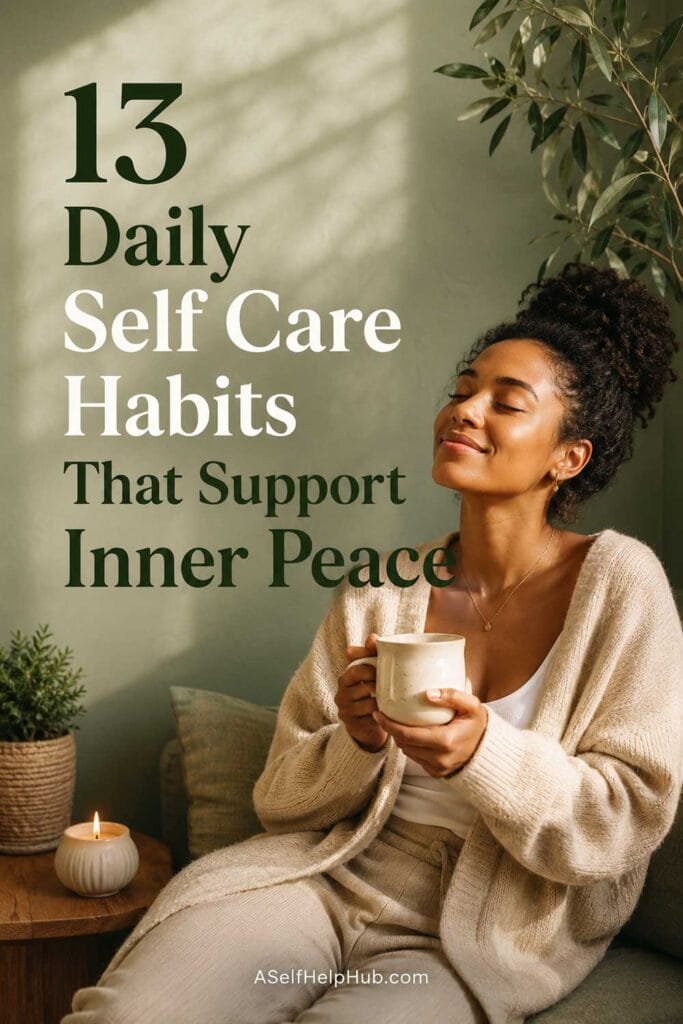
11 Self Care Ideas That Help You Build More Inner Peace
Inner peace is not something that arrives when the circumstances are finally right — when the schedule clears, the relationships settle, the work slows down, or the world stops making so many demands. It does not wait for the quiet to arrive. It is built inside the noise, in the small consistent choices to tend to the person at the center of everything else. The grand gesture of the retreat or the vacation may offer a taste of it. The daily practice is what makes it stay.
These eleven self care ideas will help you slow down, reconnect with yourself, and create more calm in a world that never stops moving. Peace begins the moment you choose yourself without apology. Self care is not a luxury — it is the discipline of showing up whole. Give yourself permission to rest, reset, and return to what matters most. Start with one idea today. The peace being built in the small choices accumulates into something the grand gesture never quite produces on its own.
Free Download: The Self-Care Starter Kit
Building more inner peace starts with building a self-care practice that actually fits the real life you are living. The free Self-Care Starter Kit gives you simple, sustainable tools to slow down, reset, and start choosing yourself with the same consistency you have always brought to choosing everyone else. Download it free and begin today.
Get the Free Starter Kit1. Give Yourself One Unscheduled Hour Every Week
“The unscheduled hour — the one with no agenda, no productivity requirement, and no obligation to produce anything — is one of the most countercultural and most restorative things you can give yourself in a week that has too much of everything else.”
The calendar packed to its edges with obligations, commitments, and productivity is the calendar that leaves no room for the self to breathe. Inner peace requires space — not the space of completed to-do lists, but the space of genuine unoccupied time that belongs to nothing and no one. Most people have not given themselves an hour like this in longer than they can remember, and the absence is felt in the low-grade depletion that passes for normal in a life that has been optimized entirely for output.
Protect one hour per week that belongs to no agenda. Not an hour of rest with a purpose. Not an hour of self-care activities from a list. An hour of complete openness — in which you do whatever the moment actually calls for rather than whatever was planned in advance. Walk if you want to walk. Sit if you want to sit. Read, draw, stare out the window, make tea slowly. The specific activity is irrelevant. The specific quality — the belonging-to-nothing, the no-output-required — is the practice. That quality, given one hour a week consistently, begins to produce the inner spaciousness that the fully scheduled life never could.
“The hour that belongs to nothing is the hour that gives everything back. Protect one each week. It is more restorative than it sounds and harder to give yourself than it should be.”
2. Create a Simple Transition Ritual Between the Day’s Chapters
“The person who moves from one chapter of the day to the next without a pause carries the previous chapter’s residue into the next one. The transition ritual is the clearing between them — the reset that makes full presence in each chapter possible.”
One of the quiet contributors to the feeling of overwhelm and depletion that undermines inner peace is the absence of genuine transitions between the different demands of the day. Work bleeds into family time. Family time bleeds into the evening. The evening bleeds into sleep still carrying the unprocessed residue of everything that preceded it. Without a deliberate transition — a short, consistent ritual that marks the end of one chapter and the beginning of the next — the day becomes one long continuous blur rather than a series of different presences that each receive genuine attention.
Build a simple transition ritual for the most significant shift in your day — the commute home reframed as decompression rather than extension of the workday, the five-minute walk between finishing work and beginning the evening, the brief stillness before moving from one obligation into the next. It does not need to be elaborate. Three deep breaths. A change of clothes. A short walk. A specific piece of music that signals the shift. The specific form is yours. The purpose is consistent: to clear the residue of the previous chapter before entering the next, so that each part of the day receives the quality of presence it deserves.
“Build the pause between the chapters. The day lived in transitions is the day lived in full presence rather than in the blur of one thing bleeding into the next.”
3. Spend Time Outside Without a Destination or a Device
“The outdoor time without a destination or a device is the outdoor time that actually restores. The walk with the podcast and the agenda is exercise. The walk without them is something closer to medicine.”
The research on the restorative effects of nature is among the most consistent in the field of human wellbeing — exposure to natural environments reduces cortisol, lowers heart rate, improves mood, and produces a measurable shift in attention and cognitive function that indoor environments and urban settings rarely replicate. Most people know this and most people spend their outdoor time with headphones in, their phone in hand, and their attention divided between the physical environment and the digital one. The restoration that the outdoor time was supposed to provide is significantly reduced by the inputs competing for the attention that the restoration requires.
Try the outdoor time without the input. A short walk with the phone in the pocket and the ears available to whatever the environment offers. Five minutes in the backyard without anything to do. A longer walk with no destination and no agenda beyond the walking itself. The absence of input is uncomfortable for most people initially — the mind reaches for the podcast, the music, the distraction. Stay with the discomfort for long enough and what emerges on the other side is the specific quality of restored attention that the device-accompanied outdoor time was never quite producing. The nature needs the attention to do its work. Give it the attention.
Visit Premier Print Works
Bring a little calm and intention into the spaces where the daily self-care happens. Premier Print Works offers prints, mugs, and art designed for the person building more inner peace into their everyday life — warm, grounding pieces for the rooms where the rest and the restoration take place.
Visit Premier Print WorksHow Anya Found Inner Peace in the Spaces She Had Always Been Too Busy to Notice
Anya had been searching for inner peace for two years with the same energy she brought to everything else — productively, ambitiously, with a reading list and a meditation app and a journal she filled conscientiously every morning. She was doing all the right things. She was also exhausted in a specific way that the right things were not reaching, because the doing of the right things had become one more performance in a life already full of performances, and the peace she was looking for was something that could not be performed into existence.
The shift came from an unexpected place: her car breaking down on a Tuesday morning and a mechanic who told her it would take three hours. She had no laptop, a phone with ten percent battery she was saving for emergencies, and a small park across the street. She sat in the park for three hours with nothing to do and nowhere to be and no way to be productive about the waiting. It was the first genuinely unoccupied time she had experienced in months that she had not immediately filled.
What she noticed in the second hour — after the first hour had spent itself on the discomfort of not doing anything — was something quiet and entirely unexpected. The absence of the agenda was not empty. It was full of small things she had not been available to notice: the quality of the light through the trees, the specific way her own breathing sounded when she was not moving, the thought that arrived without being summoned about something she had been avoiding feeling. She drove home from the mechanic feeling more genuinely restored than she had from any of the intentional self-care practices she had been maintaining. The peace had been in the unoccupied spaces all along. She had simply never stopped long enough to enter them.
4. Say No to the Things That Consistently Cost More Than They Give
“Inner peace and a life shaped entirely by other people’s requests do not coexist. The no that protects your peace is not unkindness — it is the condition that makes genuine presence possible.”
One of the most consistent contributors to the inner disquiet that prevents peace is the accumulated weight of obligations agreed to without genuine willingness — the yes said from guilt, from habit, from the fear of disappointing, from the sense that declining is not an option available to someone like you. These obligations do not only consume time. They consume the quality of attention and presence available for everything else, including the relationships and activities that actually matter and the person at the center of it all.
Identify the one recurring obligation in the current life that consistently costs significantly more energy than it returns in value, meaning, or genuine connection. Not the difficult but necessary things — the ones that are genuinely draining without proportional return. Practice declining it once, gently and completely, without the extended apology and justification that soften the no until it becomes a yes. Notice that the world does not end. Notice the specific quality of the energy that was not spent on the declined obligation and what it was available for instead. The no that protects the peace is not the withholding of generosity — it is the condition in which real generosity becomes possible again.
“The no that protects your energy is not selfishness. It is the prerequisite for the genuine yes — the one that comes from a full place rather than a depleted one.”
5. Create a Physical Space in Your Home That Belongs Only to Calm
“The physical space designated for peace is not a luxury. It is the external architecture of the internal state being built — the place the nervous system learns to associate with safety, stillness, and the permission to stop.”
Environments shape states. The office chair associated with work produces a different internal state than the reading chair associated with rest — not because the chairs are different, but because the nervous system has learned what each one signals. A small physical space deliberately designated for calm — for rest, for quiet, for the daily practice of coming back to yourself — becomes, over time, a reliable cue to the nervous system that this is the place where the peace is available and the demands are not.
It does not require a whole room or a significant renovation. A chair positioned near a window. A corner of the bedroom cleared of everything work-related and held for reading or stillness. A small outdoor space with a single comfortable seat. The specific form is whatever fits the life. What matters is the designation — the deliberate claiming of this space as the one where nothing is required and the peace is the only agenda — and the protection of that designation from the encroachment of other purposes that will inevitably attempt to colonize it. The physical space protected for peace tells the nervous system, every time it is entered, that rest is available here. Over time, the body believes it.
Free Download: The 7-Day Life Reset
If building more inner peace feels like it requires a clearer starting point — if you are ready to take a full week to intentionally reconnect with yourself, clarify what matters, and build the foundation the peaceful life needs — the free 7-Day Life Reset gives you seven structured days to do exactly that. Download it free and start the reset today.
Get the Free 7-Day Reset6. Practice the Kindness You Extend to Others on Yourself
“The inner peace available to the person who speaks to themselves with the same kindness they extend to the people they love is a different quality of peace from the one available to the person maintaining the harsher standard for themselves alone.”
Self-compassion is not self-indulgence. It is not the lowering of standards or the excusing of behavior that deserves examination. It is the extension to the self of the basic human kindness that most people extend readily to others and withhold almost automatically from themselves. The inner critic that runs constantly — cataloguing mistakes, amplifying failures, applying a standard of self-judgment that would be unrecognizable as kindness if directed at anyone else — is not a path to peace. It is one of the most reliable obstacles to it.
When the critical inner voice speaks, try the question that most directly reveals the double standard: would I say this to someone I genuinely care about in the same situation? If the answer is no — and it almost always is — find the version you would say to that person and offer it to yourself instead. Not because the kinder version is softer. Because it is more accurate. The friend seen from the outside is seen more clearly than the self seen through the distortion of the inner critic. The self-compassionate response is usually the more honest one. Practice it. The inner peace it produces is the specific peace of a mind that has stopped fighting itself.
“Extend to yourself the kindness you would not hesitate to offer a friend. The peace that grows from that extension is the peace of a mind that has finally made an ally of itself.”
Building Inner Peace Alongside Recovery? This Is for You.
For some people, the work of building more inner peace is happening alongside the daily practice of sobriety — where the self-care and the recovery are being built from the same material at the same time. If that is where you are, the free Sober Survival Guide offers six proven actions for managing cravings, grounding practices for the hardest days, and honest support for the person doing both kinds of work at once. Download it free.
Get the Free Sober Survival Guide7. Let Go of What You Cannot Change, Today, Deliberately
“The peace unavailable to the person holding the thing that cannot be changed is available the moment the holding is released. The releasing is not resignation — it is the precise act of redirecting the energy from what is fixed to what is not.”
A significant portion of the inner unrest that prevents peace is the continued investment of mental and emotional energy in things that have already been determined — the conversation that happened and cannot be unhappened, the decision made by someone else that affects you but is not yours to unmake, the past event that still occupies the present attention long after the present has moved entirely past it. This investment produces no change in the fixed thing. It produces only the ongoing cost of the holding.
Practice the deliberate release — not as a one-time dramatic act of forgiveness or acceptance, but as a daily small practice of noticing the thing being held that cannot be changed and choosing, just for today, to set it down. Not to resolve it. Not to achieve permanent peace with it. Just to put it down for the day and be available for what is actually present. The release can be renewed tomorrow if necessary. Today it is enough to stop holding it for the hours between now and sleep. The daily practice of the small release accumulates, over time, into the genuine releasing that the one-time dramatic act rarely achieves.
“Release what cannot be changed — not permanently, not dramatically, but today. Today’s release is enough. Tomorrow’s can be renewed if necessary.”
8. Read Something That Has Nothing to Do With Being More Productive
“The book read purely for pleasure — not for self-improvement, not for professional development, not to become more — is the book that gives the mind permission to simply be. That permission is rarer and more restorative than most people give it credit for.”
The self-care reading list has a tendency to fill itself with books about becoming better — the productivity system, the mindset upgrade, the habit framework, the leadership philosophy. These books have their value. They are also part of the same optimization project that the rest of the exhausted life is running, and they ask the mind to continue working on itself even in the hours ostensibly designated for restoration. The fiction novel, the nature essay, the poetry collection, the book chosen because it sounds genuinely interesting rather than because it will make you better at something — these ask something entirely different of the mind, and the mind often needs exactly that different kind of asking.
Read something purely for the pleasure of it. Not the book you should read. The book you actually want to read, however frivolous or unimproving it might appear from the outside. The mind that is allowed to follow genuine curiosity without a self-improvement agenda is a mind being given a kind of rest that the productivity reading cannot provide. The inner peace of genuine leisure is different from the inner peace of optimized recovery. Both have their place. The genuine leisure is the one most consistently missing from the life that has decided every hour should be productive.
“Read the book you want to read, not the one you should. The permission to be interested without an agenda is itself a form of peace.”
9. Move Gently Toward What Your Body Is Asking For
“The body’s requests are honest in a way the mind’s narratives sometimes are not. Hunger, tiredness, the need to move, the need to stop — these are accurate signals from a reliable source. Honoring them is a form of inner peace.”
Inner peace has a physical dimension that the purely mental approaches to it tend to miss. The body carries the inner life in a very literal sense — the tension held in the shoulders when the stress is present, the heaviness of the limbs when the depletion is real, the restlessness that signals the need for movement that has not been given its proper space. The person who has learned to hear what the body is asking for — and to move toward it rather than away from it — has access to a reliable inner compass that the most sophisticated mindfulness practice is partly trying to reach by other means.
Practice tuning in to the body’s actual requests rather than the mind’s habitual override of them. The tiredness that says sleep rather than one more hour of screen. The restlessness that says movement rather than another chapter of stillness. The hunger that says nourishment rather than distraction. The tension that says gentle stretching rather than pushing through. None of these responses require elaborate programs or significant time. They require the willingness to hear what the body is asking and the self-respect to take it seriously enough to respond. The body tended to becomes a quieter place to live.
“Hear what the body is asking. Move toward it rather than through it. The body honored becomes a gentler, quieter place to spend a life.”
How Luca Learned That Inner Peace Was in the Places He Had Been Avoiding
Luca had a well-developed capacity for staying busy. He was not especially anxious by nature — he simply found that the motion of the doing kept the background noise of his inner life at a manageable level, and that stopping, even briefly, tended to surface things he would rather not be available to feel. He had never quite named this to himself as avoidance. It had always felt more like efficiency.
A period of forced stillness — a minor health issue that required several days of reduced activity — removed the option of the productive busyness he had been using as the default setting. He spent the first day restless and slightly miserable. The second day slightly less so. By the third day something had shifted in the quality of his inner experience — not dramatically, not comfortably, but genuinely. The things he had been moving too fast to feel were present, and being present to them turned out to be less destructive than the avoidance had been suggesting it would be.
He came back from the enforced slowdown with one small practice: ten minutes each morning with the phone in another room, doing nothing in particular before the day began. Not meditation — he had tried and found it precious. Just sitting. Drinking something warm and existing without producing anything. The ten minutes were uncomfortable for the first week. By the second week they were the part of the morning he protected most carefully. The inner peace he had been moving too fast to find had been in the stillness all along. He had simply needed the stopped motion to discover it was there.
10. Name Three Things You Are Grateful for With Genuine Specificity
“The gratitude that names the specific moment rather than the general category is the gratitude that actually moves something. The generic list is the habit. The specific detail is the practice.”
Gratitude as a self-care practice has been sufficiently mainstreamed that most people who try it experience it as rote rather than restorative — the same three general categories named each morning in a ritual that has stopped producing the genuine shift it was supposed to create. The practice works when it is specific. It stops working when it becomes performed. The difference between the two is the level of detail brought to the noticing.
Not “I am grateful for my family” but “I am grateful for the specific way my son asked me a question at dinner last night that reminded me he is actually listening to the things I say.” Not “I am grateful for my health” but “I am grateful that my body let me take that walk this afternoon and that the air smelled the way it did at the end of it.” The specificity forces the attention into the actual present experience rather than the general category, and the actual present experience is where the genuine gratitude — and the peace it produces — actually lives. Stay specific. The shift is in the detail.
“Name the specific thing, not the category. The peace lives in the detail — in the exact moment noticed, not the general blessing acknowledged.”
11. End the Day With Something That Closes It Gently
“The day that ends gently — with something that signals to the body and the mind that the work is done and the rest is safe — is the day that actually ends. The day that trails off into a screen just becomes tomorrow, still unfinished.”
Most days do not end. They trail off — into the scroll, into the half-watched show, into the sleep that arrives as collapse rather than as the deliberate closing of a chapter that was genuinely completed. The day that ends without a closing ritual carries its residue into the night and from the night into the next morning, where it joins the new day’s accumulation before the new day has properly begun. The gentle ending is the practice that finally gives the day a real finish line.
Build a simple closing ritual — not elaborate, not time-consuming, simply reliable. Three things that went well today, written or named. A few minutes of gentle stretching. A warm drink consumed without a screen. A brief moment of acknowledgment that the day happened and is now complete and that rest is available and earned and welcome. The specific elements are yours to choose. The principle is the same: the day given a real ending is the day the mind can actually release. The released day becomes the sleep that actually restores. The restored sleep becomes the morning that begins from a genuinely different place. The closing ritual is the beginning of the next day’s inner peace — built the night before, from the simple act of letting today be finished.
“Close the day gently. The day given a real ending is the day the mind can finally put down. The putting down is where tomorrow’s peace begins.”
Picture the Life Being Built in the Quiet Choices
Not the dramatically transformed life. The same life, lived from a quieter center — with enough space in it to breathe, enough self-compassion in it to rest without guilt, enough intentional self-care woven through it that the difficult parts do not get to define the whole thing. A life where the person at the center is actually being tended to, the way she tends to everyone else, in the small daily ways that compound over time into something that genuinely feels like peace.
That life is built in these eleven ideas, applied in whatever order fits the current season. Start with the one that feels most available today. Keep it long enough to feel what it changes. Add the next one when the first has become familiar. Inner peace is not found in the grand gesture. It is built in the quiet, consistent choices — the unscheduled hour, the gentle closing, the specific gratitude, the deliberate release. Begin building it today.
Free Download: The Self-Care Starter Kit
Do not let these ideas stay as intentions. The free Self-Care Starter Kit gives you simple, sustainable tools to begin the daily self-care practice that builds more inner peace — gentle enough to start today and real enough to actually make a difference in the life you are already living. Download it free and begin.
Get the Free Starter KitOur Top Picks for a Better Life
We have gathered our favorite tools, resources, and recommendations for self-care, inner peace, and building a daily life that has enough calm woven through it to feel genuinely sustainable — everything we trust enough to share, all in one place.
See Our Top PicksInner Peace and Self-Care Prints at Premier Print Works
Bring the reminder into the spaces where the daily self-care happens. Visit Premier Print Works for prints, mugs, and art designed for the person who is doing the quiet, consistent work of building more peace into the everyday — honest, warm pieces for the rooms where the rest and the returning to yourself take place.
Visit Premier Print WorksDisclaimer
The content published on A Self Help Hub is provided for informational, educational, and inspirational purposes only. The self-care ideas, perspectives, and personal stories shared throughout this site are intended to offer general encouragement and support for everyday personal wellbeing and growth. They represent personal perspectives and general principles rather than clinical guidance and should not be interpreted as professional mental health advice, psychological counseling, medical diagnosis, or therapeutic treatment of any kind.
Every person’s experience with stress, anxiety, and the pursuit of inner peace is unique. If you are experiencing significant anxiety, depression, trauma, or other mental health conditions that are affecting your daily functioning or sense of safety, please consult a qualified mental health professional for support specific to your circumstances. General self-care ideas are not a substitute for professional care for clinical mental health conditions.
The personal stories and composite characters featured in this article, including Anya and Luca, are illustrative in nature. They are drawn from a combination of common experiences and narrative examples created to make the content relatable and accessible. They are not presented as factual accounts of specific individuals. Any resemblance to a particular person is coincidental.
Some links on this site, including links to Premier Print Works and other recommended resources, may be affiliate or partner links through which A Self Help Hub earns a commission at no additional cost to you. We only recommend products and resources we genuinely believe in and would share regardless of any compensation received.
The Sober Survival Guide and any recovery-related content linked from this site is provided as general supportive information only. It is not a substitute for professional addiction treatment, clinical intervention, medical detox, or licensed counseling services. If you or someone you love is struggling with addiction or substance use, please seek the care of a qualified healthcare or addiction treatment professional. Recovery is possible and professional support significantly improves outcomes.
If you are experiencing a mental health crisis, thoughts of self-harm, or are in immediate danger, please do not rely on this content for support. Contact emergency services, a crisis helpline, or a qualified mental health professional immediately. You deserve real, immediate help — and it is available to you.
All content on A Self Help Hub is the copyrighted property of A Self Help Hub. You may not copy, reproduce, or republish our content without prior written permission. By reading this article you acknowledge that you have read and agree to this disclaimer.