13 Growth Mindset Tips That Help You Think Bigger
Many of us stop short of a big idea because a smaller one feels safer.
I have done it plenty of times. I would have a thought that scared me a little, like starting something of my own, asking for more, or aiming higher than felt reasonable. Then, almost automatically, I would shrink it into something safe and sensible. The smaller idea was easier to explain and less likely to embarrass me, and it was also much less interesting.
A growth mindset, as I think about it, is the belief that you can learn, stretch, and improve with effort. Thinking bigger is what that belief looks like when you apply it to your goals. These thirteen tips are about widening your sense of what is possible, and then testing bigger ideas in small, low-risk steps. You do not have to leap. You only need to stop shrinking your ideas before you have given them a chance.

Build the Daily Habits Behind Bigger Thinking
Download the free 9 Daily Habits guide and get nine simple morning practices that give bigger ideas a steady place to grow.
Get the Free Guide1. Notice when you shrink an idea, and write down the bigger version.
The first step is catching the habit. When a bold thought shows up, watch what you do with it. Do you quietly cut it down to a safer size? Do you tell yourself it is unrealistic before you have examined it?
Keep a note on your phone for bigger ideas. When one appears, write it down in its full size, before your inner editor gets to it. You can decide later what to do with it.
Over a few weeks, you will see how often you trim your own thinking.
For one week, write down every idea you catch yourself shrinking, and keep the full-sized version.
2. Ask bigger questions, since the size of your questions shapes the size of your answers.
A small question gets a small answer. “How can I get a little more money each month?” leads in one direction. “What could I build that would let me earn in a completely different way?” leads somewhere else.
Try rewriting a goal as a bigger question. Ask what it would take, who has done it, and what the first step could be.
You do not have to answer right away. A good question can work in the background.
Take one goal you have, and rewrite it as three bigger questions.

Keep Your Bigger Ideas in Plain Sight
Premier Print Works creates quality prints, mugs, and shirts for people thinking bigger. Find a small reminder that your ideas are worth pursuing.
Visit Premier Print Works3. Collect examples of people who did what you want to do, and learn how they started.
Big ideas feel less scary when you see someone who has done something similar. Look for people with a story like yours, who began without special advantages. Read about them, listen to them, or talk to them if you can.
Notice the early steps, not just the end result. Many of them started small, made mistakes, and kept going.
These examples can expand what feels possible, and they often show a path you can follow.
Find three people who have done something like what you want, and write down how each one began.
“Most big things start as ideas that someone refused to shrink.”
4. Replace “I can’t” with “How could I?”, so your mind goes looking for ways.
The words we use matter. “I can’t” closes a door. “How could I?” opens one. Even when the honest answer is that something is hard, asking how often turns up options.
Practice this with real problems. When you hear yourself say “I can’t afford that” or “I can’t do that,” pause and ask how it could be done, even over a long time.
You may find that you cannot do it now, and you can do it later, or in a different form.
The next time you say “I can’t,” stop and write down three ways it might be possible.
Look at the Bigger Picture Each Week
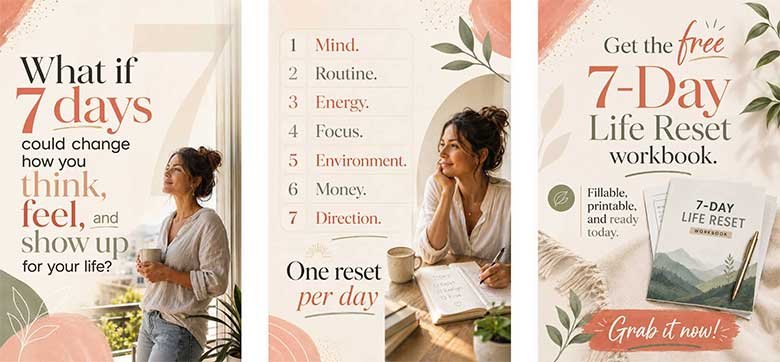
The free 7-Day Life Reset gives you a short, simple way to step back and see how your week connects to your larger goals.
Get the Free Reset5. Think in years as well as days, since big things take time.
Many of us plan in weeks and judge ourselves in days. Big goals need a longer view. Ask yourself where you would like to be in three years, and what small steps now would make that possible.
A long view also makes slow progress feel normal. A year of small steps can add up to something large.
Write a short note about where you would like to be in three years, and pick one habit that would help.
Write a paragraph about where you want to be in three years, and choose one habit to start now.
6. Break the big idea into stages, so it becomes a series of doable steps.
A big goal can feel impossible when you look at all of it at once. Break it into stages. What is the very first stage? What comes after? What would success look like at the end of each?
Give each stage a rough timeline. The first stage should be small enough to start this week.
Seeing the stages can turn a daunting idea into a plan.
Break one big goal into three stages, and define the first stage in a way you could begin this week.
7. Test the idea in a small, safe way before you commit to the whole thing.
You do not have to bet everything to find out whether a bigger idea has legs. Look for a small experiment. If you want to start a business, sell to one customer. If you want a new career, talk to someone in the field or take a short class. If you want to write, share a short piece.
Keep the test small, cheap, and quick. Then notice what you learn.
Small tests let you try big ideas without big risks.
Design one small, low-risk test of a bigger idea, and set a date to try it.
8. Spend time in rooms with bigger conversations, because ideas spread between people.
The people and places around us shape our thinking. If you want to think bigger, spend time with people who are curious, ambitious in a kind way, or doing things you admire. Attend a workshop, join a group, or follow thoughtful people.
You do not need to fit in right away. Listen, ask questions, and notice how others talk about their goals.
Bigger conversations tend to stretch what feels normal.
Find one group, event, or person that exposes you to bigger ideas, and plan to spend time there this month.
9. Ask for more, in small ways, so you practice expecting more.
Many of us do not ask because we assume the answer is no. Practice with small requests. Ask for a better price, a flexible schedule, a larger project, or an introduction. Notice what happens.
Some answers will be no, and that is fine. Many will surprise you.
Each ask builds the habit of aiming higher, and shows you that the world is often more flexible than we assume.
Make one reasonable request this week that you would normally talk yourself out of.
10. Let yourself be a beginner, because bigger things start with not knowing.
Thinking bigger often means stepping into areas where you are new. That can feel uncomfortable, especially if you are used to being good at things. Remind yourself that every expert was once a beginner.
Choose to be curious instead of embarrassed. Ask simple questions, and expect to be clumsy for a while.
The willingness to be a beginner is one of the strongest signs of a growth mindset.
Choose one area where you are a beginner, and spend fifteen minutes this week learning something basic about it.
11. Protect time for thinking, since big ideas need quiet room.
Busy days leave little space for new thoughts. Set aside a regular time, even twenty minutes, to think about your life and your goals. Go for a walk, sit with a notebook, or simply let your mind wander.
Write down anything that comes up. Many bigger ideas show up when we stop rushing.
Treat this time as an appointment, because it is easy to push aside.
Schedule a weekly twenty-minute thinking session, and bring a notebook.
12. Invest in learning something that stretches you, so your skills can grow with your ideas.
Bigger goals usually need new skills. Look at what you want, and ask what you would need to learn. It might be writing, speaking, a technical tool, or managing money.
Choose one skill, and set a small, steady plan. A few hours a week can add up. Use library resources, free courses, and practice projects.
Skills give you confidence, and they make big ideas more practical.
Pick one skill that would support a bigger goal, and block out two hours this week to start learning it.
13. Review your progress, and keep stretching just beyond what is comfortable.
Every few months, look back at what you have done. What has changed? What feels easier than it did? What would be the next stretch?
Celebrate what you have achieved, and then raise the bar a little. A growth mindset means continuing to grow, and one big goal is only part of that.
Write down the next thing you want to learn or try.
Put a quarterly review on your calendar, and write down one new stretch goal each time.
Explore Our Top Picks for a Better Life
We have gathered the tools, resources, and products we think are genuinely worth your time, covering mindset, self-care, health, and home. All in one place, hand-picked to support the bigger ideas you are growing.
See Our Top PicksReal Stories, Real Results
Let me share two examples I like to use. Kezia had a quiet idea about starting a small business, but she kept shrinking it into a vague hobby. When she wrote the full-sized version and broke it into stages, she saw a first step she could take within a week: offering her service to one customer. She told me that one small test showed her more than months of thinking.
Daniel’s pattern was assuming the answer would be no. He tried one small ask each week, a flexible schedule, a larger project, an introduction. Most of the answers were better than he expected. He said the real change was in how he thought. Both of them said the same thing: thinking bigger started with small steps, and not with a leap.
Thinking Bigger Starts When You Stop Shrinking Your Ideas
Picture an idea that once scared you, now broken into stages with a first step on your calendar. You have tested it in a small way, you have learned something, and you are curious about what comes next. The idea feels less like a dream and more like a project.
Choose two or three tips from this list, and begin by writing down the full-sized version of one idea. Download the free 9 Daily Habits guide to give your days a steady base. Big things tend to start small, and they start with permission to think.
Want Ready-Made Tools to Help You Put This Into Action?
Sometimes the fastest way forward is a tool that someone has already built. Browse our hand-picked resources and downloads, chosen to help you take the next step with less guesswork.
Browse Resources and Downloads
Ready to Think Bigger and Take the First Step?
The free 9 Daily Habits guide gives you simple morning practices that make bigger goals feel doable.
Download Free Now
Fill Your Space With Bigger Ideas
Premier Print Works makes quality prints, mugs, and shirts for people who dream and do. Browse the collection and find what speaks to your journey today.
Visit Premier Print WorksDisclaimer
The content on this page is for informational and inspirational purposes only. It is not professional mental health, medical, financial, or career advice of any kind. Pursuing bigger goals carries risk and cannot guarantee any particular outcome, so please use your own judgment and consult qualified professionals before making major decisions. Results and experiences vary significantly from person to person.
The stories of Kezia and Daniel are illustrative composite characters created to bring the content to life. They are not real people. Any resemblance to a real person is purely coincidental.
Some links on this page, including links to Premier Print Works and other resources, are affiliate links. If you make a purchase through one of these links, we may earn a small commission at no extra cost to you. We do not own, produce, or control any affiliate products, and we are not responsible for them — we only own and sell the products offered through our own store, Premier Print Works.
All content on A Self Help Hub is the property of Digital Marketing 215 LLC and is protected by copyright law. No part of this page may be copied, reproduced, republished, distributed, or transmitted in any form without prior written permission from the author.