13 Self Care Habits That Help You Slow Down and Breathe
The rushing has become so normal that the not rushing feels wrong. The full calendar feels like evidence of a productive life. The busy feels like proof of value. And the slowing down — the breath taken before the next thing begins, the pause before the response, the afternoon without an agenda — feels like falling behind rather than like the essential maintenance it actually is. The world has rewarded the rush for long enough that many people have forgotten what the alternative feels like. This article is the reminder.
These thirteen habits are not complicated. They do not require significant time or money. They require only the willingness to choose the slower pace when the faster one is automatically available — to protect the breathing room that the daily life keeps trying to fill. Start with the one that is most immediately available. Add the next one when the first is running steadily. Let them build the rhythm that the rushing has been preventing. The breathing room is there. These habits help you protect it.

Free Download: The Self-Care Starter Kit
Slowing down and breathing more deeply starts with a daily self-care foundation that supports the pace you actually need. The free Self-Care Starter Kit gives you simple daily practices for your mind, your body, and your inner life. Download it free today.
Get the Free Self-Care Starter Kit1. Take One Slow Breath Before You Answer Any Message
“Slow down — everything you are rushing toward will still be there when you arrive with your whole self.”
The reactive response — the answer sent before the breath is finished, the reply typed while the notification is still vibrating — is the response that belongs to the urgency rather than to the person. The one slow breath before the answer is the small interruption that returns the response to the person rather than to the reflex. It takes three seconds. It changes the quality of every communication it precedes. And practiced consistently, it changes the relationship with the inbox from reactive management to deliberate engagement.
The breath is the gap between the stimulus and the response. The gap is where the person lives rather than the habit. The habit says: answer immediately, answer from the urgency, answer before you have considered whether the immediate answer is the best one. The breath says: you have three seconds. Use them. The message will still be there after the breath. The response given after the breath will be more yours than the one given before it. One breath. Every message. The difference accumulates.
“Breathing deeply and living slowly are not luxuries — they are the foundation of everything else.”
2. Eat at Least One Meal Each Day Without a Screen
“Slow down — everything you are rushing toward will still be there when you arrive with your whole self.”
The screen-free meal is the meal actually eaten. The meal consumed with the phone in hand is the meal processed on autopilot while the attention was entirely elsewhere — the food tasted partially if at all, the break from the day’s demands not actually taken because the screen kept the demands running through the eating. The screen-free meal is a different experience. The food is noticed. The break is real. The fifteen minutes that the meal occupies are fifteen minutes that genuinely belonged to the eating rather than to the task queue.
One meal per day. Not all meals — one. The one that is fully present for itself. The food tasted rather than consumed. The fifteen minutes that belong entirely to the act of eating and to whatever is available in the environment around it rather than to the screen that makes the environment irrelevant. This is a small habit. Its effect on the quality of the daily experience is not small. The deliberate presence at one meal per day is more restorative than it appears from the outside of it.
“Breathing deeply and living slowly are not luxuries — they are the foundation of everything else.”
3. Build a Ten-Minute Wind-Down Before Sleep That Belongs Only to You
“Slow down — everything you are rushing toward will still be there when you arrive with your whole self.”
The transition from the day’s full activity to sleep is not automatic for most people in the modern environment. The day’s demands run right up to the moment the light is turned off and sometimes past it. The mind that has not been given a transition period does not transition cleanly into the rest that the night is supposed to provide. The ten-minute wind-down is the transition — the decompression between the active day and the necessary rest. It signals to the nervous system that the demands are finished for now and the recovery can begin.
What the ten minutes contains matters less than what it excludes. No screens. No processing of tomorrow’s problems. No review of the day’s undone items. The novel. The quiet music. The slow stretching. The five minutes of simply sitting in the stillness before the lights go out. Any of these work. What they share is the deliberate absence of the inputs that keep the active mode running. Ten minutes. Before sleep. Belonging entirely to the transition. The sleep that follows a genuine wind-down is different from the sleep that begins in the middle of the rush. Build the difference.
“Breathing deeply and living slowly are not luxuries — they are the foundation of everything else.”
4. Leave Earlier Than You Need To — and Refuse the Rush
“Slow down — everything you are rushing toward will still be there when you arrive with your whole self.”
The chronic arriving just in time produces the chronic background stress of the person who is always managing proximity to lateness rather than moving at a sustainable pace. The five extra minutes that leaving earlier provides are five minutes of not rushing — of the walk to the car at a normal pace, the drive without the adrenaline of the tight timeline, the arrival with a moment to settle before the meeting begins rather than the arrival in the middle of the breath needed to recover from the getting there. Five minutes. The stress reduction is disproportionately large for such a small investment.
Build the leaving earlier as a habit rather than as the occasional luxury when everything goes right. Set the departure time five to ten minutes before the latest possible departure and hold it. The calendar entry that ends ten minutes earlier than the appointment begins. The alarm set for the time that makes the unhurried departure possible. The small structural adjustment that removes the rush from the daily movement through the world. The pace of the arriving is the pace that sets the nervous system for the thing being arrived at. Arrive slowly. Everything is better from there.

Visit Premier Print Works
Keep the reminder that slow down — everything you are rushing toward will still be there when you arrive with your whole self — visible where the daily pace is set. Premier Print Works offers prints, mugs, and art for the person choosing the slower, more sustainable rhythm. Visit the shop today.
Visit Premier Print WorksHow Heloise Changed the Entire Quality of Her Daily Life by Changing the Pace of the First Twenty Minutes of Her Morning
Heloise worked in a demanding professional environment and lived by a personal philosophy that had served her well for most of her adult life: the more efficiently the time was used, the better the life. She was productive. She was capable. She was also, by the time she acknowledged it honestly, exhausted in a way that the productivity was not resolving — a tiredness that the accomplishment did not touch because it was not the accomplishment that was tired, it was the pace.
She had never once had a morning that did not begin at full speed. The alarm was the starting gun. The phone was picked up before the feet were on the floor. The shower was functional. The breakfast was consumed standing. The commute was used. There was no part of the morning that was not being used toward something. The using of every minute was the habit and the habit had become so automatic she had never questioned whether the using of every minute was producing anything worth the cost of never stopping.
A single experiment changed her assessment. She committed to twenty slow minutes at the start of every morning for two weeks. No phone. No news. No efficiency. Coffee made slowly and drunk while sitting at the kitchen table looking at whatever the window offered. The first morning she spent most of it mentally cataloguing everything she should be doing instead. By the fourth morning the cataloguing had quieted. By the eighth morning she had discovered something that had been waiting for her in the slow twenty minutes for years: the quality of thought available before the day began its demands was completely different from the quality available after they had started. The morning thinking — the undirected, unhurried kind that arrived when nothing was requiring it — was where her best ideas lived. They had been there the whole time. The rushing had been too loud to hear them. Twenty slow minutes had changed the quality of the other fourteen waking hours in a way that no amount of additional efficiency in those hours had ever produced.
5. Say No to One Thing Each Week That You Said Yes to From Habit Rather Than Want
“Breathing deeply and living slowly are not luxuries — they are the foundation of everything else.”
The calendar fills itself if nothing prevents it from doing so. Every invitation accepted because declining felt awkward. Every obligation maintained because it has been maintained for long enough that stopping would require an explanation. Every yes given because the no required more energy than the yes in the moment. These habit-based yeses are the breathing room being given away before it has a chance to exist. The one weekly no — the deliberate declining of the one thing that was offered from habit rather than genuine want — is the reclaiming of one week’s worth of that given-away space.
Before the next yes is given ask: do I genuinely want this or is this the yes that habit is producing before the choice has been made? The genuine want says yes and the yes is fine. The habitual yes says yes before the question has been asked. That one — the habitual one — is the one to try declining this week. The no said from genuine preference rather than performed obligation is the beginning of the calendar that has room to breathe in it. One per week. The breathing room accumulates.
“Slow down — everything you are rushing toward will still be there when you arrive with your whole self.”
6. Keep One Evening Each Week Completely Unscheduled
“Breathing deeply and living slowly are not luxuries — they are the foundation of everything else.”
The unscheduled evening is one of the rarest available luxuries of the modern life and one of the most restorative. Not the evening with fewer obligations — the evening with none. Where what happens is determined in the moment by what sounds genuinely appealing rather than by what was agreed to in advance when the calendar was open. The unscheduled evening gives the person living it the experience of spontaneous self-direction that the full calendar consistently prevents. What do I actually want to do right now? The question asked without the predetermined answer is the question that most accurately reveals what genuine rest and restoration look like for this specific person.
Protect one evening per week from the scheduling impulse. Mark it on the calendar as unavailable — not for a specific thing, for the openness itself. When the week arrives and the unscheduled evening does too, resist the impulse to use it productively. Let it be what the moment asks for. The slow walk that goes nowhere in particular. The novel opened at eight PM with nowhere to be at ten. The conversation with the person in the house that has no agenda. The nothing that is everything when the nothing has been absent for too long.
“Slow down — everything you are rushing toward will still be there when you arrive with your whole self.”
7. Spend Ten Minutes in Nature Every Day Without an Agenda
“Breathing deeply and living slowly are not luxuries — they are the foundation of everything else.”
The natural environment offers something the built environment consistently does not: attention without demand. The tree does not require anything from the person looking at it. The sky does not ask for a response. The sound of the wind in the leaves does not trigger an obligation. Nature is one of the few available environments where the attention can genuinely rest — not because there is nothing to notice but because nothing that is noticed requires anything in return. The research on the restorative effects of time in natural environments is consistent: even brief exposure measurably reduces cortisol, improves mood, and restores the directed attention capacity that the demanding day depletes.
Ten minutes. Outside. Without the phone or the agenda or the productivity podcast filling the ears. Just the environment and the presence in it. The walk that goes nowhere in particular. The bench in the park. The backyard in the early morning. Any outdoor space that offers a few minutes of the attention that does not need to accomplish anything. The ten minutes without agenda in a natural space is one of the most cost-effective restorative practices available. Its effect on the hours that follow it is reliably positive. Build it in. Every day.
“Slow down — everything you are rushing toward will still be there when you arrive with your whole self.”
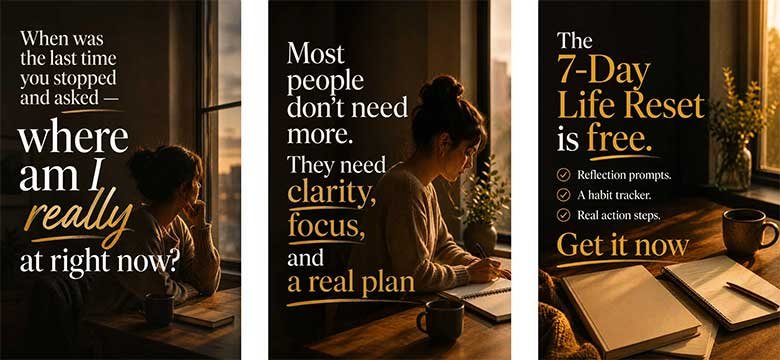
Free Download: The 7-Day Life Reset
Slowing down and building the breathing room takes root most easily from an intentional daily structure that protects it. The free 7-Day Life Reset gives you seven simple focused days to reset your daily habits and build the daily foundation from which the slower, more sustainable rhythm grows. Download it free today.
Get the Free 7-Day Reset8. Put the Phone Away One Hour Before Bed — Every Night
“Breathing deeply and living slowly are not luxuries — they are the foundation of everything else.”
The phone in the hour before bed is the most reliable way to prevent the nervous system from beginning the transition to rest. The light from the screen signals wakefulness to the brain. The content on the screen — the news, the social media, the email — keeps the active processing mode running at the exact time the biology needs it to be winding down. The research on sleep and screens is consistent enough to be unambiguous: the phone in the last hour before sleep measurably reduces sleep quality, extends the time it takes to fall asleep, and reduces the restorative depth of the sleep that follows.
Put it away one hour before the intended sleep time. Not in the same room where it will produce the impulse to check it. In a different room. The separation removes the availability that the proximity creates. The hour that follows the separation is the hour for the wind-down — the reading, the conversation, the quiet settling that the biology requires before the rest can be genuine. The phone will have new content in the morning. The rest foregone for it will not be recovered. The exchange is not worth it. One hour. Every night. The sleep that follows the protected hour is worth the protection.
“Slow down — everything you are rushing toward will still be there when you arrive with your whole self.”

Slowing Down and Building a Sober Life? This Is for You.
For some people, learning to slow down and build a gentler daily rhythm is one of the most important parts of the recovery journey. If that is where you are, the free Sober Survival Guide offers honest daily support for that work. Download it free.
Get the Free Sober Survival Guide9. Do One Thing Per Day With Your Full Attention and Nothing Else
“Breathing deeply and living slowly are not luxuries — they are the foundation of everything else.”
The multitasking habit has made the single-tasking feel like a waste. The cooking while listening to the podcast while checking the phone while planning the conversation for tomorrow feels like efficiency. It is actually the experience of three things done partially — none of them fully inhabited, none of them producing the specific quality of presence that the thing done with full attention produces. The meal cooked while fully present for the cooking is a different experience from the meal cooked as background activity to four other inputs running simultaneously. Both produce a cooked meal. Only one produces the experience of having been present in the making of it.
One thing per day with the full attention and nothing else. Not the morning routine done with the podcast and the phone — the morning routine experienced as the morning routine. Not the walk taken as exercise while the audiobook plays — the walk taken as the walk, noticed and present for. One thing. Fully. The experience of the single-tasking is so qualitatively different from the multitasking that it functions as its own form of rest — the rest of the undivided attention finding the activity rather than the activities finding the divided attention. One per day. The presence accumulates.
“Slow down — everything you are rushing toward will still be there when you arrive with your whole self.”
10. Let the First Five Minutes of the Morning Belong to You Before the Day Begins
“Breathing deeply and living slowly are not luxuries — they are the foundation of everything else.”
Five minutes before the phone. Before the news. Before the demands of the day have had the chance to establish themselves as the first input of the morning. Five minutes that belong entirely to the transition from sleep to wakefulness — the breath, the stillness, the brief unhurried moment of being in the body before the mind has been claimed by the day’s requirements. These five minutes are available every morning. They are consistently given away to the phone before they have had a chance to be what they could be.
Hold the first five minutes. The phone stays face down or in the other room until the five minutes have passed. The breath is taken. The body is present in the bed or the chair or wherever the morning begins. The day is not yet running. There is just this moment of unhurried presence before the running begins. Five minutes. Every morning. The quality of what follows those five minutes is different from the quality of what follows the immediate phone-first start. The difference is not dramatic. Over weeks and months it is unmistakable.
“Slow down — everything you are rushing toward will still be there when you arrive with your whole self.”
11. Build a Weekly Ritual That Has No Purpose Other Than Rest
“Breathing deeply and living slowly are not luxuries — they are the foundation of everything else.”
The ritual with no purpose other than rest is one of the hardest things to protect in the productivity-oriented life because it offers nothing that can be measured as a return on the investment of time. It cannot be justified to the part of the mind that evaluates time in terms of what was produced. It can only be justified to the part that knows, from the experience of genuine rest, that the unmeasured restoration it provides is the condition that makes the measurable productivity possible. The weekly ritual that exists purely for the experience of it — not for what it produces, not for the goal it serves — is the ritual that most deeply restores.
What would that ritual be for you? Not the thing that is also productive or improving or working toward a goal. The thing that is only itself. The long bath taken on Sunday evening. The walk that goes wherever the feet suggest. The cooking of something elaborate purely for the pleasure of the cooking. The afternoon in the bookshop with nowhere to be at any particular time. These things restore something that the purposeful activities cannot reach. Build one. Protect it. Let it exist purely for the restoration it provides. The unmeasured return is the largest available.
“Slow down — everything you are rushing toward will still be there when you arrive with your whole self.”
12. Let Yourself Be Bored for Five Minutes Each Day
“Breathing deeply and living slowly are not luxuries — they are the foundation of everything else.”
Boredom has been nearly eliminated from the modern life by the availability of stimulation in every unoccupied moment. The phone fills the waiting room, the queue, the commercial break, the thirty seconds between tasks that used to be the intervals where the mind was unoccupied and therefore available for the kind of processing, creativity, and integration that only happens in the absence of directed activity. The mind that is never bored is the mind that never gets the unoccupied intervals that the brain’s default mode network uses to consolidate, generate, and restore.
Let yourself be bored for five minutes each day. Deliberately. Not as punishment — as the provision of the mental space that the constant stimulation has been eliminating. The five minutes waiting for something without the phone in hand. The commute without the podcast for one trip. The five minutes between tasks that are allowed to be the nothing they are instead of the opportunity for more input. Sit in the boredom. The thoughts that arrive in the absence of the stimulation are often the most interesting ones available. The boredom is where they live. Let them surface.
“Slow down — everything you are rushing toward will still be there when you arrive with your whole self.”
13. Practice Saying — and Meaning — I Have Enough Time for This
“Breathing deeply and living slowly are not luxuries — they are the foundation of everything else.”
The mental habit of not enough time is one of the primary generators of the rush that these habits are designed to interrupt. The feeling of not enough time precedes the actual shortage of it in almost every case. The feeling arrives first — the sense that the current activity is consuming time that should be going to something else — and produces the rushed quality of the engagement before the time has actually run out. The feeling is a habit. Like most habits, it can be replaced by practice with a different one.
Practice saying I have enough time for this when the not-enough-time feeling arrives. Not as a denial of the actual schedule — the actual schedule may be genuinely tight. As the interruption of the habitual response that arrives before the actual schedule has been consulted. Most of the time the actual schedule has more room in it than the habitual feeling suggests. The practice of the different phrase is the practice of checking the actual reality before accepting the habitual assessment of it. I have enough time for this. Said enough times to mean it, it gradually becomes true — not because the time changed but because the relationship with it did.
“Breathing deeply and living slowly are not luxuries — they are the foundation of everything else.”
How Rafferty Found the Breathing Room He Had Been Missing by Building Just Three Slow Habits Into the Most Rushed Parts of His Day
Rafferty had what he accurately described as a fast life. The professional demands were real and significant. The personal commitments were genuine. The pace was not manufactured or performed — it was the honest expression of a life that had a lot in it. He was not complaining about the fullness. He was genuinely struggling with the quality of his presence inside it. He was in the life but not fully in it. Moving through it rather than inhabiting it. Present in body and absent in the more important ways.
He tried the comprehensive approach first. Reading about slow living, identifying twenty practices he wanted to adopt, creating a system for implementing them across the week. He was consistent with the system for eleven days. The system was too large for the life it was supposed to inhabit. It had produced a new thing to manage rather than a reduction in the management. He abandoned it.
What worked was smaller. He identified the three moments in his day when the rushing was most concentrated and most damaging to the quality of his presence. The morning phone-first habit that started the day in reactive mode. The lunch eaten at his desk while working that produced no actual break. The evening transition from work that ran right into the family dinner without any decompression between them. Three specific moments. One slow habit for each.
The morning got five phone-free minutes before anything else. The lunch got moved away from the desk three days a week. The evening got a ten-minute walk between the end of work and the start of dinner — alone, without the phone, without the podcast. Three habits. Applied to three specific concentrated rush points. The effect on the rest of the day was larger than the three habits alone could account for. The breathing room that the three slow points created had a way of spreading into the stretches between them. The life had not gotten less full. The relationship to the fullness had changed enough to make the fullness navigable. He had been looking for a different life. What he had found was a different pace for the same one. It turned out that was what he had actually needed.
The Breathing Room Is Already in Your Life — These Habits Help You Protect It
The slow pace does not require a simpler life. It requires the habits that create the pause within the life that exists. The breath before the response. The meal without the screen. The five minutes in the morning before the day claims them. The ten minutes outside without the agenda. The one evening each week left open. These are not dramatic changes. They are the small structural protections of the space that the rush keeps eliminating before it has a chance to be what it could be. Build them in. Hold them. Let the breathing room they create spread into the rest of the day. Everything you are rushing toward will still be there when you arrive with your whole self. Slow down. The whole self is what makes the arriving worth it.

Free Download: The Self-Care Starter Kit
Build the daily self-care foundation that supports the slower, more sustainable rhythm these habits are building toward. The free Self-Care Starter Kit gives you simple sustainable daily practices for your mind, your body, and your inner life. Download it free today.
Get the Free Self-Care Starter KitOur Top Picks for a Better Life
We have gathered our favorite tools, resources, and recommendations for slowing down, building sustainable daily self-care practices, and creating the breathing room in the daily life that makes everything else feel more possible and more worth being present for. Everything we trust enough to share, all in one place.
See Our Top Picks
Slow Down Prints at Premier Print Works
Keep the reminder that breathing deeply and living slowly are not luxuries — they are the foundation of everything else — visible where the daily pace is set. Visit Premier Print Works for prints, mugs, and art for the person choosing the rhythm that makes the life worth being present in.
Visit Premier Print WorksDisclaimer
The content on A Self Help Hub is for informational and inspirational purposes only. The self care habits and personal stories in this article offer general support for everyday wellbeing and personal development. They are not professional mental health advice, medical advice, or any form of clinical treatment.
Everyone’s experience with pace, rest, and self-care is different. If you are experiencing significant anxiety, burnout, depression, or other mental health conditions affecting your daily functioning and ability to slow down, please speak with a qualified mental health professional. General self-help content is not a substitute for professional care. If you are in an unsafe situation, please reach out to a trusted person or professional resource right away. Your safety comes first.
The stories and composite characters in this article, including Heloise and Rafferty, are illustrative. They are based on common experiences and created to make the content relatable. They are not real people. Any resemblance to a specific person is coincidental.
Some links on this site, including links to Premier Print Works, may be affiliate links. A Self Help Hub may earn a small commission at no extra cost to you. We only recommend things we genuinely believe in.
The Sober Survival Guide linked in this article is general supportive information only. It is not a substitute for professional addiction treatment or medical care. If you or someone you love is struggling with addiction, please seek help from a qualified professional. Recovery is possible.
If you are in a mental health crisis or thinking about self-harm, please do not rely on this content for support. Contact emergency services or a crisis helpline right away. You deserve real help and it is available to you now.
All content on A Self Help Hub is copyrighted. You may not copy or republish it without written permission. By reading this article you agree to this disclaimer.