15 Self Care Tips for People Who Give Too Much to Others
There is a specific kind of exhaustion that comes from giving too much for too long. It is not the tiredness that a good night of sleep fixes. It is the deeper, quieter kind that builds up when you have been consistently putting everyone else’s needs ahead of your own until there is genuinely nothing left for yourself. You know the feeling. You have probably been living in it for a while.
These 15 self care tips are written specifically for you. Not the person who occasionally forgets to take care of themselves. The person who has made a habit, possibly a lifelong one, of being last on their own list. These tips are honest about what that pattern costs and practical about what it actually takes to change it. Self care for the chronic giver is not bubble baths and scented candles. It is the harder, more necessary work of learning to take your own needs as seriously as you have always taken everyone else’s.

Free Download: The Self-Care Starter Kit
If you have been last on your own list for too long, the Self-Care Starter Kit is the practical place to begin. Simple daily practices for your mind and body that build the foundation of showing up for yourself the way you have always shown up for everyone else. Download it free today.
Get the Free Self-Care Starter Kit1. Recognize that giving from empty helps no one.
“Self care for the chronic giver is not an indulgence. It is the necessary work of learning to take your own needs as seriously as you have always taken everyone else’s.”
The most common justification for neglecting your own needs is that other people need you. That is true. And it is also true that the version of you running on empty, resentful, depleted, and disconnected from your own needs, is not the version that helps people well. You cannot pour from an empty cup is a phrase that has become a cliché precisely because it is accurate. The people in your life who depend on you are not better served by a version of you that is running on nothing. They are better served by a version of you who has enough left to give. Filling your own cup is not selfish. It is what makes genuine giving possible.
2. Notice the difference between giving freely and giving to avoid guilt.
Not all giving looks the same from the inside. There is giving that comes from genuine desire, the kind that feels good and does not leave resentment behind. And there is giving that comes from guilt, fear of disappointing people, or the belief that your worth depends on your usefulness to others. The second kind is the kind that depletes you fastest, because it is not actually a choice. It is a compulsion. Start noticing which kind of giving you are doing most often. The awareness alone does not change the pattern immediately, but it creates the space in which change becomes possible. You cannot address a pattern you have not yet seen clearly.
3. Practice saying no without an explanation attached.
“There is giving that comes from genuine desire and giving that comes from guilt. The second kind depletes you fastest because it is not actually a choice. It is a compulsion.”
Most chronic givers are also chronic over-explainers. They say no, and then immediately fill the space with justifications, apologies, and alternative offers, as if the no alone is not a complete or acceptable response. It is. No is a complete sentence. You do not owe anyone a lengthy explanation for declining something that would cost you more than you can afford to give right now. Practice the bare no in low-stakes situations. Build the muscle. It gets easier with repetition, and the people in your life who are worth keeping will not require the explanation that the people who are using your giving tend to demand.

Visit Premier Print Works
The reminders that you matter too are worth keeping visible. Premier Print Works offers prints, mugs, and art for people who are learning to take their own needs seriously and building the daily self care habits that make genuine giving possible. Visit the shop today.
Visit Premier Print Works4. Schedule time for yourself the way you schedule time for others.
If you would not cancel a commitment to someone else without a very good reason, stop canceling commitments to yourself without one. The time you block for your own rest, your own interests, your own restoration deserves the same protection as any other appointment on your calendar. Put it in writing. Treat it as non-negotiable. The fact that it is an appointment with yourself does not make it less real or less important. It makes it more important, because no one else is going to schedule it for you or hold you accountable for keeping it. That is your job. Do it.
5. Identify the one thing that restores you most and protect it fiercely.
Everyone has something that restores them. Not just relaxes them but actually refills them, that moves the needle from depleted back toward whole. For some people it is physical solitude. For others it is creative work, movement in nature, or a specific kind of conversation. For most chronic givers, whatever restores them is also the first thing to get sacrificed when someone else needs something. Identify yours. Then protect it with a specific kind of fierceness. Not when there is time left over. As a non-negotiable. Because there will never be time left over. The time has to be claimed.
6. Stop apologizing for having needs.
“The time you block for your own rest and restoration deserves the same protection as any other appointment on your calendar. Put it in writing and treat it as non-negotiable.”
Chronic givers often apologize for their own needs as if needing things is an imposition on the people around them. I am sorry to ask but, I hate to bother you with this, I know you are busy, I would not ask if I did not really need to. Each of these phrases signals to the other person and to yourself that your needs are a burden. They are not. They are normal human requirements that deserve to be stated plainly and received without apology. You have spent years receiving other people’s needs without treating them as impositions. You deserve the same. Stop apologizing for being human.
7. Rest without earning it first.
Many chronic givers believe, often without being fully conscious of it, that rest is something you earn by completing enough tasks or helping enough people first. If the list is done, then you can rest. If everyone is taken care of, then you can rest. The list is never done. Everyone is never fully taken care of. The rest that waits to be earned is the rest that never comes. Rest is not a reward for productivity. It is a human need that belongs in your life regardless of what you have or have not accomplished today. You are allowed to rest before you have finished. You are allowed to rest because you are tired. That is enough of a reason.
8. Learn to receive help without deflecting it.
“Rest is not a reward for productivity. It is a human need that belongs in your life regardless of what you have or have not accomplished today. You are allowed to rest simply because you are tired.”
When someone offers to help you, what do you do? Most chronic givers deflect. Oh, I am fine. You do not need to do that. I can handle it. The deflection feels like politeness. It is actually a refusal to be in the receiving position that feels unfamiliar and slightly threatening to someone whose identity is organized around giving. Letting other people help you is not weakness. It is a skill, and it is one that the chronic giver usually has to build deliberately. The next time someone offers, say yes. Let them. Notice what it feels like. Do it again until it stops feeling wrong.
9. Address resentment honestly when it builds.
Resentment is the inevitable result of giving without receiving in return over a long enough period. It is not a character flaw. It is a signal. It is telling you that something in the giving equation is out of balance and has been for long enough to produce a genuine emotional response. When you notice resentment building, take it seriously as information rather than pushing it down or apologizing for having it. What is it pointing to? What have you been giving that you did not want to give? What have you been needing that no one has been giving back? The resentment is not the problem. It is the symptom. The imbalance it is pointing to is the problem worth addressing.

Free Download: The 9 Daily Habits Checklist
Showing up for yourself consistently is a daily practice, not a one-time decision. The free 9 Daily Habits Checklist gives you nine simple daily practices that build the foundation of genuine self care, especially for the person who has been giving to everyone else first. Download it free today.
Get the Free Habits Checklist10. Set one boundary this week and hold it.
Not ten boundaries. One. The chronic giver who decides to start setting boundaries often tries to set all of them at once, which is overwhelming and usually collapses quickly. Choose one situation where a boundary is clearly needed. Name it clearly to yourself and if necessary to the other person. Then hold it when it is tested, because it will be tested. One boundary held consistently does more for your self care practice than ten boundaries stated and then quietly abandoned. Build the muscle with one. Then add more when that one is solid enough to stand on.
11. Stop monitoring everyone else’s emotional state as your responsibility.
“Resentment is not a character flaw. It is a signal that the giving equation has been out of balance for long enough to produce a genuine emotional response. Take it seriously.”
Chronic givers are often highly attuned to the emotional states of the people around them, scanning constantly for who needs what and adjusting their own behavior accordingly. This hypervigilance is exhausting and it is also a way of taking responsibility for other people’s feelings that is not actually yours to carry. Other people’s emotional states are theirs to manage. You can care about how someone feels without making it your job to fix it. You can notice that someone is unhappy without immediately reorganizing yourself to address it. This distinction is one of the most freeing things a chronic giver can practice. Their feelings are theirs. Yours are yours.
12. Make one decision each day based entirely on what you want.
Just one. It does not have to be significant. What do you want for lunch, not what is easiest for everyone else. What do you want to do with the next hour, not what would be most useful to someone else. The chronic giver is often so practiced at subordinating their own preferences that they have genuinely lost touch with what they want in the small daily moments. Rebuilding that contact takes practice. One decision a day is where that practice starts. It accumulates over time into a much more honest relationship with your own desires and preferences. Which is where self care actually lives.
13. Give yourself the same grace you give everyone else.
“Other people’s emotional states are theirs to manage. You can care about how someone feels without making it your job to fix it. That distinction is one of the most freeing things a chronic giver can practice.”
When a friend makes a mistake, you probably offer understanding and perspective. When you make the same mistake, you probably offer yourself criticism and a lengthier version of the story of your own inadequacy. The standard you apply to yourself is almost certainly harsher than the one you apply to anyone you love. Self care includes extending to yourself the same fundamental grace you extend to others as a matter of course. You are allowed to get things wrong. You are allowed to be imperfect. You are allowed to need time, rest, and gentleness when you are struggling. Give yourself what you would give without hesitation to anyone else in your position.
14. Create a small daily ritual that belongs entirely to you.
A ritual does not have to be elaborate to be meaningful. A cup of tea drunk slowly before anyone else is awake. Ten minutes of reading something you chose for yourself. A brief walk with no destination and no purpose other than the walk itself. The ritual matters not because of what it is but because of what it represents: a daily, consistent claim on a small piece of your own life that is not organized around anyone else’s needs. For the chronic giver, that claim is a practice of self respect. Do it every day. Protect it from being given away. Let it be yours.
15. Accept that some people will be disappointed when you start showing up for yourself.
“Give yourself what you would give without hesitation to anyone else in your position. You deserve at least that much from yourself.”
This is the hardest tip on the list and the most important one. When you begin to take your own needs seriously, to say no, to set limits, to rest without earning it, some people in your life will be disappointed. Some of them will express that disappointment in ways that feel like pressure to go back to the way things were. This is the moment the pattern is most likely to collapse. Hold the line anyway. The disappointment of people who benefited from your overgiving is not evidence that you are doing something wrong. It is evidence that you are doing something different. Different is not wrong. Different is the whole point.
How Kezia and Amara Each Found the Tip That Changed Their Relationship With Giving
Kezia had built an entire identity around being the person everyone could count on. She was the friend who showed up, the colleague who covered, the family member who handled it. She was also, by the time she sat down and honestly assessed her own life, deeply resentful of almost everyone she loved and had no idea what she actually wanted from her own days. The tip that shifted things was the simplest one: make one decision a day based entirely on what you want. Not what is useful. Not what anyone else needs. What do you want. The first week she could barely answer the question. She had been asking it about everyone else for so long that her own answer was genuinely unclear. By the end of the second week she was beginning to hear it. It was quiet and a little unfamiliar and completely hers. She followed it. The following months were not always comfortable. They were, for the first time in years, genuinely hers.
Amara’s moment came from the tip about receiving help. A colleague had offered to take something off her plate during an overwhelming week and Amara had done what she always did: declined, reassured the colleague she was fine, and then spent the next three days managing the thing alone while quietly falling apart. A friend who had been watching this pattern for years finally named it directly. You do not let anyone help you. You give constantly and you receive nothing and you call it being capable. Amara sat with that for a long time. The next time someone offered help she said yes. It felt deeply uncomfortable and slightly shameful, which told her everything she needed to know about how distorted her relationship with receiving had become. She kept saying yes. The discomfort faded. What replaced it was something she recognized eventually as being in a real relationship with the people around her, one that went both directions, which turned out to be what she had been missing the entire time.
You Deserve to Be on Your Own List. Not Last. Just On It.
You do not have to stop caring about other people to start taking care of yourself. You do not have to become selfish to stop being depleted. The shift that self care requires from the chronic giver is not a personality transplant. It is a rebalancing. A recognition that your needs are real, your energy is finite, and taking care of yourself makes you better at everything else, including the giving that is genuinely part of who you are.
Start with one tip. The one that landed hardest or felt most uncomfortable is probably the one that is most needed. Practice it until it feels slightly less foreign. Then add another. The goal is not to transform overnight. The goal is to begin moving in the direction of a life where you are genuinely present in it, not just managing it for everyone else.
You deserve to be taken care of. Starting with yourself.
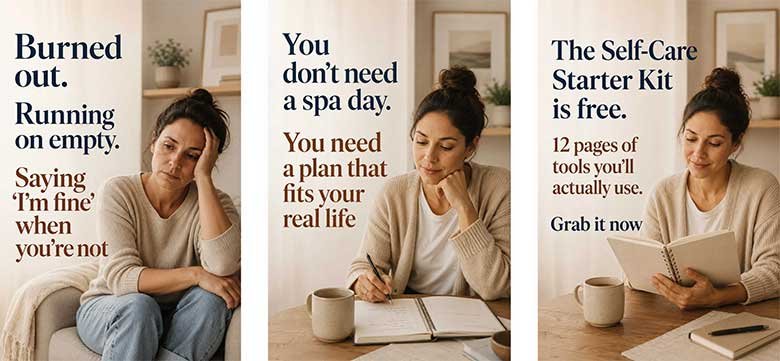
Free Download: The Self-Care Starter Kit
Let these self care tips be the reminder you needed that you are allowed to be on your own list. The free Self-Care Starter Kit gives you simple daily practices to start building the habit of showing up for yourself with the same consistency you have always shown up for everyone else. Download it free today.
Get the Free Self-Care Starter KitOur Top Picks for a Better Life
We have gathered our favorite tools, resources, and recommendations for people who are learning to take their own needs seriously, build genuine self care habits, and show up for themselves with the same energy they have always brought to everyone else. Everything we trust enough to share, all in one place.
See Our Top Picks
Self Care Reminders at Premier Print Works
Keep the reminders that you matter too visible on the days when it is easiest to forget. Visit Premier Print Works for prints, mugs, and art for people who are learning to take their own needs seriously and building the self care habits that make a sustainable life possible.
Visit Premier Print WorksDisclaimer
The content on A Self Help Hub is for informational and inspirational purposes only. The self care tips and personal stories in this article offer general support for everyday wellbeing, personal boundaries, and intentional living. They are not professional mental health advice, psychotherapy, medical advice, or any form of clinical treatment.
If you are dealing with significant burnout, anxiety, depression, codependency, or other patterns affecting your daily functioning and relationships, please speak with a qualified mental health professional. General self-help content is not a substitute for professional care.
The stories and composite characters in this article, including Kezia and Amara, are illustrative. They are based on common experiences and created to make the content relatable. They are not real people. Any resemblance to a specific person is coincidental.
Some links on this site, including links to Premier Print Works, may be affiliate links. A Self Help Hub may earn a small commission at no extra cost to you. We only recommend things we genuinely believe in.
If you are in a mental health crisis or thinking about self-harm, please do not rely on this content for support. Contact emergency services or a crisis helpline right away. You deserve real help and it is available to you now.
All content on A Self Help Hub is copyrighted. You may not copy or republish it without written permission. By reading this article you agree to this disclaimer.