15 Self Improvement Habits That Help You Build a Stronger Morning
I used to build these beautiful, elaborate morning routines. Meditation, journaling, a workout, a healthy breakfast, all stacked up in a row like something out of a magazine. And they worked great, right up until the first night I slept badly, or a kid woke up sick, or I just genuinely overslept. Then the whole thing collapsed, and because I’d tied my sense of a “good morning” to doing all of it, I usually just gave up on the entire day instead of doing part of it.
That’s the real problem with most morning advice. It’s designed for your best day, and most days aren’t your best day. So this list isn’t about building the ideal morning. It’s about building one that’s actually strong enough to survive a bad one.

Get the Nine Habits I Actually Rely On
Grab my free 9 Daily Habits guide. It’s the real, simple set of morning practices I go back to, especially on the days I don’t feel like it.
Get the Free Guide1. Build a “minimum version” of every habit you care about, not just the full one
For every habit in your morning, decide in advance what the smallest possible version of it looks like. Not the ten-minute workout, the two-minute version. Not the full journal page, one sentence. This isn’t lowering your standards. It’s giving yourself a version of the habit that survives on your worst days instead of getting skipped entirely.
Write down the minimum version of your one or two most important morning habits today.
2. Decide the night before exactly what you’ll do if you oversleep
There’s real research behind this one, from a psychologist named Peter Gollwitzer, who studied what he called implementation intentions, basically, deciding in advance “if this happens, then I’ll do this” instead of leaving it to be figured out in the moment. His research found that people who make a specific if-then plan are considerably more likely to actually follow through than people who just intend to handle it when it comes up.
Apply that here directly. Decide tonight: “If I oversleep tomorrow, then I’ll skip the shower and just do my two-minute version of X.” Having the decision already made means you’re not negotiating with a groggy, rushed version of yourself at 7 AM.
Write down tonight what you’ll actually do tomorrow if you oversleep.

Something to Start Your Morning Off Right
I’ve got prints, mugs, and shirts over at Premier Print Works for people building mornings that actually hold up. Take a look if you want a little reminder on your counter.
Visit Premier Print Works3. Pick one anchor habit that doesn’t depend on your mood
Most morning habits get skipped because they require some amount of motivation, drinking a green smoothie, journaling about your feelings, that kind of thing. Pick one habit that’s almost mechanical, something you can do regardless of how you feel, like opening the blinds or drinking a glass of water. This becomes the one thing that happens no matter what, which matters more than people think, because it keeps the morning from feeling like a total loss even on the roughest days.
Pick your one mood-proof anchor habit today, and do it tomorrow no matter what.
“A strong morning isn’t the ideal one. It’s the one that’s actually strong enough to survive a bad one.”
Get Honest About What Actually Derails Your Mornings
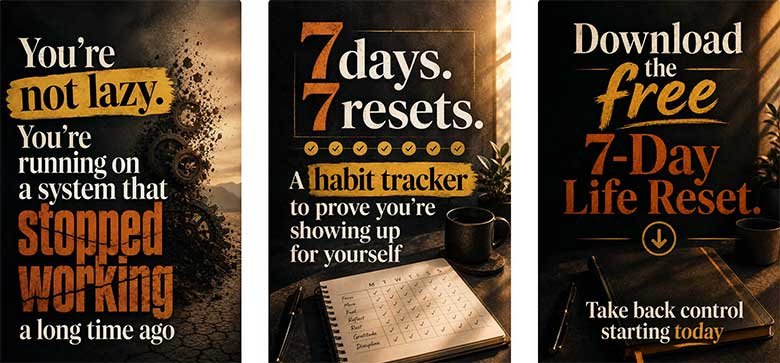
My free 7-Day Life Reset gives you one honest prompt a day for a week. It’s a good place to figure out what actually knocks your mornings off track before you try to fix it.
Start the Free Reset4. Do tonight’s prep during the calmest part of your evening, not the most tired
A lot of morning-prep advice tells you to prep the night before, but doesn’t mention that doing it at 11 PM, exhausted, means it often just doesn’t happen. Find the calmest window in your evening, right after dinner, during a show’s commercial break, whatever it is, and do your prep there instead. The task is the same. The timing is what makes it actually stick.
Pick one specific, calm window tonight to do tomorrow’s prep.
5. Reduce the number of real decisions you have to make before 8 AM
Every decision your brain makes in the morning, what to wear, what to eat, what to do first, uses up a real, limited amount of mental energy. Reducing the number of decisions doesn’t make you boring. It means more of that energy is left over for the parts of your day that actually need it. Lay out clothes the night before. Eat the same breakfast most days. Decide your first task before you go to sleep.
Pick one decision today that you can remove entirely from tomorrow morning.
6. Give yourself a real buffer, not the exact amount of time you think you need
Most people time their mornings assuming everything goes right, and then feel like failures the first time something doesn’t. Build in an extra ten or fifteen minutes you don’t expect to need. On the days everything goes smoothly, you get a few unplanned quiet minutes. On the days something goes wrong, that buffer is what keeps the whole morning from unraveling.
Add fifteen minutes of real buffer to tomorrow’s morning schedule.
7. Separate “getting ready” from “waking up,” and don’t rush the second one
A lot of us jump straight from the alarm into getting-ready mode, phone, shower, clothes, without ever actually letting our brain finish waking up first. Give yourself even two or three minutes of just sitting there, present, before you start moving through tasks. It sounds small, but starting the task list before you’re actually awake is part of why mornings can feel like a blur.
Give yourself two real minutes tomorrow to just wake up before you start getting ready.
8. Keep one small, physical ritual that has nothing to do with productivity
Not every morning habit needs to be optimizing something. A specific mug for your coffee. A particular chair you sit in for five minutes. Something that exists purely because it feels good, not because it’s making you more productive. These small, unproductive rituals are often what actually make a morning feel like yours instead of just a checklist to get through.
Choose one small ritual today that exists just because you like it, not because it’s useful.
9. Notice which habits you’re doing out of guilt, and be honest about dropping them
Some habits stay in a morning routine long after they’ve stopped actually helping, purely because stopping feels like giving up. If a habit consistently gets skipped, resented, or rushed through without care, that’s real information, not a failure of discipline. Be honest about which ones on your list actually deserve to stay.
Look at your current morning today, and name one habit you keep out of guilt, not benefit.
10. Let your morning look different on weekends, on purpose, not by accident
Trying to run the exact same tight routine every single day, weekday or not, often leads to just abandoning it entirely on the days it doesn’t fit. Instead, decide on purpose what a weekend or day-off version looks like. It can be looser. It can start later. The point is that it’s still a real, chosen version, not just the routine falling apart because the schedule changed.
Design your weekend morning version today, on purpose, instead of leaving it to chance.
11. Keep a short list of what’s actually gone wrong most mornings, and fix that first
Instead of guessing at what a stronger morning needs, look honestly at your last two weeks. What actually derailed things, specifically? A phone notification pulling your attention. A missing ingredient for breakfast. Fix the real, specific thing that’s actually been going wrong, rather than adding a brand new habit on top of an unsolved problem.
Write down today the one specific thing that’s derailed the most mornings recently.
12. Build in one small, sensory cue that tells your brain the day has actually started
A specific smell, a certain song, a particular light turning on, these can act as a real signal to your brain that the day has genuinely begun, separate from just glancing at a clock. Pick one sensory cue and use it consistently. Over time, it starts doing some of the mental work of “waking up” for you, automatically.
Choose one sensory cue today, and use it every morning this week.
13. Don’t let a missed morning habit turn into a missed morning entirely
Missing one habit doesn’t have to mean the whole morning is a wash. That’s a mental habit as much as anything else, treating one skipped piece as proof the whole thing failed. Practice catching that thought and correcting it in the moment: one missed habit is one missed habit, not a ruined morning.
Notice today if you catch yourself writing off an entire morning over one missed piece.
14. Revisit your morning setup every season, since your actual life keeps changing
A morning that worked well in the summer might not work once the days get shorter and darker. A routine built before a new job, a new baby, a new schedule, might not fit anymore. Revisit the actual setup every few months rather than assuming a “good” routine should just keep working forever unchanged.
Check in today on whether your current morning setup still actually fits your current life.
15. Judge your morning by whether it held up, not by whether it was perfect
At the end of each week, ask yourself one honest question: did my morning setup hold up, even on the hard days? Not “was it perfect,” but “did it survive.” That’s a completely different standard, and it’s the one that actually matters if the goal is a morning that works in real life, not just on your best days.
Ask yourself this week whether your morning held up, not whether it was perfect.
Explore Our Top Picks for a Better Life
I put together a list of tools and products I genuinely think are worth your time, covering mindset, habits, health, and home.
See Our Top PicksTwo Mornings I Think About
I know a woman named Kezia who used to have this elaborate seven-step morning routine, and the first time her toddler woke her up an hour early, she skipped the entire thing and started the day already feeling like she’d failed before 7 AM. The week she built a two-minute minimum version of just her top two habits, everything changed. She told me the hard mornings stopped feeling like failures. They just became the shorter version of the same routine.
I also think about a guy named Daniel, who used to time his mornings down to the exact minute, and any small delay, a missed bus, a slow toaster, would throw the whole thing into chaos. The first time he added a real fifteen-minute buffer he didn’t think he needed, he said it was strange how much calmer the entire morning felt, even on days nothing actually went wrong.
If You Only Change One Thing
Build the minimum version of your most important habit. That’s it. Not the perfect version, the smallest one that still counts. Once that exists, it becomes the floor your morning can never fall below, no matter how the night before actually went.
Everything else on this list is there to protect that floor. But the floor has to exist first.
Want to Go Further?
I’m building out some deeper, paid resources for people who want more than a single article can cover. They’re not live yet, but you can see everything I currently have ready for you, free and otherwise, on my Top Picks page.
See What’s Available
Ready to Build a Morning That Actually Holds Up?
My free 9 Daily Habits guide walks you through nine simple morning practices built to survive a real, imperfect day.
Download Free Now
Something to Start Your Morning Off Right
Take a look at Premier Print Works for prints, mugs, and shirts made for people building mornings that actually hold up.
Visit Premier Print WorksDisclaimer
This page is for informational and inspirational purposes only. It is not professional coaching, medical, or mental health advice. The concept of implementation intentions referenced here comes from the real, published research of psychologist Peter Gollwitzer, summarized here in plain language rather than quoted directly. Results and experiences vary from person to person.
Kezia and Daniel are made-up characters used to bring this content to life. They are not real people.
Some links on this page, including links to Premier Print Works, are affiliate links. If you buy something through one, we may earn a small commission at no extra cost to you. We only own and sell products through our own store, Premier Print Works.
All content on A Self Help Hub belongs to Digital Marketing 215 LLC and is protected by copyright law. No part of this page may be copied or reused without written permission.