9 Recovery Tips for Getting Through Hard Days Without Giving Up
Hard days are not optional. They arrive without warning, they do not care about your schedule, and they often come in clusters that make it genuinely difficult to remember that they will pass. Recovery — from a hard day, a hard season, or a hard chapter — is not dramatic. It is quiet, unglamorous, and made up of small choices that most people never see.
These 9 tips are written for the person who is in the middle of a hard day right now and needs something honest and practical to hold onto. Not inspiration — grounding. Not a promise that everything will be fine — a reminder that you have tools available and that getting through this day is enough of a goal.
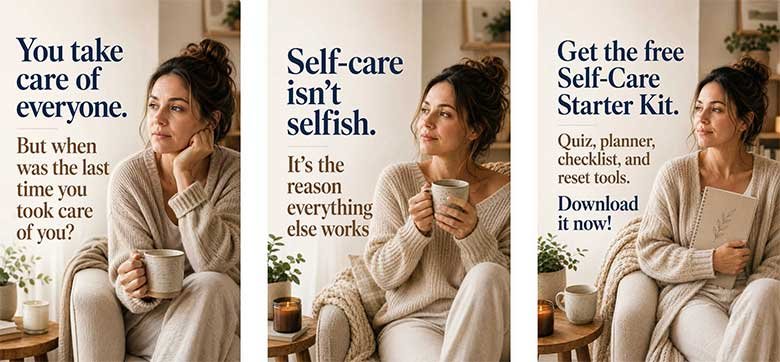
Build the Daily Practice That Supports You on the Hard Days
Download the free Self-Care Starter Kit and build a simple daily routine that gives you something solid to return to — especially on the days when everything else feels uncertain or too heavy.
Get the Free Starter Kit1. Lower the bar on hard days — not permanently, but for today — because surviving is a legitimate goal when the weight is real.
On a hard day the goal does not have to be thriving or progressing or performing at your usual level. Sometimes the goal is simply to get through the day without making things worse. That is a legitimate goal and it deserves to be treated as one. Holding yourself to your best-day standards on your worst days is not discipline. It is cruelty.
Give yourself permission to have a recovery day. A day where the bar is lower and the standard is simply: did I get through it? Did I not quit? Did I take care of the most essential things and let the rest wait? That permission is not weakness. It is the honest recognition that some days require a different kind of strength — the kind that knows when to ask less of yourself so you can still be here tomorrow.
2. Break the day into the smallest possible units — this hour, this task, this one next thing — and refuse to look further ahead than that.
On a hard day the whole of what is ahead can feel unsurvivable. The week, the month, the situation as it stands — the wide view is overwhelming. The narrow view is almost always manageable. This hour. This one task. This next small thing that needs doing. Nothing beyond that.
When the day feels like too much, shrink the scope. What is the one thing that needs to happen in the next hour? Do that. Then ask again. One thing at a time. One hour at a time. The whole hard day gets through itself this way — not in one impossible piece but in a series of small, manageable ones that add up to having survived.
“Getting through a hard day without giving up is not a small thing. It is an act of persistence that most people never see and that almost always costs more than it looks.”
3. Move your body even briefly — a 10-minute walk, some stretching, anything — because physical movement is one of the fastest ways to shift a stuck emotional state.
The body and the emotions are not separate systems. When emotional weight is heavy, the body holds it — in the shoulders, the chest, the jaw, the stomach. Movement releases some of what the mind alone cannot process. Ten minutes of walking does not fix the hard thing. It changes the physical state in which you are holding the hard thing, which is often enough to make it more bearable.
You do not need to feel like moving. You do not need to make it a workout. You just need to get up and move your body briefly. That small physical interruption to a stuck emotional state is one of the most consistently reliable self-recovery tools available to a person, regardless of circumstances.
4. Reach out to one person — not to explain everything, just to say you are having a hard day and let someone know you are in it.
Isolation makes hard days harder. The experience of going through difficulty entirely alone — without anyone knowing it is happening — compounds the weight in ways that are genuinely difficult to measure. You do not need to burden anyone with the full weight of what you are carrying. You just need one person to know that today is hard.
Send a text. Make a brief call. Say the simple, honest thing: I am having a hard day. You do not need a response with solutions. You just need the small but significant shift that comes from not being the only one who knows. That shift — from alone to not entirely alone — is one of the most effective recovery tools there is.

Put Something in Your Space That Holds You on the Hard Days
Premier Print Works creates quality prints, mugs, and shirts with words that keep you going even when things are genuinely difficult. Find something that speaks to your strength and your recovery today.
Visit Premier Print Works5. Do one small act of self-care — eat something real, drink water, wash your face — and let it be a signal that you are worth taking care of today.
On hard days self-care is often the first thing to go. People skip meals, forget to drink water, neglect the basic physical maintenance that their body needs because the emotional weight crowds out everything else. But those basic acts of physical care are not trivial on hard days. They are signals. Small, consistent signals that you are still here, still worth taking care of, still choosing yourself even at a minimal level.
It does not have to be more than one thing. Eat something. Drink a glass of water. Wash your face. Take your medication. One small act of physical self-care on a hard day is an act of self-respect that costs almost nothing and means more than it looks.
6. Name what you are feeling out loud or on paper — not to fix it, but to acknowledge it and reduce the additional weight of carrying it unnamed.
Unnamed feelings are heavier than named ones. The vague sense of dread, the heaviness without a clear source, the overwhelm that has not been articulated — all of these are harder to carry than the same feelings named clearly. Research on emotional labeling consistently shows that naming what you feel reduces its intensity, even when the circumstance producing the feeling has not changed.
Say it or write it. I am sad. I am anxious. I am exhausted and I do not know how to keep going. I feel like I am failing. I am scared. Whatever is true. Saying the honest name of the feeling is not dwelling in it — it is meeting it clearly so it does not have to work so hard to get your attention. Named feelings are more manageable than unnamed ones. Name yours.
7. Remind yourself that you have had hard days before and every single one of them has eventually ended — this one will too.
The feeling of permanence is one of the most reliable features of a hard day. From inside it, the difficulty feels like a permanent state rather than a temporary one. It has not always been this hard. It will not always be this hard. Every hard day you have ever had has eventually ended — including the ones that felt in the moment like they would not. This one will too.
That is not a promise that tomorrow will be easy. It is an accurate statement of pattern. You have a 100 percent completion rate on your hard days so far. This one is going on the same list. Get through it. Not because the ending is guaranteed to be good but because the ending is guaranteed to arrive — and getting through is the only way to be there when it does.
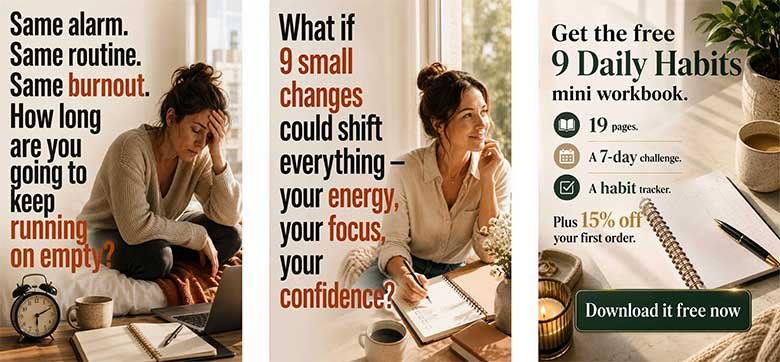
Build the Daily Habits That Carry You Through the Hard Days
The free 9 Daily Habits guide gives you nine simple morning practices that build the daily resilience and self-care foundation that makes getting through hard days genuinely more possible.
Get the Free Guide8. Protect yourself from the urge to make permanent decisions on a hard day — wait until you are on the other side of it before deciding anything that cannot be undone.
Hard days produce a compelling sense that something permanent needs to change right now — quit the job, end the relationship, walk away from the commitment, make the dramatic move that will finally make this stop. Sometimes that sense is accurate. More often it is the exhaustion and the pain making a decision that a rested and recovered version of you would not make in the same way.
Protect tomorrow’s you from today’s hard day by making an agreement with yourself: no permanent decisions today. If something genuinely needs to change, it will still need to change tomorrow when you are more resourced. Wait. If the decision still seems right from the other side of the hard day, it is more likely to be right. If it does not, you will be grateful you waited.
9. End the hard day by acknowledging that you got through it — even if barely, even if imperfectly — because getting through matters more than getting through gracefully.
The end of a hard day deserves acknowledgment. Not celebration necessarily — acknowledgment. You got through something difficult. You did not quit even when quitting felt tempting. You made it to the other side of a day that was genuinely hard. That is not nothing. That is in fact a great deal — and it is evidence of the kind of quiet, unglamorous strength that most people have far more of than they give themselves credit for.
Say it to yourself before you sleep. Write it down. Text it to someone. I got through today. It was hard and I am tired and I did not do everything perfectly and I got through it anyway. That acknowledgment is not pride — it is honest self-recognition. And honest self-recognition, practiced on the hard days, is how you build the kind of belief in yourself that the next hard day cannot easily shake.
“The hard days are not the exception to your story. They are part of it — and the way you move through them is building something in you that the easy days never could.”
Explore Our Top Picks for a Better Life
We have gathered the best tools, resources, and products to help you get through the hard days, build your recovery toolkit, and keep moving toward a life that feels more genuinely yours. All in one place, hand-picked just for you.
See Our Top PicksReal Stories, Real Results
Amara had a stretch of three weeks where every day felt like a hard day. She was going through something she could not fully explain to the people around her — a combination of grief, uncertainty, and an exhaustion that sleep was not touching. She said the thing that kept her from giving up was not inspiration. It was the narrowing of scope. She stopped thinking about the week or the month and started thinking about the next hour. Just this hour. Then the next one. She sent one text to a close friend every day — not a long explanation, just “hard day today.” Her friend always replied. She said she did not need the reply to solve anything. She just needed someone to know. She got through the three weeks one narrow hour at a time. On the other side she said the experience had permanently changed her relationship to her own capacity. She knew something about herself now that she could not have known any other way: she could get through things that felt like too much. She had proof.
Joel had a habit of making decisions on hard days that he regretted on easier ones. He had quit a job during a particularly difficult week that in hindsight he would have kept. He had ended a friendship during a conflict that, cooler-headed, he would have navigated differently. He made a rule for himself: no permanent decisions for 48 hours after a hard day. Just a flat rule, applied without judgment. The next time a hard day arrived and the urge to make a dramatic change came with it, he held the rule. He felt the urge. He did not act on it. Two days later the urge had changed shape entirely — the decision that had felt urgent and necessary had become one among several options, none of which required immediate action. He said the rule had saved him from himself at least four times in the years since he made it. He never planned to need it. He was glad he had it when he did.
Getting Through Is the Goal on Hard Days — and Getting Through Is Enough
Every tip in this article is built around one central truth — that on a hard day, survival is not a failure mode. It is the appropriate goal. The quiet persistence of getting through a genuinely difficult day, without quitting, without making it worse, without abandoning yourself entirely in the process — that is a genuine accomplishment. It deserves to be treated as one.
If you are reading this on a hard day, take one tip from this list and use it right now. Just one. Download the free Self-Care Starter Kit to build a daily practice that gives you something solid to return to on the days when everything else feels uncertain. You are going to get through this. One tip, one hour, one small act of self-care at a time.
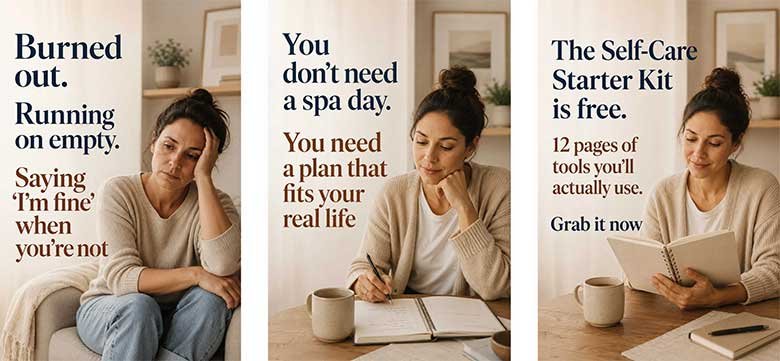
Your Daily Self-Care Practice Is What Carries You Through
The free Self-Care Starter Kit gives you simple, practical tools to build a daily routine that supports your recovery and gives you something real to return to on even the hardest days.
Download Free Now
Surround Yourself With Words That Keep You Going
Premier Print Works makes quality prints, mugs, and shirts for people who are getting through hard things and choosing to keep going. Browse the collection and find what holds you up today.
Visit Premier Print WorksDisclaimer
The content on this page is for informational and inspirational purposes only. It is not professional mental health, medical, or personal advice of any kind. If you are experiencing significant distress, depression, anxiety, or other mental health challenges, please seek support from a qualified mental health professional. Results and experiences vary from person to person.
The stories of Amara and Joel are illustrative composite characters created to bring the content to life. They are not real people. Any resemblance to a real person is purely coincidental.
Some links on this page, including links to Premier Print Works and other resources, are affiliate links. If you make a purchase through one of these links, we may earn a small commission at no extra cost to you. We only recommend things we genuinely believe in.
If you are in crisis, please contact emergency services or a crisis helpline in your area immediately. You are not alone and help is available.
All content on A Self Help Hub is protected by copyright. It may not be copied, republished, or distributed without written permission from the author.