9 Budgeting Tips That Help You Stretch a Small Income
A small income does not have to mean a financially chaotic life. The gap between what arrives in your account and what leaves it is where financial progress lives — and that gap can be widened, even modestly, through the right approach to the money you already have. The budgeting tips that actually help on a tight income are not the ones that assume plenty of room to maneuver. They are the ones built for the reality of not having much margin and making the most of every dollar anyway.
These 9 tips are written for that reality. Honest, practical, and focused on what actually works when the income is limited and the pressure is real. Start with one and let it change how you relate to the money you have.
Build the Budget That Makes the Most of What You Have
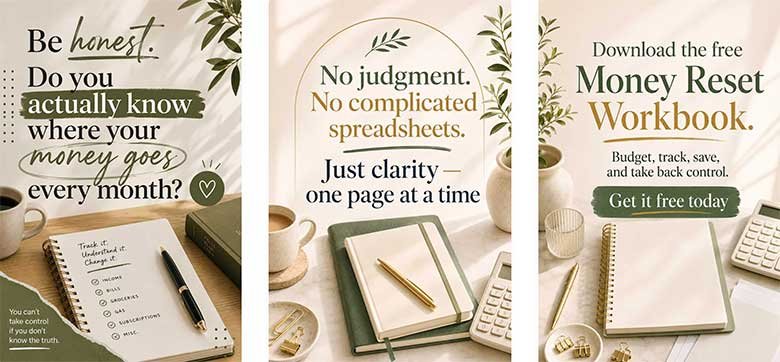
Download the free Money Reset Workbook and get the practical tools to build a clear, realistic budget that stretches your income further, reduces financial stress, and helps you make real progress even on a tight income.
Get the Free Workbook1. Know your actual monthly number — the real total of what your essential expenses cost — before you make any other budgeting decision.
Most people on a tight income have a general sense of their expenses but not a precise one. The difference between a general sense and an accurate number is where the budget either holds or breaks down. When you know exactly what your essential expenses cost — housing, utilities, food, transportation, minimum debt payments — you know precisely how much of your income is committed before any discretionary decision is made. That knowledge is the foundation everything else builds on.
Spend one hour gathering the actual numbers from your last two months of statements. Add them up honestly. The total may be uncomfortable. It is also the most useful financial information you can have, because it tells you exactly what margin you are actually working with — and what you need to protect, reduce, or earn more of in order to make progress.
2. Pay your essential expenses and your savings contribution first — even a small one — before any discretionary spending gets access to what remains.
The budget structure that works on a small income is the same one that works on any income: the important things come first, and the discretionary things operate within whatever is left. On a small income the margin for discretionary spending is narrow, which makes the sequence even more important. When essential expenses and savings are paid first, the remaining discretionary budget is a real and workable number. When discretionary spending happens first, the essentials often compete with whatever is left — a competition that produces financial stress rather than progress.
Even a very small savings contribution placed at the front of the month matters more than its size suggests. It builds the habit, it accumulates over time, and it establishes the identity of someone who saves — which makes the habit more durable than the amount alone would suggest. Start with whatever you can genuinely sustain. Size it up when the income allows.
“Stretching a small income is not about deprivation. It is about clarity — knowing exactly what you have, exactly what it is committed to, and making every remaining dollar a deliberate decision rather than a default.”
3. Meal plan for the week before you grocery shop — because unplanned grocery trips on a tight budget are one of the most reliable ways to overspend on food.
Food is one of the largest variable expenses in most budgets and one of the most improvable on a tight income. The difference between a planned grocery shop and an unplanned one — in both cost and food waste — is consistently significant. When you know what you are cooking before you shop, you buy what you need, you use what you buy, and you spend what the plan requires rather than what the store suggests.
A weekly meal plan does not need to be elaborate. Five or six simple meals, a shopping list built from them, and the discipline to buy what is on the list. Cook in batches when possible. The food cost reduction from consistent meal planning on a tight budget is often one of the fastest and most meaningful improvements available — and it requires time rather than income to implement.
4. Build a small irregular expenses fund — even a few dollars a month — so that predictable but unpredictable expenses do not destroy your budget when they arrive.
The budget-breaking expenses on a tight income are almost never genuinely surprising. Car maintenance, medical copays, school supplies, seasonal clothing, annual subscriptions, holiday costs — all of these are predictable in category even when unpredictable in exact timing and amount. Without a fund for them, they arrive as emergencies and get paid on credit or by pulling from savings intended for something else. Either way they cost more than they should and set the budget back further than necessary.
Estimate what these irregular expenses cost you annually. Divide by 12. Set that amount aside each month in a dedicated account. When the irregular expense arrives, the money is there. The car repair is not a crisis — it is a planned expense that has been funded all along. On a tight income this small monthly reserve is one of the highest-impact budgeting moves available.
5. Cut the recurring costs that no longer serve you — subscriptions, memberships, automatic renewals — and redirect every recovered dollar to something with higher priority.
On a tight income, money spent on things that are not being used or genuinely valued is money that cannot go toward things that are. A quarterly review of every recurring charge — subscriptions, memberships, automatic renewals — consistently reveals spending that is happening without a genuine decision behind it. Canceling those charges does not require sacrifice. It requires the small effort of noticing what has been invisible.
Go through your last two months of statements and highlight every recurring charge. For each one ask a simple question: am I genuinely using this and does it justify its cost given what else this money could do? Cancel the ones that do not survive that question. The dollars recovered from each cancellation are small individually. They are meaningful in aggregate and they compound into real financial progress over the months and years the subscription would otherwise have continued.

Surround Yourself With What Keeps You Focused on Your Financial Progress
Premier Print Works creates quality prints, mugs, and shirts for people who are doing the honest, consistent work of building a better financial life on whatever income they have. Find what keeps you going today.
Visit Premier Print Works6. Use cash or a dedicated debit card for your highest-risk spending categories so that when the money is gone, the decision is made for you.
Credit cards and debit cards connected to your main account create a frictionless spending experience that makes it genuinely difficult to stay within a budget on a tight income. When the spending limit is a card swipe rather than a physical stack of bills, the visual and tactile feedback that spending is happening is removed — and with it, much of the spending awareness that budgeting requires. Cash or a dedicated prepaid or debit card for discretionary categories reintroduces that feedback.
Identify your highest-risk spending category — the one where you most consistently overspend. Allocate the budgeted amount for that category in cash or on a separate card at the beginning of the month. When it is gone, it is gone. The decision does not require willpower in the moment because the money is no longer there. The constraint is built into the system rather than requiring ongoing self-discipline.
7. Find the free and low-cost versions of the things you spend on for enjoyment — because living on a small income does not require eliminating pleasure, only finding it more efficiently.
A budget that eliminates all enjoyment is a budget that will not be sustained. People need pleasure, recreation, connection, and beauty in their lives — and these things are available at many price points, not only expensive ones. The budgeting challenge on a tight income is not to eliminate enjoyment but to find the version of it that fits the available resources without resentment or deprivation.
Most communities have free or very low-cost versions of most forms of enjoyment — libraries, parks, community events, free museum days, hiking trails, streaming services shared between households, potluck gatherings rather than restaurant meals. Mapping your current paid enjoyment to its free or lower-cost equivalent does not reduce the quality of your life. It reduces its cost, which on a tight income is exactly what the budget needs without asking you to sacrifice what makes life worth living.
8. Track your spending in real time — even briefly, even imperfectly — because the awareness that tracking produces changes behavior in ways that planning alone never does.
Budgeting is a plan. Tracking is what tells you whether the plan is working. On a tight income the gap between a reasonable budget and the actual spending that month is where financial stress is either created or prevented. Tracking spending in real time — even a brief daily or weekly review of what has been spent against what was planned — surfaces the gaps while there is still time to adjust rather than at the end of the month when the damage is done.
The method matters less than the consistency. A notes app, a simple spreadsheet, a budgeting app, a paper notebook — whatever you will actually use. The awareness that comes from tracking consistently is worth more than any budgeting strategy applied in ignorance of how the month is actually going. You cannot make adjustments to what you are not looking at. Look at it regularly.
9. Resist the comparison that tells you your income is the problem — because how you manage what you have matters more than the number, especially in the short term.
On a small income, the loudest voice in the budgeting conversation is often the one that says the income itself is the real problem and that budgeting is pointless until the income improves. This voice is not entirely wrong — income absolutely matters and increasing it is worth pursuing. But it is wrong in its conclusion. How you manage a small income determines the financial habits, the savings capacity, the debt avoidance, and the financial resilience you will carry into whatever income comes next. Managing a small income poorly is practice for managing a larger income poorly.
The people who arrive at higher incomes with strong financial outcomes are almost always the ones who built strong financial habits at lower ones. The budget, the savings habit, the spending awareness — all of it transfers. The income that makes it easier comes later. The habits that make the higher income work have to be built now, with what is available now. That building is not second-best. It is the actual work.
“A small income managed with intention and honesty is worth more financially than a large income managed carelessly — because the habits you build at any income level are the habits you will bring to every income level that follows.”
Explore Our Top Picks for a Better Life
We have gathered the best tools, resources, and products to help you budget more effectively, build financial confidence, and make real progress on whatever income you have. All in one place, hand-picked just for you.
See Our Top Picks
Reset Your Financial Habits and Build a Budget That Actually Works
The free 7-Day Life Reset gives you a simple daily plan to reset your relationship with money, build better spending habits, and start making real financial progress — no matter how tight the budget.
Get the Free Reset GuideReal Stories, Real Results
Kezia had been telling herself for two years that she could not budget effectively on her income because the income was simply not enough. Then a financial counselor asked her a question that changed the frame: do you know exactly what your essential expenses cost each month? She did not — she had a general sense but not a precise number. The counselor suggested she find the number before concluding the income was the problem. When she did, she discovered that her essential expenses were lower than she had assumed and that a significant portion of her monthly financial stress came from irregular expenses arriving without a fund to cover them, and from subscriptions she had genuinely forgotten she was paying. She built a simple budget around the real numbers, created a small irregular expenses fund, and cancelled seven subscriptions. Within three months her financial stress had reduced significantly — not because her income had changed but because she finally had an accurate picture of what she was working with and a plan that fit the reality rather than a version of it she had never actually looked at clearly.
Daniel had always assumed budgeting was for people with more disposable income — that it was a tool for allocating abundance rather than managing scarcity. When a period of reduced income forced the issue, he discovered the opposite was true: budgeting mattered more on a tight income than on a comfortable one, because the margin for error was so much smaller. He started with the simplest possible version — five categories, real numbers from his actual statements, cash for his highest-risk category. The first month he went over in two categories. The second month he went over in one. By the fourth month he had a month with a small surplus for the first time in years — not because the income had improved but because the budget had made the spending visible enough to adjust. He said the most surprising thing was how much he had been spending without knowing it. The budget had not restricted his life. It had just made the choices conscious. And conscious choices, made on a tight income, turned out to produce meaningfully better outcomes than the unconscious ones had.
A Small Income Managed Well Is the Foundation for Everything That Comes Next
Every tip in this article is about making the most of what you have right now — not waiting for better circumstances to start building better financial habits, not postponing the budget until the income improves, but doing the honest, unglamorous work of managing what exists with intention and clarity. That work is not second-best to a larger income. It is the training ground for everything that comes next.
Pick one tip from this list that fits your situation and implement it this week. Download the free Money Reset Workbook to build the complete financial picture and the realistic budget that gives your small income the best possible chance of producing the progress you are working toward. The income is what it is. What you do with it is yours to decide.

Build the Budget That Makes Real Progress Possible on Any Income
The free Money Reset Workbook gives you the practical tools to understand your real financial picture, build a budget that fits your actual life, and start making consistent progress — no matter how tight the income.
Download Free Now
Celebrate the Progress You Are Building One Budget at a Time
Premier Print Works makes quality prints, mugs, and shirts for people who are doing the honest, consistent work of building better financial habits. Browse the collection and find what keeps you motivated today.
Visit Premier Print WorksDisclaimer
The content on this page is for informational and educational purposes only. It is not professional financial, investment, or legal advice of any kind. Every financial situation is unique and individual results vary significantly. Please consult a qualified financial professional before making significant financial decisions.
The stories of Kezia and Daniel are illustrative composite characters created to bring the content to life. They are not real people. Any resemblance to a real person is purely coincidental.
Some links on this page, including links to Premier Print Works and other resources, are affiliate links. If you make a purchase through one of these links, we may earn a small commission at no extra cost to you. We only recommend things we genuinely believe in.
If you are in crisis, please contact emergency services or a crisis helpline in your area immediately. You are not alone and help is available.
All content on A Self Help Hub is protected by copyright. It may not be copied, republished, or distributed without written permission from the author.