11 Confidence Quotes That Help You Trust Yourself Again
Confidence that has been shaken does not return through force of will alone. It returns through small, consistent evidence — the honest reminder of what you have already survived, the recognition of what you are actually capable of, and the willingness to act before the confidence fully arrives rather than waiting indefinitely for a feeling that mostly comes after the action rather than before it.
These 11 quotes are offered as companions for that process. Not empty encouragement, but honest, grounding truths about what confidence actually is and how it is actually rebuilt. Read them slowly. Let the one that resonates most stay with you today.

Build the Daily Practice That Helps You Rebuild Confidence and Self-Trust
Download the free Self-Care Starter Kit and build a simple daily routine that nurtures your self-belief, quiets the inner critic, and gives you the consistent foundation from which genuine confidence actually grows.
Get the Free Starter Kit1. “Confidence is not the belief that you will not fail. It is the belief that you will be able to handle it if you do.”
The common misunderstanding of confidence treats it as a prediction of success — the confident person believes they will not fail, and the person who has lost confidence is simply someone whose predictions have turned pessimistic. The more accurate understanding of confidence is different: it is not a prediction about outcomes at all. It is a trust in your own capacity to handle whatever the outcome turns out to be, including the outcomes that do not go as hoped.
Rebuilding confidence, in this light, does not require becoming certain that things will go well. It requires rebuilding the more foundational trust that you will be able to handle it either way. That trust is built from the accumulated evidence of times you have already handled difficulty — evidence that exists, even when the current moment makes it hard to remember.
2. “You do not have to feel confident to act with confidence. Action often comes first. The feeling tends to follow.”
Waiting to feel confident before acting is waiting for a sequence that, for most people in most situations, runs in the opposite direction. Confidence as a feeling is frequently the result of having acted — the accumulated evidence of having tried, having navigated the discomfort, having discovered that the anticipated catastrophe did not fully materialize. The action produces the feeling more reliably than the feeling produces the action.
If you are waiting to feel confident before taking the next step you have been considering, consider taking the step anyway, with whatever confidence currently exists — even if it feels minimal. Let the confidence that follows the action be the confidence you were actually waiting for, rather than continuing to wait for a feeling that was more likely to arrive after the step than before it.
“Trusting yourself again does not require becoming a different, more certain person. It requires remembering the person you already are — the one who has survived every difficult thing that has happened so far.”
3. “The version of yourself who doubts everything is not more honest than the version who trusts your own capability. It is simply louder, because self-doubt tends to shout while self-trust speaks quietly.”
Self-doubt often feels more credible than self-trust, not because it is more accurate, but because it tends to be more insistent, more repetitive, and more emotionally activated. Self-trust, by contrast, tends to be quieter — a steady, undramatic confidence that does not need to shout to be true. This difference in volume is frequently mistaken for a difference in accuracy, when it is actually just a difference in how each voice tends to present itself.
The next time self-doubt is loud, remember that its volume is not evidence of its accuracy. The quieter voice of self-trust, however hard to hear beneath the noise, is not less true for being quieter. Practice listening for it deliberately, even when the doubt is shouting louder.
4. “You have already survived one hundred percent of your worst days. That is not a small statistic. It is proof already collected.”
The evidence for your own resilience is not hypothetical or aspirational. It is a documented, complete record: every difficult day you have already lived through, every fear that felt insurmountable in the moment and was eventually moved through one way or another. This record exists whether or not you are currently accessing it, and it is directly relevant evidence about your actual capability, not a comforting platitude offered without basis.
When self-trust feels distant, deliberately recall this record. Not to minimize current difficulty, but to remember the accurate, complete evidence about your own demonstrated capacity to survive and move through hard things. That evidence, consciously remembered, is one of the most reliable foundations for rebuilding trust in yourself.
5. “Comparing your current chapter to someone else’s highlight reel is not information about your worth. It is simply an unfair comparison that confidence cannot survive and was never meant to be measured against.”
Confidence erodes significantly faster in the presence of constant comparison to other people’s curated, selective presentations of their own lives — presentations that show the achievement without the struggle, the outcome without the uncertainty, the highlight without the ordinary days that made it possible. This comparison is structurally unfair, and confidence rebuilt while still engaging in it consistently is confidence built on unstable ground.
Notice when you are measuring your own current, complicated reality against someone else’s curated presentation, and name the comparison as unfair when you catch it. Redirect the comparison, if any is needed, to your own progress against your own past — a fairer and more genuinely useful measure than the comparison against someone else’s edited highlight reel.

Put the Words That Inspire Your Confidence Right Where You See Them
Premier Print Works creates quality prints, mugs, and shirts for people who are rebuilding their confidence and self-trust one day at a time. Find what speaks to the belief in yourself you are working to reclaim.
Visit Premier Print Works6. “Self-trust is rebuilt the same way it is originally built: through the accumulation of small, kept promises to yourself, not through a single dramatic act of belief.”
The instinct to rebuild confidence through a single significant, dramatic action — the big leap, the bold declaration — often produces disappointment, because trust in yourself, once shaken, is rarely restored by one large gesture. It is restored the way it was originally built: gradually, through the accumulated evidence of small commitments made and kept, each one adding a little more weight to the case that your word to yourself can actually be relied upon.
Start smaller than feels significant. A small promise, kept today. Another one tomorrow. The accumulation, not any single instance, is what rebuilds the trust. Be patient with the pace. It is the same pace at which self-trust was originally built, and there is no genuine shortcut around it.
7. “The people who seem naturally confident are, more often than you would guess, simply more practiced at acting despite the same doubts you are currently experiencing.”
Confidence observed from the outside frequently looks like an absence of doubt, when it is more often a greater practiced tolerance for acting while doubt is present. The person who appears naturally confident has usually had more repetitions of doing the thing that scares them and discovering they survived it — which is available to anyone willing to accumulate the same repetitions, regardless of how far behind they currently feel.
Release the belief that confident people simply do not experience the doubt you are currently experiencing. They very likely do. What differs is the practiced willingness to act despite it — a willingness built through repetition, which means it is available to you too, starting with whatever the next small repetition happens to be.
8. “You are allowed to be a beginner again at something you have already been good at. Confidence does not require permanent mastery. It survives the return to beginner status just fine.”
Confidence sometimes fractures specifically around the experience of returning to beginner status at something previously mastered — a career change, a return after time away, a new challenge in a familiar domain that suddenly feels unfamiliar again. The fear that this return exposes some permanent inadequacy, rather than being a normal feature of genuine growth, is one of the more common and more unnecessary threats to rebuilding confidence.
If you are currently a beginner again at something, let that be allowed. Beginner status is not evidence against your competence. It is simply the honest starting point of any genuine new challenge, regardless of your competence in other, more established areas. Confidence can coexist with beginner status. It does not require permanent mastery of everything to remain intact.
9. “The inner critic that tells you all the ways you might fail is not protecting you. It is simply loud, and loud is not the same as accurate or helpful.”
The inner critic frequently presents itself as a protective voice — warning of failure, cataloguing inadequacy, preparing you for disappointment before it arrives. This framing gives the critic more authority than it has earned. The critic is rarely protecting you from genuine harm. It is usually simply generating anxiety, and anxiety is not the same thing as useful preparation or genuine protection.
The next time the inner critic activates, ask honestly: is this voice actually protecting me from something real, or is it simply loud and anxious? Distinguishing between genuine caution and reflexive self-criticism is one of the most useful skills for reclaiming self-trust from a voice that has, for many people, been mistaken for wisdom for far too long.
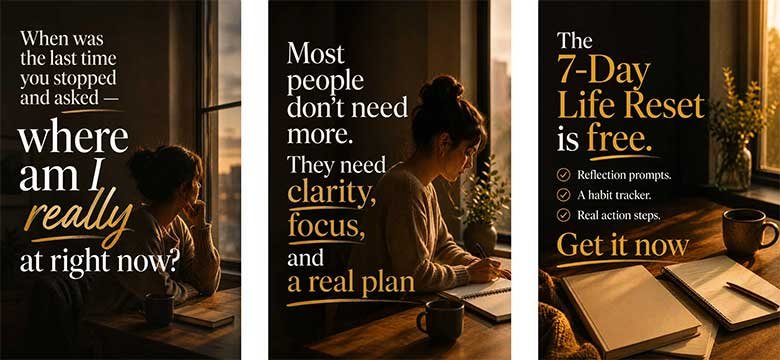
Reset Your Habits and Start Rebuilding Your Confidence and Self-Trust This Week
The free 7-Day Life Reset gives you a simple daily plan to break the patterns that are eroding your self-belief and build the daily habits that help you gradually rebuild trust in yourself and your own capability.
Get the Free Reset Guide10. “You do not need everyone’s approval to trust your own decisions. You need enough self-respect to make them thoughtfully and enough resilience to live with the outcome either way.”
Waiting for universal or near-universal approval before trusting your own decisions is waiting for a condition that almost never arrives for any decision significant enough to matter. Genuine self-trust does not depend on external consensus. It depends on the honest, thoughtful process behind the decision and the willingness to take responsibility for the outcome, whatever it turns out to be, without requiring everyone else’s validation along the way.
Notice the decisions you are currently delaying while waiting for broader approval that may never fully arrive. Consider what it would look like to make the decision from your own thoughtful process instead, trusting your own reasoning enough to act without the universal consensus that was never actually a realistic requirement in the first place.
11. “The you who is rebuilding trust in yourself right now is not behind schedule. There is no schedule. There is only the next honest step, taken today, exactly where you are.”
The comparison to where you feel you should be by now — more confident, further along, more recovered — is one of the more common obstacles to the actual, gradual work of rebuilding trust in yourself. There is no genuine external schedule this process is supposed to follow. There is only the actual pace at which it is genuinely happening for you, and that pace, however it compares to an imagined timeline, is the only one that is actually real.
Release the comparison to an imagined schedule and return attention to the next honest, small step available to you today. That step, taken from exactly where you currently are, is the actual work of rebuilding self-trust. It has always been the entire process — not a race against an imagined timeline, but a series of honest steps, taken one at a time, for exactly as long as they are needed.
“Trusting yourself again is not a single decision you make once. It is a practice, returned to daily, through small honest steps that gradually rebuild the evidence that you are more capable than the doubt currently allows you to believe.”
Explore Our Top Picks for a Better Life
We have gathered the best tools, resources, and products to help you rebuild your confidence, quiet your inner critic, and develop the genuine daily self-trust that makes every part of your life feel more navigable. All in one place, hand-picked just for you.
See Our Top PicksReal Stories, Real Results
Kezia had lost confidence gradually, over a series of setbacks that individually seemed manageable but that had accumulated into a persistent sense that she could no longer trust her own judgment about much of anything. She found herself second-guessing decisions she would have made easily a few years earlier, deferring to others on matters she was genuinely capable of handling herself. The shift began with a single small practice: keeping a written list of small promises made to herself and honoring every single one, however minor. Drink water before coffee. Take the walk she said she would take. Reply to the email she had been avoiding. None of these were significant individually. The accumulated evidence of a month of kept small promises produced something she had not expected — a quiet, growing sense that her word to herself actually meant something again. She said the confidence had not returned through any single breakthrough. It had returned the same way it had left: gradually, through a pattern repeated enough times that the pattern itself became the new evidence her inner life was operating from.
Daniel had a specific area where his confidence had collapsed almost entirely — public speaking, after a presentation that had gone badly enough to leave a lasting impression that shaped every subsequent opportunity he avoided rather than pursued. He did not try to rebuild the confidence through a single bold reentry into public speaking. He started smaller: speaking up in a small team meeting where the stakes were genuinely low. Then a slightly larger meeting. Then a short presentation to a small, familiar group. Each step was small enough to be survivable and large enough to produce genuine evidence. Over the better part of a year, the accumulated evidence rebuilt something that no single confidence-boosting pep talk had managed to produce in the immediate aftermath of the original difficult experience. He said the lesson had been about patience with the actual pace required rather than the pace he wished were available. The confidence came back at the speed the evidence could actually support, not any faster.
Trusting Yourself Again Is a Practice, Not a Single Decision
Every quote in this article points toward the same underlying truth: confidence and self-trust are not fixed traits you either have or lack permanently. They are built and rebuilt through consistent, honest practice — the small kept promises, the willingness to act before the feeling fully arrives, the deliberate remembering of your own already-demonstrated capacity to handle hard things.
Choose one quote from this list that speaks most directly to where your confidence currently needs rebuilding and let it guide one small action today. Download the free Self-Care Starter Kit to build the daily foundation of self-care and self-respect that supports the gradual return of genuine trust in yourself. You are more capable than the current doubt allows you to believe. Begin proving it to yourself again, one small step at a time.

Build the Daily Practice That Helps Your Confidence Grow Back Stronger
The free Self-Care Starter Kit gives you simple, practical tools to build a daily routine that nurtures your self-belief, quiets the inner critic, and gives your confidence the consistent daily foundation it needs to genuinely rebuild.
Download Free Now
Surround Yourself With What Reminds You of Your Own Strength
Premier Print Works makes quality prints, mugs, and shirts for people who are rebuilding their confidence and want the daily reminder of their own capability. Browse the collection and find what speaks to the trust you are rebuilding in yourself today.
Visit Premier Print WorksDisclaimer
The content on this page is for informational and inspirational purposes only. It is not professional mental health, counseling, or personal advice of any kind. If you are experiencing significant or persistent difficulty with self-esteem or confidence, please consider seeking support from a qualified mental health professional. Results and experiences vary significantly from person to person.
The stories of Kezia and Daniel are illustrative composite characters created to bring the content to life. They are not real people. Any resemblance to a real person is purely coincidental.
Some links on this page, including links to Premier Print Works and other resources, are affiliate links. If you make a purchase through one of these links, we may earn a small commission at no extra cost to you. We only recommend things we genuinely believe in.
If you are in crisis, please contact emergency services or a crisis helpline in your area immediately. You are not alone and help is available.
All content on A Self Help Hub is protected by copyright. It may not be copied, republished, or distributed without written permission from the author.