9 Mindfulness Quotes That Inspire Better Daily Habits
Mindfulness is easy to admire in theory and surprisingly hard to practice on an ordinary Tuesday, when the mind is already three tasks ahead of the body and the present moment feels like something to get through rather than something to notice. A good quote will not fix that on its own, but it can interrupt the momentum for just long enough to ask a different question — not what is next, but what is actually happening right now.
The nine reflections below are built to do exactly that. Each one pairs a short idea worth sitting with alongside a daily habit that turns the idea into something you can actually practice, rather than something you only agree with.

Build the Daily Practice That Turns Mindfulness Into a Habit
Download the free Self-Care Starter Kit and get simple, practical tools for building a daily rhythm of presence and calm, one small habit at a time.
Get the Free Starter Kit1. Presence is not something you find once. It is something you keep choosing, one ordinary moment at a time.
“You do not arrive at presence and stay there. You return to it, again and again, every time your attention wanders off without you noticing.”
The idea that mindfulness is a permanent state, once achieved, sets people up to feel like they are failing every time their mind drifts — which it will, constantly, because that is simply what minds do. The more useful frame is that presence is a habit of returning, not a destination you reach and then keep. Every return counts, even the hundredth one in a single afternoon.
Build one small cue into your day — a doorway, a red light, the first sip of coffee — that reminds you to notice where your attention actually is. The cue does not need to be dramatic. It only needs to be consistent.
2. The quality of your attention shapes the quality of your day far more than the number of things you get done.
“A full attention on one thing will always feel better than a divided attention on five.”
Busyness and presence are often mistaken for each other, but they pull in opposite directions. A day spent half-attending to many things tends to feel rushed and unsatisfying, even when a great deal technically got accomplished. A day spent fully attending to fewer things tends to feel calmer, even when the total output is smaller.
Choose one task today and give it your genuinely full attention, closing the tabs and putting down the phone for that window of time. Notice how different the same task feels when it has your whole focus instead of a fraction of it.

Surround Yourself With What Supports Your Daily Mindfulness Practice
Premier Print Works creates quality prints, mugs, and shirts for people who are building the small daily habits that support a calmer, more present life. Find what speaks to your journey today.
Visit Premier Print Works3. The breath is always available, which is exactly why it is one of the most reliable ways back to the present moment.
“You cannot control most of what happens in a day. You can almost always control one slow breath.”
Most sources of stress are, at least in the moment, outside of direct control — the delayed meeting, the unexpected bill, the difficult conversation. The breath is one of the few things that remains available regardless of what else is happening, and it has the unusual property of directly influencing the nervous system’s stress response simply by slowing down.
When a moment starts to feel overwhelming today, take three slow breaths before doing anything else. This tiny pause does not solve the underlying problem, but it changes the state you meet it from.
4. Gratitude is not about pretending things are fine. It is about noticing what is also true alongside the difficulty.
“A hard week and a good cup of coffee can both be true on the same Tuesday.”
Gratitude gets misunderstood sometimes as a kind of forced positivity that denies real difficulty, which is not what it is at its best. Genuine gratitude does not erase the hard parts of a day. It simply widens the frame enough to notice that the hard parts are not the whole picture, even on the days when they feel like they are.
Name one small, specific thing you are genuinely glad for today, even in the middle of a difficult stretch. This is not about denying the difficulty — it is about refusing to let it be the only thing you notice.
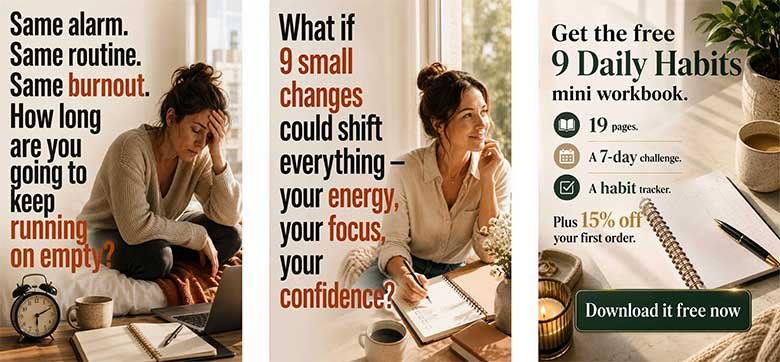
Build the Morning Habits That Make Mindfulness Automatic
The free 9 Daily Habits guide gives you nine simple morning practices that build the daily clarity and presence these quotes are pointing toward.
Get the Free Guide5. Most suffering lives in the replay of the past or the rehearsal of the future, not in the moment actually in front of you.
“The present moment is rarely as heavy as the one you are remembering or the one you are dreading.”
A striking amount of daily distress comes not from what is happening right now but from mentally replaying a past conversation or rehearsing a future one that has not happened yet. The present moment, examined honestly and on its own, is very often more manageable than the mental loop layered on top of it.
When you notice yourself replaying or rehearsing today, gently ask what is actually true right now, in this specific moment. The answer is often more peaceful than the loop suggested.
6. A quiet mind is not an empty mind. It is a mind that has stopped arguing with what is already true.
“Peace is not the absence of thought. It is the absence of resistance to what already is.”
Mindfulness is sometimes misunderstood as a demand to stop thinking altogether, which is neither realistic nor actually the goal. A quieter mind is not a blank one — it is one that has stopped fighting against the facts of the present moment and started simply working with them instead.
Practice naming one thing you are currently resisting — a delay, a decision, a feeling — and simply acknowledging it as true for now, without immediately trying to fix or escape it. Notice whether the resistance itself, once named, loosens a little.
7. Small, repeated moments of attention change a life more reliably than occasional, dramatic ones.
“A minute of real presence, repeated daily, will outlast a single perfect hour of it.”
There is a temptation to treat mindfulness as something that requires a significant block of uninterrupted time — a retreat, a long meditation session, a quiet weekend. In practice, brief and consistent moments of attention, repeated daily, tend to shape a life more reliably than rare and dramatic ones, simply because consistency compounds in a way that occasional effort does not.
Choose one minute today — brushing your teeth, waiting for the kettle, walking to the car — and give it your full, undivided attention. One genuine minute, repeated daily, is a real practice.
8. Compassion toward yourself is not indulgence. It is what makes honest self-reflection possible in the first place.
“You will look at your own mistakes more clearly with kindness than you ever will with judgment.”
Harsh self-judgment feels, to many people, like the responsible response to a mistake, but it tends to produce defensiveness and avoidance rather than genuine reflection. A measure of self-compassion, offered honestly rather than as an excuse, tends to create the safety needed to actually look at what happened and learn something useful from it.
The next time you notice yourself making a mistake, try offering yourself the same tone you would offer a friend in the same situation. Notice whether that tone makes it easier, not harder, to see clearly.
9. The habits that matter most rarely look impressive from the outside. They simply get repeated.
“Nobody notices the breath you took before responding calmly. That is exactly why it works.”
The most meaningful mindfulness habits are frequently invisible to everyone but the person practicing them — the pause before a reaction, the breath before a difficult reply, the moment of noticing instead of reacting on autopilot. None of it looks dramatic from the outside, and none of it needs to, because its value is measured in the life it quietly shapes, not in how visible it is to anyone else.
Pick one small, invisible habit from this list and commit to it for the next seven days. Its value will not be obvious to anyone watching. It will be obvious to you.
Explore Our Top Picks for a Better Life
We have gathered the tools, resources, and products we think are genuinely worth your time — covering mindfulness, mindset, health, and home. All in one place, hand-picked to support the daily habits behind these quotes.
See Our Top PicksReal Stories, Real Results
Amara used to read quotes about presence and feel a familiar mix of agreement and helplessness, nodding along without any real sense of how to translate the idea into an actual Tuesday. What shifted things was choosing just one — the line about the breath always being available — and deciding to test it literally, three slow breaths, every time a moment started to feel like too much. The first week felt mechanical, something she had to consciously remember rather than something that came naturally. By the third week, she noticed she was doing it without deciding to, in the middle of a tense phone call, before she had even registered how tense she was. She said the quote had not changed anything by itself. The daily repetition of the one small habit behind it had.
Joel had always assumed mindfulness required a kind of stillness he did not have access to, given how much of his day was spent moving between tasks with barely a pause. The idea that reframed things for him was the one about small, repeated moments outperforming rare, dramatic ones. He picked the walk from his car to his office door — less than a minute, most days — and decided that minute would be fully his, no phone, no rehearsing the day ahead. Months later, that one minute had become the most reliable part of his day, the place he reset before everything else began. He said it had taken him a long time to believe that something so small could matter, and longer still to notice that it was the thing actually holding the rest of his day together.
Mindfulness Is Built Quote by Quote, Habit by Habit
Each reflection in this article points toward the same underlying idea from a slightly different angle — that presence is not a state you achieve once, but a habit you keep choosing, in small and often invisible ways, throughout an ordinary day. None of these ideas require a retreat or a dramatic life change to practice.
Choose the one quote and habit that spoke to you most directly, and give it a real week before moving to the next. Download the free Self-Care Starter Kit to give this practice a consistent daily structure to build from. A calmer, more present life is built this way — one small return at a time.

Ready to Build Your Own Mindfulness Practice?
The free Self-Care Starter Kit gives you simple, practical tools to turn these ideas into a daily rhythm of presence and calm, one small habit at a time.
Download Free Now
Fill Your Space With What Supports Your Mindfulness Practice
Premier Print Works makes quality prints, mugs, and shirts for people building a calmer, more present daily life. Browse the collection and find what speaks to your journey today.
Visit Premier Print WorksDisclaimer
The content on this page is for informational and inspirational purposes only. It is not professional mental health or medical advice of any kind. If you are experiencing significant or persistent stress, anxiety, or other mental health challenges, please consider seeking support from a qualified mental health professional. Results and experiences vary significantly from person to person.
The quotes in this article are original reflections written for A Self Help Hub and are not attributed to any real person. The stories of Amara and Joel are illustrative composite characters created to bring the content to life. They are not real people. Any resemblance to a real person is purely coincidental.
Some links on this page, including links to Premier Print Works and other resources, are affiliate links. If you make a purchase through one of these links, we may earn a small commission at no extra cost to you. We do not own, produce, or control any affiliate products, and we are not responsible for them — we only own and sell the products offered through our own store, Premier Print Works.
All content on A Self Help Hub is the property of Digital Marketing 215 LLC and is protected by copyright law. No part of this page may be copied, reproduced, republished, distributed, or transmitted in any form without prior written permission from the author.