17 Quotes for Motivation and Inspiration That Help You Build Inner Strength
Inner strength is easy to admire from a distance and considerably harder to locate in the actual moment it is needed most — the tired evening, the setback that arrived without warning, the stretch where everything feels heavier than it should. A quote will not manufacture strength out of nothing, but the right reframe, held onto at the right moment, can be enough to keep a person upright until their own steadiness returns.
The seventeen reflections below are written for exactly those harder moments. Each one offers a different honest angle on inner strength, not as a permanent trait but as something built and rebuilt, moment by moment, through how a person meets what is actually in front of them.

Build the Daily Habits Behind Genuine Inner Strength
Download the free 9 Daily Habits guide and get nine simple morning practices that build the daily foundation these reflections are meant to support.
Get the Free Guide1. Inner strength is not the absence of struggle. It is what continues showing up inside the struggle anyway.
“Strength was never about feeling unshaken. It was about staying present while shaken.”
Inner strength is sometimes imagined as a kind of emotional invulnerability, a state where difficulty simply stops landing, which sets an unreachable standard that no one actually meets. Genuine strength looks less like invulnerability and more like continued presence through something genuinely difficult, which is both more honest and considerably more achievable.
The next time you feel shaken by something difficult, remember that staying present through it is itself the strength, not a failure to feel unshaken.
2. You have already survived every difficult day you have lived through so far, which is worth remembering on the next one.
“Every hard day you have gotten through is quiet proof about the one you are in now.”
A current difficult stretch can feel uniquely unmanageable in the moment, overshadowing the plain fact that every previous difficult stretch was also survived, one way or another. This track record, though easy to overlook while inside a new difficulty, is genuine evidence worth remembering rather than dismissing.
The next time a difficult day feels unmanageable, remind yourself of the track record of every difficult day you have already gotten through.

Surround Yourself With What Supports Your Inner Strength
Premier Print Works creates quality prints, mugs, and shirts for people who are building the daily habits that support genuine, lasting inner strength. Find what speaks to your journey today.
Visit Premier Print Works3. Strength does not require doing everything. It only requires doing the next small thing in front of you.
“You do not need the strength for the whole mountain. You only need enough for the next step.”
A difficulty viewed in its entirety, all at once, can feel like it requires an amount of strength no one genuinely has available, while the same difficulty broken into its next single step requires something far more manageable. Focusing strength on the next step alone, rather than the entire remaining distance, makes continued movement genuinely possible.
The next time a challenge feels too large to face all at once, focus your strength only on the next single step in front of you.
4. Asking for help is not a departure from strength. It is one of the clearer expressions of it.
“It takes more strength to say I cannot do this alone than to quietly struggle and call it independence.”
A common but limiting belief equates strength with never needing help, which frequently leads to unnecessary, prolonged struggle carried entirely alone out of a fear that asking would reveal weakness. In reality, the willingness to ask for help, honestly and directly, requires its own genuine courage and reflects strength rather than its absence.
The next time you are struggling alone, consider that asking for help is itself an expression of strength, not evidence against it.
“Inspiration gets you started. Inner strength is what keeps you going once inspiration has quietly left the room.”
Get Clear on the Inner Strength You Are Actually Building
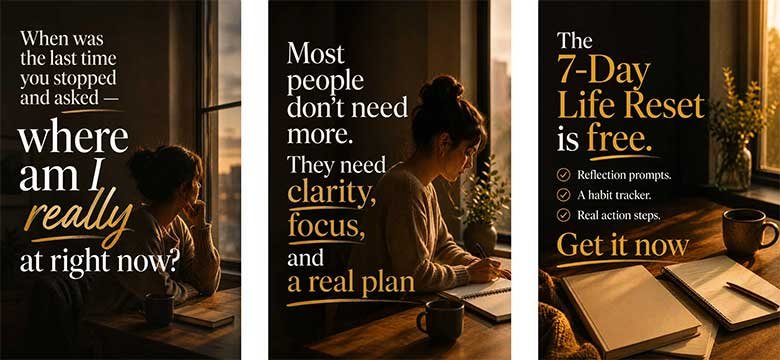
The free 7-Day Life Reset gives you one short prompt a day for a week, helping you get honest about the strength you are already building, day by day.
Start the Free Reset5. Tears and strength are not opposites. Feeling something fully and still showing up is what strength actually looks like.
“Strength was never about not crying. It was about crying and still getting up anyway.”
A common but inaccurate belief treats visible emotion as evidence of weakness, which pushes people toward suppressing genuine feeling rather than allowing it, even though suppression tends to cost more in the long run than honest expression does. Feeling something fully, including grief or fear, while still continuing to show up, is a more accurate and more sustainable picture of what genuine strength looks like.
The next time you feel something difficult fully, remind yourself that the feeling and your continued strength are not actually in conflict.
6. You are allowed to be strong and still have a hard day at the exact same time.
“A hard day does not cancel out the strength that got you to it.”
A single hard day can feel like it disproves an entire pattern of genuine strength, as though one difficult moment retroactively erases everything that came before it, when the two are actually fully compatible rather than mutually exclusive. A hard day and genuine underlying strength can be true at the exact same time.
The next time a hard day makes you doubt your own strength, remind yourself the two are not actually in conflict.
7. The strength you are building right now will not feel obvious until you actually need to use it.
“You will not feel the strength you are building today until the day it is finally called on.”
Inner strength being built gradually, through ordinary difficult moments, often feels invisible in the moment it is actually forming, and its presence only becomes clear later, when a genuinely hard moment arrives and the built strength turns out to be there. This delayed visibility can make the ongoing building process feel discouragingly unproductive, even while genuine capacity accumulates underneath.
Trust that the strength you are building through today’s difficulty may not feel obvious yet, but will be there when it is genuinely needed.
8. Comparing your visible struggle to someone else’s hidden one will always feel unfair, because it is.
“You are comparing your hardest moment to someone else’s best-edited one.”
What is visible of other people’s inner strength is almost always a curated, later-stage version, while your own struggle is experienced in full, including every uncertain and difficult part that never makes it into anyone else’s visible presentation. This mismatched comparison reliably makes your own struggle feel worse by comparison, simply because the comparison was never fair to begin with.
The next time you compare your visible struggle to someone else’s apparent strength, remember you are likely comparing your full reality to their edited version.
9. Rest is not a departure from strength. It is one of the things that actually makes continued strength possible.
“Strength that never rests eventually has nothing left to draw on.”
Strength pushed continuously, with no genuine rest, eventually depletes the very capacity it depends on, which means rest functions not as a departure from strength but as one of the conditions that allows it to continue at all. Treating rest as essential, rather than as a weakness, protects the strength that depends on it.
The next time you feel guilty for resting, remember that rest is part of what makes your continued strength genuinely possible.
10. What broke you open once does not have to be what defines you permanently.
“A difficult chapter is not the same thing as the whole book.”
A significant difficulty can feel, in the moment, like it will permanently define an entire identity, when a longer, more honest view usually shows that even the most difficult chapters eventually become one part of a much longer, still-unfolding story. Holding onto this longer view protects a genuine sense of self from being permanently defined by any single hard chapter.
The next time a difficult experience threatens to feel like your permanent identity, remind yourself it is one chapter, not the entire book.
11. Strength built through genuine difficulty tends to be more durable than strength that has never actually been tested.
“Untested strength is a theory. Tested strength is something you actually know you have.”
Strength that has never faced genuine difficulty remains, in a sense, theoretical — assumed to exist but never actually confirmed — while strength that has survived a real test becomes something known with certainty rather than merely hoped for. This distinction offers a different, more hopeful way to view a current difficulty, as the very thing that will confirm a strength otherwise left theoretical.
Consider that your current difficulty, however unwelcome, may be exactly what confirms a strength you have only theoretically had until now.
12. You do not need to feel inspired to keep going. Inner strength is what carries you on the days inspiration does not show up.
“Inspiration is a visitor. Strength is what stays after it leaves.”
Inspiration is a genuinely unreliable, intermittent visitor, arriving and leaving on its own schedule regardless of what is actually needed, while inner strength is capable of carrying continued effort during exactly the stretches inspiration has gone quiet. Relying on strength rather than waiting for inspiration produces a far more consistent foundation for continued movement.
The next time inspiration feels absent, lean on your inner strength instead, and notice that it is capable of carrying you without it.
13. Strength is not a fixed amount you either have enough of or do not. It grows specifically through the moments that ask for it.
“You do not run out of strength by using it. You grow more of it, the same way a muscle does.”
Strength is sometimes imagined as a fixed, depletable reserve, used up gradually until nothing is left, when it more closely resembles a capacity that actually grows through the specific moments that call for it, much like a muscle strengthened through repeated use rather than worn down by it. Trusting this growth-based model changes how a difficult moment gets interpreted — not as draining a limited reserve, but as building a larger one.
The next time a difficult moment calls for strength, remember it is building your capacity, not simply draining a fixed and limited reserve.
14. You are allowed to acknowledge how hard something has been without that acknowledgment undoing your strength.
“Naming the difficulty honestly does not make you weaker. It makes the strength that follows more real.”
A belief that acknowledging genuine difficulty undermines strength discourages honest acknowledgment altogether, which tends to produce a brittle, denial-based version of strength rather than a genuine, resilient one. Honestly naming how hard something has actually been, rather than minimizing it, makes the strength that follows more real and more sustainable.
Name honestly how hard your current difficulty has actually been, without treating that honesty as undoing any of your strength.
15. The strength to begin again after a setback is often greater than the strength it took to start the first time.
“Starting again after falling asks more of you than starting ever did the first time.”
The first attempt at something difficult carries the energy of genuine novelty and hope, while starting again after a setback requires continuing without that same fresh energy, which makes the second start genuinely more demanding in its own way. Recognizing this makes a second, third, or tenth start feel like the significant achievement it actually is, rather than a lesser effort than the original.
If you are starting again after a setback, recognize that this restart genuinely asks more of your strength than the original start did.
16. Inner strength does not always look dramatic. Sometimes it looks exactly like an ordinary day, quietly gotten through.
“Nobody applauds the ordinary day someone simply got through. That does not make it less of an achievement.”
Genuine inner strength is frequently expressed in undramatic, unremarkable ways — simply making it through an ordinary difficult day — which means it often goes entirely unrecognized, even by the person demonstrating it, since it does not resemble the more dramatic version of strength usually celebrated. Recognizing this undramatic version as genuine strength allows it to be acknowledged rather than dismissed.
Acknowledge one ordinary day you simply got through as a genuine expression of strength, even though it looked undramatic.
17. Building inner strength is a lifelong, ongoing practice, not a destination you eventually finish arriving at.
“You do not finish building strength. You simply keep building it, for as long as life keeps asking.”
Inner strength is sometimes imagined as a finish line eventually reached, after which difficulty stops requiring any further effort, but a more honest view treats it as an ongoing, lifelong practice, continually rebuilt through each new difficulty that life presents. Accepting this ongoing nature removes the discouragement of feeling like the work should have already been finished by now.
Accept that building your own inner strength is an ongoing, lifelong practice, rather than a destination you should have already reached.
Explore Our Top Picks for a Better Life
We have gathered the tools, resources, and products we think are genuinely worth your time — covering mindset, habits, health, and home. All in one place, hand-picked to support the strength behind these reflections.
See Our Top PicksReal Stories, Real Results
Amara had gone through a genuinely difficult year and had spent much of it feeling like her visible struggle was proof she lacked the same strength other people seemed to display so effortlessly. The reflection about comparing her full, unedited reality to other people’s curated presentation was the one that finally cracked something open for her, revealing how unfair that comparison had actually been the entire time. She said she had never stopped struggling because the reflection told her to. She had simply stopped assuming the struggle meant she lacked what other people apparently had.
Joel had always assumed that asking for help was a quiet admission of weakness, which meant he had carried several genuinely difficult stretches entirely alone, well past the point it had stopped being sustainable. The reframe that asking for help is itself an expression of strength, not evidence against it, was uncomfortable to accept at first, but it eventually gave him permission to reach out during a stretch he would have previously white-knuckled through alone. He said the help itself had mattered less than finally believing he was allowed to ask for it.
Inner Strength Is Built Reflection by Reflection, Not Moment by Moment
Each reflection in this article challenges a different misconception about what genuine inner strength actually looks like — the invulnerability myth, the belief that rest undermines it, the assumption that asking for help is weakness. None of these require strength to already be present before they can help.
Choose the one or two reflections that speak most directly to your own current struggle, and return to them the next time strength feels hard to find. Download the free 9 Daily Habits guide to give this ongoing practice a consistent daily foundation to build from. Inner strength is built quietly, moment by moment, through exactly the difficulties that ask for it.

Ready to Build the Habits Behind Your Own Inner Strength?
The free 9 Daily Habits guide walks you through nine simple morning practices that build the daily foundation these reflections are meant to support.
Download Free Now
Fill Your Space With What Supports Your Inner Strength
Premier Print Works makes quality prints, mugs, and shirts for people building genuine, lasting inner strength. Browse the collection and find what speaks to your journey today.
Visit Premier Print WorksDisclaimer
The content on this page is for informational and inspirational purposes only. It is not professional mental health or medical advice of any kind. If you are experiencing significant or persistent stress, grief, or other mental health challenges, please consider seeking support from a qualified mental health professional. Results and experiences vary significantly from person to person.
The quotes in this article are original reflections written for A Self Help Hub and are not attributed to any real person. The stories of Amara and Joel are illustrative composite characters created to bring the content to life. They are not real people. Any resemblance to a real person is purely coincidental.
Some links on this page, including links to Premier Print Works and other resources, are affiliate links. If you make a purchase through one of these links, we may earn a small commission at no extra cost to you. We do not own, produce, or control any affiliate products, and we are not responsible for them — we only own and sell the products offered through our own store, Premier Print Works.
All content on A Self Help Hub is the property of Digital Marketing 215 LLC and is protected by copyright law. No part of this page may be copied, reproduced, republished, distributed, or transmitted in any form without prior written permission from the author.