17 Emotional Support Ideas That Help You Feel More Centered
Feeling centered does not mean feeling calm all the time or having every emotion resolved. It is closer to having a steady baseline to return to, even in the middle of a genuinely unsteady stretch — a sense that whatever is happening, there is still solid ground somewhere underneath it. That baseline is built through a range of different supports, since no single practice covers every source of unsteadiness on its own.
The seventeen ideas below draw from several different angles — physical, relational, mental, and environmental — to build a more complete kind of emotional support. Try a few and notice which ones actually help you find your own footing.

Build the Daily Practice That Helps You Feel Centered
Download the free Self-Care Starter Kit and get simple, practical tools for building a daily rhythm that supports a steadier emotional baseline.
Get the Free Starter Kit1. Name what you are actually feeling before trying to fix or change anything about it.
A vague, unnamed sense of being off-center is harder to work with than a specifically identified feeling, since precision allows a more accurate, more effective response to follow. Pausing to name the specific feeling, before jumping to fix or change it, is often the first genuine step back toward feeling grounded.
The next time you feel off-center, pause to name the specific feeling before deciding what, if anything, to do about it.
2. Reach out to one person who reliably makes you feel steadier, even for a brief conversation.
Isolation quietly amplifies a sense of being ungrounded, particularly during a stretch that already feels unsteady, while a brief, genuine conversation with someone who reliably has a grounding effect often restores a sense of centeredness that solitary effort alone struggles to produce.
Reach out to one person today who reliably makes you feel steadier, even for a short conversation.

Surround Yourself With What Supports Feeling Centered
Premier Print Works creates quality prints, mugs, and shirts for people who are building the daily habits that support a steadier emotional baseline. Find what speaks to your journey today.
Visit Premier Print Works3. Practice slow, deliberate breathing for a few minutes, using the body’s own regulatory response to support a calmer state.
Slow, deliberate breathing has a genuine, physiological calming effect on the nervous system, offering a direct route back toward a steadier state that pure mental effort alone often cannot achieve as reliably. A few minutes of this practice, done consistently, becomes a genuinely useful tool during unsteady moments.
Practice a few minutes of slow, deliberate breathing today, and notice whether it shifts your overall sense of steadiness.
4. Return to a simple, familiar routine, since predictability itself can be a genuine source of stability during an unsteady stretch.
An unsteady emotional period often coincides with a disrupted routine, and the unpredictability itself, independent of the original source of distress, adds to the overall sense of being ungrounded. Returning to a simple, familiar routine restores a genuine sense of predictability that supports feeling centered again.
Identify one simple, familiar routine you could return to this week, and use it specifically as a source of stability.
“Feeling centered is not the absence of a storm. It is knowing where your own solid ground still is.”
Build the Morning Habits That Support Feeling Centered
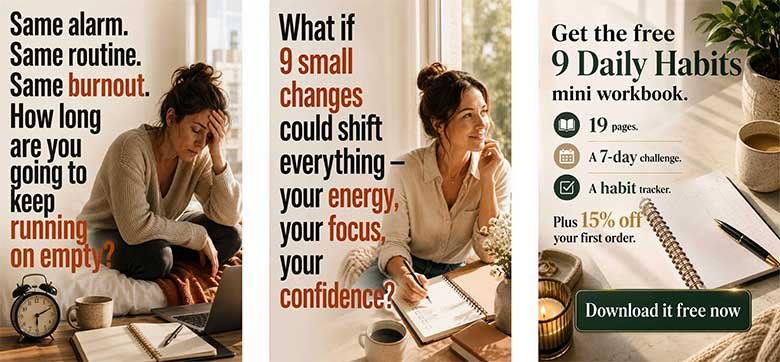
The free 9 Daily Habits guide gives you nine simple morning practices that build the daily foundation these emotional support ideas are meant to support.
Get the Free Guide5. Get outside for a short walk, letting a change of physical environment support a change in emotional state.
A physical environment can quietly reinforce a difficult emotional state, and stepping outside for even a short walk introduces a genuine change of environment that tends to support a corresponding shift in emotional state, often more effectively than staying in the same space and trying to think your way out of it.
Take a short walk outside today, specifically to introduce a change of environment that might support a calmer emotional state.
6. Write down what is actually within your control right now, separating it clearly from what is not.
Feeling ungrounded frequently involves a blurred sense of what is actually controllable versus what genuinely is not, and this blur adds a layer of unnecessary distress on top of whatever the original difficulty is. Writing a clear, honest list of what is actually within your control right now restores a sense of agency that the blur had obscured.
Write down what is genuinely within your control right now, separating it clearly from what is not, and focus your energy accordingly.
7. Practice a brief body scan, noticing and releasing physical tension you may not have realized you were holding.
Physical tension frequently accumulates without conscious awareness during an unsteady emotional stretch, and this unnoticed tension continues quietly demanding energy until it is deliberately noticed and released. A brief body scan surfaces and releases this tension directly, supporting a more genuinely centered physical and emotional state.
Spend a few minutes today doing a slow body scan, noticing and consciously releasing any tension you find along the way.
8. Limit your exposure to sources of additional stress while you are already feeling ungrounded, protecting your limited capacity.
An already limited emotional capacity gets stretched further by continued exposure to additional, avoidable sources of stress, even during a period specifically calling for stabilization rather than further depletion. Deliberately limiting exposure to avoidable stress while already unsteady protects the limited capacity available to actually stabilize.
Identify one avoidable source of additional stress, and limit your exposure to it while you are working on feeling more centered.
9. Do one small, completable task, using the sense of genuine completion to counter a broader feeling of being unmoored.
A broader sense of being unmoored can make even small, completable tasks feel pointless, but completing one small task anyway provides a genuine, concrete sense of accomplishment that counters the larger feeling of drift, even without resolving the underlying source of that drift.
Choose one small, completable task today, and notice whether finishing it provides a genuine, if modest, sense of being more grounded.
10. Practice grounding through your senses, naming something you notice through sight, sound, touch, smell, and taste.
A racing or unsteady mind is frequently absorbed in either the past or the future, and the five senses are among the most reliable tools for pulling attention back into the actual present moment, since sensory input can only ever happen right now. This practice walks attention deliberately back into the present.
The next time you feel scattered or unsteady, name one thing you notice through each of your five senses, one at a time.
11. Protect a consistent sleep schedule, since sleep deprivation directly undermines your ability to feel centered regardless of anything else.
Sleep deprivation does not just cause tiredness — it directly undermines emotional regulation, making the same set of circumstances feel considerably harder to manage on insufficient sleep than on adequate rest. Protecting a consistent sleep schedule is one of the more foundational supports available for feeling genuinely centered.
Protect a consistent bedtime this week, treating it with the same seriousness as any other important commitment.
12. Reduce your information intake temporarily, since constant input can work against the sense of steadiness you are trying to build.
Constant exposure to news, social media, and other information streams adds continuously to the mental load being carried, and this ongoing load works directly against a genuine sense of feeling centered, particularly during an already unsteady stretch. Deliberately reducing this intake, even temporarily, removes a significant source of additional strain.
Reduce your information intake today, setting specific bounded times for it rather than allowing constant, unbounded exposure.
13. Write freely for a few minutes without editing, letting your thoughts move faster than your inner critic can catch up.
Writing that is immediately self-edited tends to stay tangled up with the same evaluative part of the mind that keeps an unsteady stretch feeling critical and judged. Writing continuously for a few minutes without pausing to edit outruns that inner critic, at least temporarily, producing a genuine mental release.
Set a timer for a few minutes today and write continuously about whatever comes to mind, without stopping to edit or correct anything.
14. Identify one value you can act from today, using it as an anchor when the rest of the day feels uncertain.
A day that feels uncertain in every direction can benefit from at least one clear, stable anchor point, and a genuinely held personal value, chosen deliberately, can serve exactly that role, giving the day at least one point of genuine clarity to act from even amid broader uncertainty.
Identify one value you can deliberately act from today, and let it serve as an anchor point during an otherwise uncertain day.
15. Practice self-compassion specifically for feeling ungrounded, rather than adding self-criticism on top of an already difficult stretch.
Self-criticism directed at feeling ungrounded in the first place tends to compound the difficulty rather than resolve it, adding a second layer of distress on top of the original one. Self-compassion, offered specifically for the experience of feeling unsteady, tends to produce a calmer, more genuinely centered response than criticism ever does.
The next time you notice yourself criticizing your own lack of steadiness, practice responding with compassion instead.
16. Build a simple closing ritual for the end of the day, marking a clear transition that allows genuine rest to actually begin.
A day with no genuine close bleeds into the evening, the mental activity of an unsteady day continuing to occupy attention well past the hours actually spent on it, which prevents the genuine rest that supports feeling centered again. A deliberate closing ritual marks a clear transition, allowing rest to actually begin.
Build a brief, consistent closing ritual for the end of today that marks a genuine transition into rest.
17. Revisit what actually helps you feel centered periodically, since the specific supports that work may shift as your life and circumstances change.
A specific set of centering practices adopted at one point can become less effective as genuine circumstances change over time, continuing to be practiced out of habit even after they have stopped providing the same support. Periodically revisiting what actually helps keeps the ongoing practice aligned with what genuinely supports feeling centered now.
Spend some time this month honestly reviewing what actually helps you feel centered, and consider whether any of your current practices deserve to be updated.
Explore Our Top Picks for a Better Life
We have gathered the tools, resources, and products we think are genuinely worth your time — covering emotional wellness, mindset, health, and home. All in one place, hand-picked to support the steadiness behind these ideas.
See Our Top PicksReal Stories, Real Results
Kezia had gone through a genuinely disruptive stretch that had thrown off nearly every part of her regular routine, and the lack of predictability, more than any single event, had left her feeling constantly off-balance. Deliberately returning to one small, familiar routine — the same morning coffee ritual she had let slip — gave her a specific, reliable anchor point in an otherwise unpredictable stretch. She said the routine itself had not solved anything about the underlying disruption. It had simply given her one steady thing to return to each day while everything else settled.
Daniel had always assumed that feeling ungrounded meant something had gone genuinely wrong that needed to be fixed immediately, which added a layer of urgency and self-criticism on top of an already unsteady stretch. Practicing self-compassion specifically for feeling unsteady, rather than criticizing himself for it, changed how quickly he was able to actually settle. He said the unsteadiness had never gone away faster because he was hard on himself about it. It had simply taken longer to pass while he was busy being critical too.
Feeling Centered Is Built Support by Support, Not All at Once
Each idea in this article offers a different kind of support for an unsteady stretch — physical, relational, mental, environmental. None of them require the underlying difficulty to already be resolved before they can help.
Choose two or three ideas that address where your own unsteadiness currently shows up most, and build them into your week. Download the free Self-Care Starter Kit to give this practice a consistent daily structure to build from. Feeling centered is built through a range of small, reliable supports, not a single fix.

Ready to Build Your Own Practice of Feeling Centered?
The free Self-Care Starter Kit gives you simple, practical tools to build a daily rhythm that supports a steadier emotional baseline, one small habit at a time.
Download Free Now
Fill Your Space With What Supports Feeling Centered
Premier Print Works makes quality prints, mugs, and shirts for people building a steadier, more grounded daily life. Browse the collection and find what speaks to your journey today.
Visit Premier Print WorksDisclaimer
The content on this page is for informational and inspirational purposes only. It is not professional mental health or medical advice of any kind. If you are experiencing significant or persistent emotional distress, anxiety, or other mental health challenges, please consider seeking support from a qualified mental health professional. Results and experiences vary significantly from person to person.
The stories of Kezia and Daniel are illustrative composite characters created to bring the content to life. They are not real people. Any resemblance to a real person is purely coincidental.
Some links on this page, including links to Premier Print Works and other resources, are affiliate links. If you make a purchase through one of these links, we may earn a small commission at no extra cost to you. We do not own, produce, or control any affiliate products, and we are not responsible for them — we only own and sell the products offered through our own store, Premier Print Works.
All content on A Self Help Hub is the property of Digital Marketing 215 LLC and is protected by copyright law. No part of this page may be copied, reproduced, republished, distributed, or transmitted in any form without prior written permission from the author.