11 Self Discipline Strategies That Actually Work
Most common advice about self-discipline amounts to trying harder through sheer willpower, a genuinely limited, depletable resource that predictably runs out, especially during exactly the moments discipline is actually needed most. Strategies that actually work build structure around that limitation, rather than pretending it does not exist.
The eleven strategies below succeed specifically where willpower-only advice consistently fails. Each one removes or restructures something, rather than simply demanding more effort from an already-limited resource.

Build the Daily Habits Behind Self Discipline That Actually Works
Download the free 9 Daily Habits guide and get nine simple morning practices that build the daily foundation this discipline rests on.
Get the Free Guide1. Remove a specific, tempting distraction from your physical environment entirely, rather than relying on willpower to resist it repeatedly.
A tempting distraction, left physically present and resisted repeatedly through willpower alone, drains that limited resource with each individual act of resistance, while actually removing the distraction from the environment eliminates the need for repeated resistance altogether. This specific strategy succeeds by removing the temptation, not by strengthening resolve against it.
Remove one specific, tempting distraction from your physical environment this week, rather than resisting it repeatedly.
2. Make the desired behavior the genuinely easier option by design, reducing the actual friction required to actually do it.
A desired behavior, requiring considerable effort or friction to actually begin, competes directly against limited willpower every single time, while deliberately reducing that friction — laying out the gym clothes, pre-chopping the vegetables — makes the desired behavior genuinely the easier, default option. This specific strategy succeeds by changing the actual effort required, not by demanding more resolve.
Reduce the actual friction of one desired behavior this week, making it genuinely the easier option by design.

Surround Yourself With What Supports Discipline That Actually Works
Premier Print Works creates quality prints, mugs, and shirts for people who are building the daily habits that support genuinely structural discipline. Find what speaks to your journey today.
Visit Premier Print Works3. Schedule the specific behavior for a specific time of day, removing the daily, repeated decision of exactly when to actually do it.
A behavior with no specific, scheduled time requires a fresh, in-the-moment decision each day about exactly when to actually do it, a repeated decision that a specific, fixed time directly removes, replacing daily deliberation with a standing, automatic slot instead. This specific strategy succeeds by removing a decision, not by strengthening the will to make it well.
Schedule your specific behavior for a specific, fixed time this week, removing the daily decision of exactly when.
“Most common advice about self-discipline amounts to trying harder through sheer willpower, a genuinely limited, depletable resource that predictably runs out.”
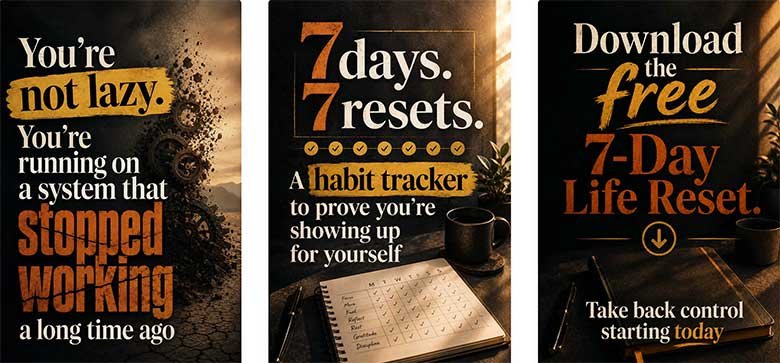
Get Clear on Where Your Own Discipline Genuinely Breaks Down
The free 7-Day Life Reset gives you one short prompt a day for a week, helping you get honest about where your own discipline genuinely breaks down.
Start the Free Reset4. Schedule genuinely demanding tasks earlier in the day, before willpower has actually been depleted by other, smaller decisions.
Willpower, genuinely depleted by a series of smaller decisions accumulated throughout a day, is considerably scarcer by the afternoon or evening than it was earlier, which means scheduling the most demanding task earlier directly captures willpower while it is still genuinely, abundantly available. This specific strategy succeeds by working with willpower’s actual, limited pattern, not against it.
Schedule your own most demanding task earlier in the day this week, before willpower has genuinely been depleted.
5. Use a specific, external commitment device — a scheduled class, a paid deposit — rather than relying on internal motivation alone to show up.
Internal motivation alone, relied on exclusively to actually show up for something, is genuinely inconsistent day to day, while a specific, external commitment device — a scheduled class, a non-refundable deposit — adds real, external stakes that do not depend entirely on that day’s internal motivation. This specific strategy succeeds by adding external structure, not by requiring stronger internal resolve.
Use one specific, external commitment device this month, rather than relying on internal motivation alone.
6. Pre-decide your response to a specific, predictable temptation in advance, rather than deciding fresh, under pressure, in the actual moment.
A decision made fresh, under pressure, in the actual moment a temptation arises, is considerably more likely to favor the temptation than the same decision genuinely made calmly, in advance. Pre-deciding your specific response ahead of time removes the need to actually decide well while under that in-the-moment pressure.
Pre-decide your response to one specific, predictable temptation this week, before it actually arises.
7. Track a specific, observable behavior visually, using the visible record itself to reinforce continued discipline, rather than relying on memory alone.
A specific behavior’s consistency, tracked only in memory, is genuinely harder to accurately assess than the same consistency made visible through an actual, visual record — a calendar, a checklist — that reinforces continued discipline through visible, accumulating evidence. This specific strategy succeeds by making progress concrete, not by asking memory to do more work.
Track one specific, observable behavior visually this week, using the visible record to reinforce continued discipline.
8. Reduce the specific number of decisions required around a recurring behavior, simplifying choices rather than strengthening resolve to choose well.
A recurring behavior, requiring a considerable number of small decisions each time it is actually performed, drains limited willpower through that repeated decision-making alone. Reducing the specific number of decisions required — a standard meal, a fixed outfit — directly conserves willpower for what actually requires it most.
Reduce the specific number of decisions required around one recurring behavior this week, simplifying the choice itself.
9. Recover deliberately after a specific lapse, rather than letting one missed day spiral into an extended, abandoned effort.
A single, specific lapse, treated as evidence the entire effort has genuinely failed, frequently spirals into a considerably longer, abandoned stretch than the original lapse itself actually warranted. Recovering deliberately, the very next opportunity, directly contains the lapse to a single, isolated instance rather than allowing it to spiral further.
Recover deliberately after your next specific lapse, containing it to a single instance rather than letting it spiral.
10. Pair a genuinely demanding behavior with something you already, genuinely enjoy, making the combined behavior easier to actually sustain.
A genuinely demanding behavior, performed entirely on its own with no accompanying enjoyment, competes directly against limited willpower each time it is actually attempted, while pairing it with something already, genuinely enjoyed makes the combined behavior considerably easier to sustain. This specific strategy succeeds by adding genuine reward, not by demanding more resolve to tolerate the difficulty alone.
Pair one genuinely demanding behavior this week with something you already, genuinely enjoy.
11. Revisit your own discipline strategies periodically, since a specific structure genuinely effective at one point can lose its effectiveness as circumstances change.
A specific discipline strategy, genuinely effective for a person at one point, can lose its effectiveness as circumstances genuinely change over time, which means periodically revisiting your own strategies keeps this practice genuinely aligned with what actually still works. This specific, periodic review protects the practice from continuing to rely on a structure that no longer genuinely fits.
Revisit your own discipline strategies this month, and adjust any that no longer genuinely work as well as they once did.
Explore Our Top Picks for a Better Life
We have gathered the tools, resources, and products we think are genuinely worth your time — covering mindset, habits, health, and home. All in one place, hand-picked to support the structure behind these strategies.
See Our Top PicksReal Stories, Real Results
Amara had always relied on willpower alone to resist a specific, tempting distraction that remained physically present in her own space, an approach that had depleted her resolve repeatedly throughout an ordinary day. Removing that distraction from her environment entirely for the first time, revealed how considerably less willpower she actually needed once the temptation itself was no longer physically present to resist. She said her repeated resistance had never actually felt like the problem to her. Compared against simply removing the distraction, though, how much unnecessary effort she had actually been spending became clear.
Joel had always treated a single, specific lapse in his own discipline as evidence the entire effort had genuinely failed, a pattern that had spiraled several past attempts into a considerably longer, abandoned stretch than the original lapse warranted. Recovering deliberately at the very next opportunity, for the first time, contained a lapse to a single, isolated instance rather than letting it spiral further. He said his past spirals had never actually felt disproportionate to him at the time. Compared against a contained, single lapse, though, how disproportionate they had actually been became clear.
Structure Works Where Willpower Alone Consistently Fails
Each strategy in this article removes or restructures something — the physical temptation, the daily decision, the friction required to begin. None of these simply demand more willpower from an already-limited, depletable resource.
Choose two or three strategies that address where your own discipline currently breaks down most, and build them in this week. Download the free 9 Daily Habits guide to give this structure a consistent daily foundation to build from. Strategies that actually work build structure around willpower’s genuine limitations, rather than pretending they do not exist.

Ready to Build the Habits Behind Discipline That Actually Works?
The free 9 Daily Habits guide walks you through nine simple morning practices that build the daily foundation this discipline rests on.
Download Free Now
Fill Your Space With What Supports Discipline That Actually Works
Premier Print Works makes quality prints, mugs, and shirts for people building genuine, structural discipline. Browse the collection and find what speaks to your journey today.
Visit Premier Print WorksDisclaimer
The content on this page is for informational and inspirational purposes only. It is not professional coaching, mental health, or medical advice of any kind. Results and experiences vary significantly from person to person.
The stories of Amara and Joel are illustrative composite characters created to bring the content to life. They are not real people. Any resemblance to a real person is purely coincidental.
Some links on this page, including links to Premier Print Works and other resources, are affiliate links. If you make a purchase through one of these links, we may earn a small commission at no extra cost to you. We do not own, produce, or control any affiliate products, and we are not responsible for them — we only own and sell the products offered through our own store, Premier Print Works.
All content on A Self Help Hub is the property of Digital Marketing 215 LLC and is protected by copyright law. No part of this page may be copied, reproduced, republished, distributed, or transmitted in any form without prior written permission from the author.