13 Budgeting Finances Ideas That Help You Track Every Dollar
Money is easy to lose track of when you can’t see it leave. A tap of a card, an automatic bill, a few dollars in cash, and it’s gone without a trace.
Researcher Dilip Soman looked at this problem in a 2001 paper in the Journal of Consumer Research. His starting point was simple. Past spending can hold back future spending, but only if you remember what you spent and feel the impact of it. In two experiments, he found that the way people paid changed both of those things. Past payments did more to reduce people’s intention to buy again when the payment method made them write down the amount they paid, and when the money left their wallet right away instead of later.
Put plainly, writing the amount down and feeling the money leave both seem to make past spending count. Some cautions, though. These were lab experiments about purchase intentions, not real budgets over a year. Later studies on cards and cash have had mixed results, so I don’t claim cash is better than cards. What I took from Soman is narrower and more useful: writing down amounts right away helps you remember your spending.
The 13 ideas below are about making every dollar visible. The first few come straight from that idea, and the rest are my own. I’ll flag which are which.

Give Every Dollar a Place on Paper
Grab my free Money Reset Workbook. It’s a good place to start writing your spending down.
Get the Free Workbook1. Write down the amount of every purchase
This is the center of Soman’s finding: requiring people to write down what they paid made past payments matter more. So do that. After you buy something, write the amount, even if it’s small.
Early on, I only tracked the big purchases and couldn’t figure out why the month disappeared. The small ones were the gap. Writing everything down takes seconds and shows you the whole picture.
Try this: For the next three days, write down every purchase and its amount, no matter how small.
2. Write it down right away, not at the end of the day
Soman’s research also pointed to immediacy, meaning how soon you feel the money leave. You can’t always control when a payment happens, but you can control when you record it. Do it right after you buy.
By the end of the day, you’ll forget a few purchases and guess at others. A quick note in the moment keeps your record accurate. The exact habit is my own, and it’s based on his idea.
Try this: Right after your next purchase, open your notes app and log the amount.

A Small Reminder to Notice Your Money
I make prints, mugs, and shirts at Premier Print Works. Some people like a reminder where they can see it.
Visit Premier Print Works3. Use one simple place for your records
Pick a single spot: a small notebook, a notes app, or a spreadsheet. Keep everything in it. If your records are scattered, you’ll give up.
I like a pocket notebook because it’s always with me. Others prefer an app. The tool isn’t the point. One place you’ll actually use is.
Try this: Choose your one tracking tool today and put it where you’ll see it.
Money you write down is money you remember spending.
4. Include the small stuff
A coffee, a snack, a parking meter. Small purchases are easy to ignore, and they add up. If you leave them out, your record won’t match your bank balance.
You don’t have to judge them. Just write them down. Seeing the total at the end of the week is often a surprise. That surprise is useful, and it’s my own experience.
Try this: Add every small purchase to your log this week and see what they add up to.
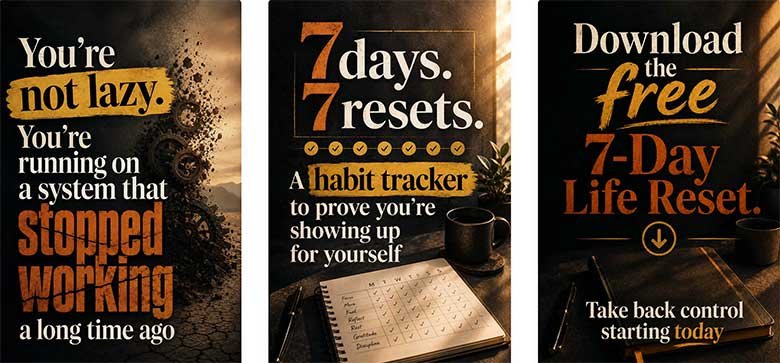
Take a Week to Notice Where Your Money Goes
My free 7-Day Life Reset is a short week of reflection on your own routines. It’s a good place to start seeing what gets in your way.
Start the Free Reset5. Include cash
Cash leaves no trail on your statement. A few bills here and there can vanish without a record. If you use cash, write those purchases down too.
Another option is to use cash less often, so more of your spending shows up automatically. Either way, don’t let cash be the gap in your tracking.
Try this: Jot down every cash purchase for one week, including the small ones.
6. Record credit card purchases when you buy, not when you pay the bill
With a credit card, the money leaves later, at the bill. That delay can make a purchase feel lighter than it is. Writing it down at the time of purchase brings the cost forward.
This is my own application of Soman’s idea about immediacy, and it’s one reason I like to log card purchases the same way I log cash. It keeps the balance from surprising me.
Try this: Log your next card purchase in your notes the moment you make it.
7. Keep a short list of bills that are coming
Tracking every dollar includes the ones that haven’t left yet. Keep a simple list of upcoming bills with their amounts and due dates. That way your balance isn’t pretending those dollars are free.
I look at the list every time I check my balance. It’s a small habit, and it changes how much money feels available. That’s my own method.
Try this: Write down every bill due in the next two weeks, with amounts and dates.
8. Sort each entry into a category as you write it
When you log a purchase, add a category, like food, gas, bills, or fun. It takes two seconds and saves you from sorting later. Keep the list of categories short.
Sorting as you go also shows you patterns while they’re happening. That’s my suggestion, not a finding from the study.
Try this: Pick five or six categories and use them for every entry this week.
9. Add up the day in two minutes at night
Each evening, spend two minutes adding up what you spent. Seeing the daily total keeps your spending visible and makes it easier to notice if a day got away from you.
I do mine while my coffee is brewing for the morning. It’s quick, and it gives me a clear picture of the day. This habit is my own.
Try this: Tonight, add up your day’s spending and write the total at the bottom of your log.
10. Compare the week to your weekly number
If you have a weekly spending amount in mind, check your total against it. You’ll see quickly whether you’re on track. If not, you can ease off for a few days.
The comparison is what makes tracking useful. Numbers without a target are just numbers. This is my own approach.
Try this: Decide on a weekly spending number and compare your log to it on Sunday.
11. Match your log to your statement once a month
At the end of the month, compare your notes to your bank or card statement. Look for anything that’s missing or surprising. If something’s missing, add it.
It takes about fifteen minutes. You’ll also catch mistakes, like duplicate charges. That’s my own habit, and it keeps my record honest.
Try this: At the end of this month, go through your statement line by line and check it against your log.
12. Put one word next to any purchase that surprised you
If a purchase feels off, write a single word beside it, like “tired,” “sale,” or “bored.” After a few weeks, you may notice a pattern in when you spend without thinking.
It’s information, not a verdict. The word helps you see your own habits. That’s my own trick.
Try this: Add a one-word note next to any purchase you didn’t plan.
13. Make it easy enough to keep doing
A tracking system that’s perfect for a week and abandoned after that doesn’t help. Round to the nearest dollar if you like. Skip a day if you need to, and restart the next.
Being about right is better than being exact and quitting. The goal is to keep the habit going. That’s my view, and I’ve found it works.
Try this: Decide on the simplest version of your tracking that you’d be willing to do on your worst day.
Explore Our Top Picks for a Better Life
I put together a list of tools and products I think are worth your time, covering mindset, self-care, health, and home.
See Our Top PicksTwo People Who Started Writing It Down
I know a woman named Kezia who said her money “just disappeared” every month. She started writing down every purchase right after she made it, including the small ones. She told me that by the end of the first week, she could name three places her money was going that she’d never noticed.
I also think about a guy named Daniel who tracked only his big expenses and couldn’t make the numbers match his statement. When he added cash and small purchases, the gap closed. He told me the moment the numbers finally added up was the moment he felt in control.
Picture a Month Where the Numbers Add Up
Imagine reaching the end of the month and knowing where every dollar went. Your notes match your statement. There are no mystery charges and no surprise gaps. You know your money because you wrote it down.
Start with the first idea. Write down the next three things you buy. If you’d like a place to keep it all, get my free Money Reset Workbook.
Want to Go Further?
I’m building out some deeper, paid resources for people who want more than a single article can cover. They’re not live yet, but you can see everything I currently have ready for you, free and otherwise, on my Top Picks page.
See What’s Available
Ready to Track Every Dollar?
Download my free Money Reset Workbook and start writing down where your money goes.
Download Free Now
A Small Reminder to Notice Your Money
Take a look at Premier Print Works for prints, mugs, and shirts made for people who like a small daily reminder.
Visit Premier Print WorksDisclaimer
This page is for information only. It is not financial, tax, legal, insurance, investment, or estate planning advice. Everyone’s finances are different, so consider speaking with a qualified professional, such as a certified financial planner or a nonprofit credit counselor, before making major money decisions. The research referenced here comes from the published work of Dilip Soman, “Effects of Payment Mechanism on Spending Behavior: The Role of Rehearsal and Immediacy of Payments” (Journal of Consumer Research, 2001), summarized here in plain language. It reported two experiments on how payment methods affect the influence of past payments on purchase intention, so it was not a study of long-term budgeting. Later research on cards and cash has produced mixed results, and this page does not claim that any payment method is better than another. The ideas labeled as my own are based on my experience, not on research. Results vary from person to person.
Kezia and Daniel are made-up characters used to bring this content to life. They are not real people.
Some links on this page, including links to Premier Print Works, are affiliate links. If you buy something through one, we may earn a small commission at no extra cost to you. We only own and sell products through our own store, Premier Print Works.
All content on A Self Help Hub belongs to Digital Marketing 215 LLC and is protected by copyright law. No part of this page may be copied or reused without written permission.