15 Emergency Fund Challenges That Help You Save Starting Today
Open your banking app. Find your savings balance. Move one dollar into it. If you just did that, you have finished challenge number one.
Challenges work because they turn a vague wish into a game with rules and a finish line. Some banks have even turned that idea into a product. Prize-linked savings accounts give account holders a chance to win prizes in place of interest. Researchers Shawn Cole, Benjamin Iverson, and Peter Tufano studied one at a large South African bank. They found that people who used it increased their total savings by about 1 percent of annual income, which was a 38 percent jump from the average level of savings, and the new deposits did not seem to come at the expense of regular savings. In the United States, a few credit unions have run a similar program called Save to Win. It is worth knowing that another set of U.S. field experiments, with low-income families in a matched savings program, found disappointing results. So I would call the idea promising, not proven for everyone.
You do not need a special account to play. Below are fifteen challenges you can start with the money and tools you already have. Each one comes with the math, so you know exactly what you are signing up for. Pick one, start it today, and let the others wait their turn.
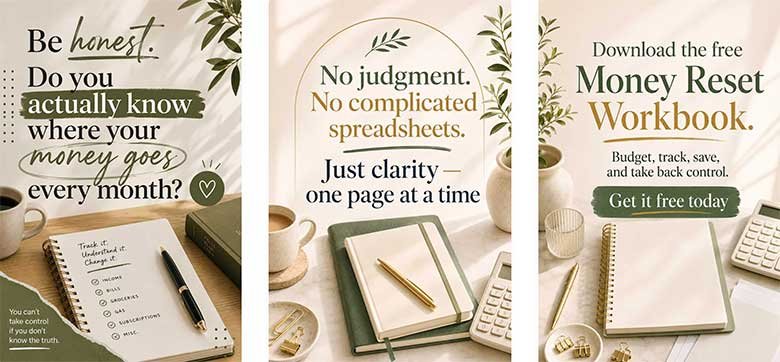
Pick Your Challenge With a Clear Budget Behind It
Download the free Money Reset Workbook and get a simple way to see how much you can comfortably set aside, so your challenge fits your real life.
Get the Free Workbook1. The One-Dollar Challenge: move a single dollar today to prove to yourself that you have started.
It sounds almost silly, and that is the point. Moving $1 takes about thirty seconds. It turns your fund from an idea into a real account with a real balance, and that tiny step breaks the biggest barrier, which is starting.
Do it right now, then do it again tomorrow if you like. You can always raise the amount later. The only goal today is to begin.
If a dollar feels too small to matter, remember that the habit matters more than the amount at this stage.
Move $1 into your savings account right now, and note the date you started.
2. The 30-Day Climb: save $1 on day one, $2 on day two, and keep adding a dollar until day 30.
This challenge builds slowly, so it feels easy at the start. By day 30, you will have moved $465 in total. That is the sum of every number from 1 to 30.
The tough part comes near the end, when the daily amount reaches $25 or more. Check your budget before you begin. If the last week looks tight, start with a lower starting amount or run it in reverse, beginning at $30 and counting down, so the harder days come first.
Mark each day on a calendar. Seeing the days fill in keeps the streak alive.
Print or draw a 30-day calendar, and put your first dollar in today.

Keep Your Challenge in Sight
Premier Print Works creates quality prints, mugs, and shirts for people taking on money challenges. Find a reminder that keeps you going.
Visit Premier Print Works3. The Dollar-a-Day Plan: put aside $1 each day for a full year and end with $365.
This one is steady and gentle. A year of $1 days comes to $365, or $366 in a leap year. You can use a jar, an envelope, or an automatic transfer from your account each day.
The amount may feel tiny, but the consistency is what makes it work. It also leaves room to grow. After a month or two, you might bump it to $2 a day, which would add up to $730 over a year.
Keep in mind that tiny daily transfers can get lost in your routine. Setting an automatic transfer helps.
Set up a daily or weekly automatic transfer that adds up to about $1 a day.
“A challenge turns a vague wish into a game you can actually win.”
4. The $10-a-Week Plan: save $10 each week for 52 weeks and finish with $520.
A weekly rhythm is easier to manage than a daily one for many people. Pick a day, such as payday or Sunday evening, and move $10. Across 52 weeks, that totals $520.
If $10 is too much right now, try $5, which comes to $260. If you can manage $20, you would end with $1,040. The right amount is the one you will keep up.
Because the amount is the same every week, there are no surprises. It is a good fit if you like predictability.
Choose your weekly amount, pick your day, and schedule the first transfer.

Keep Your Streak Steady
The free 7-Day Life Reset gives you a short, simple way to reset your week, which helps when a challenge starts to feel like a grind.
Get the Free Reset5. The 52-Week Challenge: save $1 in week one, $2 in week two, and so on, up to $52 in the final week.
This is the best-known savings challenge. If you complete all 52 weeks, you will have saved $1,378. The math is the sum of numbers from 1 to 52.
The challenge is that the last weeks are the heaviest. Weeks 48 through 52 ask for $48, $49, $50, $51, and $52. If that worries you, flip it and start at $52, with the amounts going down. The hardest weeks happen when you are fresh and excited.
Many people also skip a week when life gets busy and double up later. That is fine. The goal is the total, not perfection.
Decide whether you will count up or down, and write your 52 weeks on a single page.
6. The $5 Bill Challenge: every $5 bill you get goes into an envelope, and you deposit it monthly.
This one fits people who still use cash. Whenever you receive a $5 bill in change, you do not spend it. You slip it into an envelope. Once a month, deposit the whole envelope in your fund.
It does not guarantee a specific total, because it depends on the cash you handle. That is part of the fun. You never know how much will be in there, and it often feels like found money.
If you rarely use cash, you can swap the rule. Move $5 into savings each time you buy something specific, like a coffee or a snack.
Put an envelope in your wallet or bag today, and label it with the purpose.
7. The No-Spend Weekend: pick one weekend a month, spend nothing extra, and move what you saved.
Choose one weekend each month to cover only essentials and use what you already have. Cook at home, find free activities, and put away the card. At the end, move a set amount, like $20 or $40, into your fund.
Over a year, twelve no-spend weekends at $30 each add up to $360. Your numbers will vary. The real value is that the weekend breaks the habit of automatic spending and gives you a clearer sense of what you truly need.
Plan something fun and free ahead of time, such as a hike, a game night, or a library trip. A challenge feels easier when it has something good in it.
Pick the date of your first no-spend weekend, and decide how much you will move afterward.
8. The Sell-One-Thing Challenge: sell one item you no longer use each month and send the money to your fund.
Most homes hold things that no longer serve us. Pick one item each month, and list it online or sell it locally. Then send the entire amount to your emergency fund.
You will not know the total ahead of time, since it depends on what you sell and how it goes. Keep track of fees and shipping so you know what you actually keep. Selling your own used things for less than you paid is generally not taxable, but selling for more than you paid can be, so keep your records.
As a bonus, you also get a little more space at home.
Choose the first item to sell this week, and take the photos today.
9. The Round-Up Challenge: round up purchases to the next dollar, or the next five, and save the difference.
Many banks and apps can round up your card purchases and move the difference to savings automatically. If you buy something for $4.30, $0.70 goes to your fund. If you do not have an app, you can do it by hand with a quick transfer at the end of the day.
The amounts are small, and they add up gradually. Because they come in tiny pieces, you hardly feel them.
Check your bank’s rules for any fees or limits. If rounding up to the dollar feels too small, try rounding up to the next $5.
Look in your banking app for a round-up feature, and turn it on if it is free.
10. The Subscription Swap: cancel one unused subscription and send the same amount to your fund every month.
Scan your bank statement for recurring charges. Pick one you rarely use. Cancel it, and set up a transfer for the same amount to your emergency fund.
If the subscription cost $12 a month, that moves $144 into savings over a year. If it cost $20, that is $240. Because you were already living without that money, you probably will not miss it.
The key is to move the money right away. If you do not, it will drift into something else.
Find one subscription you can cancel today, and set up a matching transfer.
11. The Payday Split Challenge: for the next three paydays, move a fixed amount before you do anything else.
Pick an amount that feels comfortable, such as $20 or $25. On each of the next three paydays, move that amount right when your pay arrives. Three paydays is long enough to build a habit, and short enough to feel doable.
If your pay is every two weeks, that means about six weeks. After the three paydays, look at how it felt. If it was easy, raise the amount a little or keep going.
Paying yourself first is a simple rule, and it works best when you do it before the money gets spent.
Mark your next three paydays on the calendar, and decide your amount.
12. The Bill-Lowering Challenge: call one company, ask for a better rate, and save the difference.
Pick one bill, such as internet, phone, or insurance. Call and ask whether there is a lower rate or a better plan. Sometimes you will hear no. Sometimes you will save a few dollars a month.
If you do, send that exact difference to your fund. A $10 monthly saving adds up to $120 a year.
Be polite and prepared. Know what you pay now, and ask clearly what options are available. A calm, friendly call tends to go better.
Choose one bill to call about this week, and write down your current price before you dial.
13. The Change Jar Challenge: toss spare coins in a jar and deposit them when the jar is full.
Pick a jar or a container and put it somewhere you will see it. Each evening, drop in your loose change. When it is full, take it to a bank or coin machine and deposit the money.
Some coin machines charge a fee, so check before you go. A bank where you hold an account may count coins for free.
This challenge is slow, and it feels playful. It is a nice add-on to a bigger plan, not a whole plan on its own.
Set out a jar today, and decide where you will take the coins when it fills.
14. The Windfall Challenge: decide now how you will treat your next bonus, refund, or gift.
The next time unexpected money arrives, you will make a choice in seconds. Decide ahead of time. For example, you might put half into your emergency fund, and use the other half for something enjoyable.
Write the rule down and keep it where you will see it. When the money arrives, you will not need to decide. You will just follow your plan.
This challenge costs nothing to start, and it can add a surprising amount over a year.
Write your windfall rule on a sticky note and put it in your wallet or phone case.
15. The Prize-Linked Savings Challenge: find out whether a prize-linked savings account is offered near you.
A prize-linked account pays out a chance at a prize instead of interest. In the South African study, people who used one saved more overall, and it seemed to act as a replacement for lottery spending. In the U.S., some credit unions have offered a program called Save to Win.
Availability varies, so ask your credit union or bank. Read the terms, check how prizes work, and make sure your money is insured. Remember that the evidence is mixed, and that a prize is never a plan on its own.
If you cannot find one, do not worry. Your own challenge, with a clear goal, can give you much of the same fun.
Call or visit your credit union’s website, and ask whether they offer a prize-linked savings account.
Explore Our Top Picks for a Better Life
We have gathered the tools, resources, and products we think are genuinely worth your time, covering mindset, self-care, health, and home. All in one place, hand-picked to support the savings challenges you take on.
See Our Top PicksReal Stories, Real Results
Let me share two examples I like to use. Amara kept putting off her emergency fund because every plan felt too big. On a whim, she moved a single dollar into a new account, just to say she had started. The next day she did it again. After a week, she switched to the $10-a-week plan, and she told me the dollar had mattered more than the amount. It broke the spell of not starting.
Joel tried the 52-week challenge and loved the first few months, then dreaded the final weeks. He flipped it halfway through, starting the remaining weeks from the higher numbers and working down. The change kept him going. He told me that adjusting the challenge was not cheating. It was the only way he would have finished.
A Challenge Gets You Started, and Starting Is the Hardest Part
Picture yourself in a few months with a small, real fund and a habit you built on your own terms. You may not have finished every challenge. You started one, adjusted it, and kept going. That is the whole point.
Choose one challenge from this list, and begin it today. Download the free Money Reset Workbook to see where your money goes, so you can pick an amount you can keep up. The best challenge is the one you actually finish.
Want Ready-Made Tools to Help You Put This Into Action?
Sometimes the fastest way forward is a tool that someone has already built. Browse our hand-picked resources and downloads, chosen to help you take the next step with less guesswork.
Browse Resources and Downloads
Ready to Start Your First Challenge Today?
The free Money Reset Workbook helps you see your numbers clearly, so you can pick a challenge that fits.
Download Free Now
Fill Your Space With a Little Motivation
Premier Print Works makes quality prints, mugs, and shirts for people saving with purpose. Browse the collection and find what speaks to your journey today.
Visit Premier Print WorksDisclaimer
The content on this page is for informational and inspirational purposes only. It is not professional financial, investment, tax, legal, insurance, or estate planning advice. Interest rates, account terms, prize-linked savings products, and insurance coverage vary by institution and are not available everywhere, so please check the details of any account and consult a qualified professional before making decisions. Results vary widely from person to person. The research mentioned in this article studied a savings product at a South African bank, and its findings may not apply the same way to savers in other places.
The stories of Amara and Joel are illustrative composite characters created to bring the content to life. They are not real people. Any resemblance to a real person is purely coincidental.
Some links on this page, including links to Premier Print Works and other resources, are affiliate links. If you make a purchase through one of these links, we may earn a small commission at no extra cost to you. We do not own, produce, or control any affiliate products, and we are not responsible for them — we only own and sell the products offered through our own store, Premier Print Works.
All content on A Self Help Hub is the property of Digital Marketing 215 LLC and is protected by copyright law. No part of this page may be copied, reproduced, republished, distributed, or transmitted in any form without prior written permission from the author.