11 Reflection Prompts That Help You Understand Your Emotions
You snap at someone over a dishwasher. Hours later, you realize it was never about the dishwasher.
Feelings do not always come with labels that tell us where they came from. In 1983, psychologists Norbert Schwarz and Gerald Clore called people on the phone on sunny days and on rainy days and asked how satisfied they were with their lives. People on rainy days reported lower life satisfaction. Then the researchers tried something simple. For some people, they asked about the weather first. Once the weather was brought up, the rainy-day gloom no longer dragged down how people rated their lives. The mood was still there, but people stopped blaming their whole life for it. That was a small survey from long ago, with about 84 people, and later research has found weather effects can be smaller, so I treat it as a pattern and not a precise measurement.
The pattern is useful, though. Feelings often act like information, and we tend to trust that information without asking where it came from. These eleven prompts help you ask. Take your time with each one, write honestly, and be kind to whatever shows up.

Build the Daily Calm Behind Understanding Your Feelings
Download the free Self-Care Starter Kit and get simple, practical tools for building a daily rhythm that makes hard feelings easier to sit with.
Get the Free Starter Kit1. Name what you are feeling right now in plain, simple words.
Start with the simplest question: what am I feeling right now? Try not to dress it up. Words like sad, worried, irritated, tired, hurt, or lonely are enough. If more than one fits, write them all.
Naming a feeling can make it feel more manageable. You do not have to fix it yet. Just acknowledge that it is there.
If you are not sure what to call it, write a short description, such as “heavy” or “jumpy.” You can refine the word later.
Write down three words for how you feel right now, without explaining or judging them.
2. Notice where the feeling shows up in your body.
Emotions often show up physically before we find words for them. A tight chest, a clenched jaw, a heavy stomach, or restless hands can all be clues.
Close your eyes for a moment and scan from head to toe. Where do you feel the feeling most? What does it feel like, such as warm, tight, hollow, or buzzing?
Writing this down gives you another way in. It also reminds you that feelings are experiences, not facts about who you are.
Describe where in your body you feel your main emotion, and what it feels like there.

Keep a Gentle Reminder to Check In
Premier Print Works creates quality prints, mugs, and shirts for people learning to listen to their feelings. Find a small reminder to pause and notice.
Visit Premier Print Works3. Write down what has happened in the last few hours, even the small things.
Feelings rarely come from nowhere. A tough email, a short conversation, a skipped meal, or a bad night of sleep can leave a mark that lasts hours. We often forget the small triggers because they seem too minor to count.
Make a quick timeline of your day so far. Include what you ate, how you slept, who you talked to, what you read, and anything that annoyed or worried you.
Skip the blame, and look for patterns and clues.
Write a short timeline of your last six hours, and circle anything that might have shaped your mood.
“A mood tells you something about this one moment. It tells you much less about your whole life.”
4. Ask whether something simple, like weather, sleep, hunger, or news, might be coloring this mood.
This is the heart of the Schwarz and Clore study. A gray sky, a poor night’s sleep, an empty stomach, or a stream of bad headlines can nudge your mood without you noticing. Then we use that mood as information about our whole life.
Ask yourself: if this feeling had a simple, ordinary cause, what might it be? If the answer is plausible, you can name it. Just saying, “I am tired and it is gray out, so everything feels heavier,” can loosen the grip of the feeling.
I want to be clear that your feelings still count. Some feelings point to real problems, and this prompt helps you tell the difference between a mood and a verdict.
Complete this sentence: “Part of this feeling might be because…” and list three ordinary possibilities.
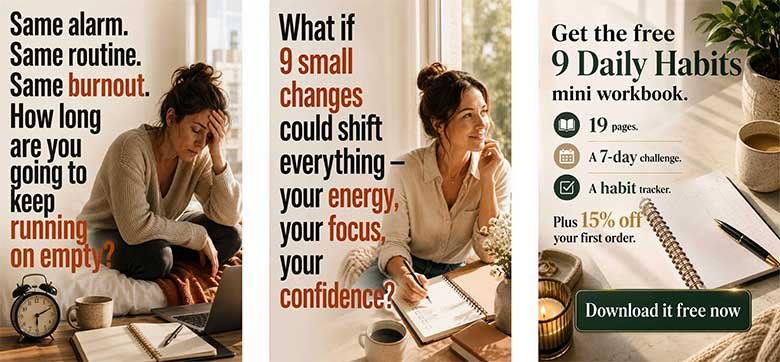
Build Morning Habits That Steady Your Mood
The free 9 Daily Habits guide gives you nine simple morning practices that build the calm foundation emotional awareness grows from.
Get the Free Guide5. Ask whether this feeling is about this moment, or about your whole life.
When we feel low, it is easy to slide from “today is hard” to “my life is hard.” The weather study suggests that a passing mood can leak into big judgments. It can make our whole life seem better or worse than it is.
Write down two columns. In one, list what is actually wrong right now. In the other, list what is actually going on in your life more broadly, including what is going well.
Seeing both columns can help you keep a hard moment from becoming a hard life story.
Draw two columns, one for “right now” and one for “my life overall,” and fill in both.
6. Write down what you were thinking just before the feeling grew.
Thoughts and feelings are closely tied. A thought like “They did not text back, so they must be upset with me” can start a wave of worry. If you can catch the thought, you can look at it.
Try to remember the moment right before the feeling changed. What was going through your mind? Write it as exactly as you can.
Then ask: is that thought a fact, or an interpretation? Sometimes just seeing the thought on paper makes it less convincing.
Write down the last thought you remember before the feeling grew, then mark it as fact or guess.
7. Ask what this feeling might be trying to tell you.
Emotions often carry messages. Anger may point to a boundary that was crossed. Anxiety may point to something that needs preparation. Sadness may point to something you value.
Not every message is accurate, and not every feeling needs action. But asking the question treats your feelings as useful, not as enemies.
Write down what you think the message might be, and hold it lightly. You can revise it later.
Complete this sentence: “If this feeling could talk, it might be saying…”
8. Check whether this feeling is new, or an old pattern showing up again.
Some feelings visit regularly. They might show up in certain situations, around certain people, or at certain times of year. If you have felt this before, you may have already learned something about it.
Look back. When did you last feel this way? What was happening? What helped, and what made it worse?
Noticing patterns can be a relief. It reminds you that you have handled this before, and it can help you plan ahead.
Write about the last time you felt this way, and what helped even a little.
9. Ask what you need right now, in the smallest possible terms.
After you understand a feeling, the next question is usually practical. What do I need? It could be rest, food, a walk, a conversation, a boundary, or just a few minutes alone.
Keep the answer small and doable. A big need can feel impossible, but a small one can often be met within the hour.
If you are not sure, try asking what would feel a little bit better, not what would fix everything.
Write down one small thing you need, and do it within the next hour if you can.
10. Decide whether to act now, wait a while, or let the feeling pass.
Not every feeling calls for action. Some need a conversation. Some need time. Some need nothing except to be noticed.
A helpful test is to ask whether you would still want to act on this feeling tomorrow. If the answer is yes, it may be a signal worth following. If not, it might be a passing wave.
When you are in the middle of strong emotion, waiting a few hours before sending a message or making a decision can save you some regret.
Write down the action you are tempted to take, and decide whether to do it now, later, or not at all.
11. End by writing one thing you want to remember about this feeling tomorrow.
A short closing note can help you learn. What did you notice? What helped? What would you do differently next time?
Keep your notes together in one place. Over weeks and months, they become a quiet record of how your feelings work, and what tends to help. That record is a form of self-knowledge that no book can give you.
Finish with a kind sentence to yourself. You did something useful just by paying attention.
Write one sentence to your future self about what you learned from this feeling.
Explore Our Top Picks for a Better Life
We have gathered the tools, resources, and products we think are genuinely worth your time, covering mindset, self-care, health, and home. All in one place, hand-picked to support the way you understand your emotions.
See Our Top PicksReal Stories, Real Results
Let me share two examples I like to use. Kezia had a habit of deciding, on gray days, that her whole life was off track. When she started writing out two columns, one for what was wrong today and one for her life overall, she noticed that the second column was nearly always more hopeful than the first. She did not talk herself out of her feelings. She simply stopped letting a hard day write the whole story.
Daniel had a different habit. He tended to act fast on strong feelings, sending sharp texts and then regretting them. He started asking himself whether he would still want to act the next day. A few times, he sent a message after the pause, and it was calmer and clearer. Other times, he let it go. Both of them said the same thing: paying attention to a feeling’s source gave them a little more choice.
Understanding Your Emotions Starts With Asking Where They Come From
Picture a day when a hard feeling arrives, and instead of obeying it or fighting it, you get curious. You name it, check what might be feeding it, and decide what you need. The feeling still shows up, but it no longer runs the show.
Choose two or three prompts from this list, and try them the next time a feeling surprises you. Download the free Self-Care Starter Kit to give your emotional awareness a gentle daily rhythm. Understanding grows with practice, and every small attempt counts.
Want Ready-Made Tools to Help You Put This Into Action?
Sometimes the fastest way forward is a tool that someone has already built. Browse our hand-picked resources and downloads, chosen to help you take the next step with less guesswork.
Browse Resources and Downloads
Ready to Understand Your Feelings a Little Better?
The free Self-Care Starter Kit gives you simple, practical tools to build a daily rhythm that supports emotional understanding.
Download Free Now
Fill Your Space With Quiet Self-Understanding
Premier Print Works makes quality prints, mugs, and shirts for people building emotional awareness. Browse the collection and find what speaks to your journey today.
Visit Premier Print WorksDisclaimer
The content on this page is for informational and inspirational purposes only. It is not professional mental health or medical advice of any kind. If you are experiencing persistent sadness, anxiety, anger, or other distressing emotions, or thoughts of harming yourself, please reach out to a qualified mental health professional or a crisis line in your area. Results and experiences vary significantly from person to person. The research mentioned in this article was a small survey conducted in 1983, and its findings may not apply the same way in every situation.
The stories of Kezia and Daniel are illustrative composite characters created to bring the content to life. They are not real people. Any resemblance to a real person is purely coincidental.
Some links on this page, including links to Premier Print Works and other resources, are affiliate links. If you make a purchase through one of these links, we may earn a small commission at no extra cost to you. We do not own, produce, or control any affiliate products, and we are not responsible for them — we only own and sell the products offered through our own store, Premier Print Works.
All content on A Self Help Hub is the property of Digital Marketing 215 LLC and is protected by copyright law. No part of this page may be copied, reproduced, republished, distributed, or transmitted in any form without prior written permission from the author.