17 Budgeting Finances Tips That Help You Build a Wealth Mindset
Some people feel that money just happens to them. Others feel that their choices steer it, at least a little.
For a long time, I felt the first way. Prices rose, bills piled up, and I assumed my choices barely mattered. Then I did one small thing. I called my phone company and lowered my bill. It was only a few dollars a month, but it was the first time my money had moved because of something I did. That small proof mattered more than the dollars.
To me, a wealth mindset has little to do with believing everything will work out. Many people face real barriers, such as low pay and high costs, and a good attitude cannot erase them. It comes from building the habit of noticing what you can influence, and then acting on it. These seventeen tips use budgeting and everyday finances as the training ground.
Build a Wealth Mindset on Real, Everyday Numbers
Download the free Money Reset Workbook and get a clear, honest picture of your money, so a wealth mindset rests on facts and not wishes.
Get the Free Workbook1. Notice where you feel helpless about money, and write it down without judging yourself.
Start by being honest. Where do you feel that money just happens to you? Maybe it is rent, a low paycheck, debt, or a sense that others have all the luck. Write these feelings down in a few sentences.
Some of that helplessness may point to real obstacles. Many people face costs and limits outside their control. Naming them is the first step in sorting what you can change from what you cannot.
Be gentle with this list. You are collecting information.
Write down three areas where you feel money is out of your hands, and one sentence about why.
2. Sort each worry into what you can influence and what you cannot, so your energy goes where it counts.
Draw a line down a page. On one side, list things you can influence, such as your spending habits, your savings amount, the bills you negotiate, the skills you build. On the other side, list things you cannot, such as interest rates, the economy, or someone else’s decisions.
This does not make the second list go away. It helps you stop spending energy on it, and it highlights the first list as your working area.
Even a short first list can feel like relief.
Make two columns, “I can influence” and “I cannot,” and fill in at least five items for each.

Keep a Reminder That Your Actions Matter
Premier Print Works creates quality prints, mugs, and shirts for people building a stronger money mindset. Find a small reminder that what you do each day counts.
Visit Premier Print Works3. Pick one thing you can control and act on it this week, so you feel a cause and effect.
A sense of control grows when you see your actions produce results. So choose one small action and watch what happens.
It might be cancelling a subscription, moving $20 to savings, calling a company about a bill, or tracking spending for a week. Keep it small and clear.
Afterward, write down what you did and what changed. That record becomes evidence for your own influence.
Choose one small money action for this week, do it, and write down the result.
“A wealth mindset begins with the belief that what you do today can change what you have tomorrow.”
4. Set up one automatic habit, so your good intentions run on their own.
Automation turns a one-time decision into steady action. Set up a small transfer to savings each payday, or an extra payment toward a debt. Choose an amount you can keep up.
Each month, you can look at the growing balance and see that your decision is working. That is a real, visible link between what you did and what you have.
Raise the amount later when you can.
Set up one automatic transfer for your next payday, in an amount that feels comfortable.

Build Steady Money Habits, Week by Week
The free 7-Day Life Reset gives you a short, simple way to reset your week, which keeps small money habits from slipping.
Get the Free Reset5. Track your net worth a few times a year, so you can see your own direction.
Net worth is what you own minus what you owe. Write it down every three or four months. Include savings, investments, home equity, and other assets, and subtract your debts.
The number may start small, or even negative. That is fine. What matters is the line over time. Seeing it move in a better direction is a strong signal that your actions matter.
Keep the record simple, such as a single page with dates.
Calculate your net worth today, and set reminders to update it every three or four months.
6. Learn one money idea a month, and make sure your confidence rests on real knowledge.
Confidence is useful, and it works best when it comes from learning. Choose one topic each month, such as how interest works, what a credit score is, or how retirement accounts work.
Use reliable, non-commercial sources, such as government and nonprofit education sites. Write a short summary in your own words. Then use what you learned in one small way, and test yourself by explaining it to someone else.
Over a year, that is twelve new tools.
Pick one money topic to learn this month, and explain it to a friend when you finish.
7. Look for one way to raise your income, even a little, because income gives your choices more room.
Budgeting is only half the picture. Raising income can change what is possible. That might mean asking for a raise, building a skill, taking on extra hours, selling things you no longer need, or starting a small side income.
Choose one step that fits your life. Even a small, steady increase can make a difference over time.
Be wary of schemes that promise easy money. Real income usually takes real effort.
Choose one concrete step to raise your income this quarter, and write down the first action.
8. Look for one way to lower your costs, since your spending is one of your strongest levers.
Review your largest recurring costs, such as housing, transportation, insurance, phone, and food. Ask whether any can be lowered through negotiation, switching providers, or small changes in habits.
A cost you lower once can pay you back every month. That is a powerful form of influence.
Make a short list, and tackle one item at a time.
List your five biggest recurring costs, and choose one to lower this month.
9. Write down cause and effect when you make a money choice, so you notice your impact.
Keep a short log. When you make a money choice, such as saving, paying extra on a debt, or skipping a purchase, write what you did and what you expect to happen. Later, add what did happen.
Over time, the log will show you patterns. You will see that your choices matter, and you will learn which ones matter most.
It also gives you proof on days when you feel like nothing makes a difference.
Start a simple money log with three columns: what I did, what I expect, and what happened.
10. Watch your language, and replace “it just happens to me” with more precise statements.
Words shape how we see things. Notice when you say “money always disappears” or “I never get ahead.” Try rewriting them: “My spending on dining out was high this month,” or “I have not yet set up a savings transfer.”
The new versions are specific and point to something you can adjust. They are also more accurate.
At the same time, do not blame yourself for real outside forces. Honest language leaves room for both.
Write down three money statements you often say, and rewrite each one to be specific and adjustable.
11. Plan for what you cannot control with a cushion, so surprises feel less threatening.
A sense of control leaves room for things going wrong, and it means preparing. An emergency fund, insurance, and a flexible budget all help you handle events you did not choose.
Start with a small cushion, and build gradually. Each dollar you add makes the unknown a little less scary.
This is control in action. You cannot control the surprise, but you can control how ready you are.
Set a small cushion goal, and set up an automatic transfer toward it.
12. Celebrate the wins that came from your own actions, so your sense of influence grows.
When you reach a goal, such as paying off a card, hitting a savings target, or sticking to a budget for a month, pause and acknowledge it. Say to yourself, “I did that.”
Celebrate in a way that does not undo your progress, such as a favorite meal at home or a walk. Write the win in your log.
These moments build confidence for the next step.
Write down your last three money wins, and note what you did to earn each one.
13. Find people who treat money as something they can manage, and learn from them.
The people around us shape our beliefs. Spend time with friends, mentors, or communities who talk about money with curiosity and action. Ask them what they do.
Be selective about advice. Look for people who are practical and honest about both their wins and their mistakes.
You do not need to copy anyone. You are looking for ideas and encouragement.
Ask one person you respect what money habit has helped them most, and listen to the answer.
14. Review your budget every month and treat each review as a chance to learn, not to judge.
A monthly review is a loop of action and result. Look at what you planned, what happened, and what you want to change. Be curious, not harsh.
Each month, choose one adjustment. Over time, those adjustments add up to a plan that fits you.
The review is where your sense of control grows, because you see that adjusting makes a difference.
Schedule a monthly budget review, and end each one by choosing one adjustment.
15. Look at structural barriers honestly, and get help where the odds are stacked.
Some money problems have little to do with habits. Low pay, high housing costs, medical bills, discrimination, and limited access to good banking can all make things harder. A wealth mindset should not ask you to ignore that.
Look for support: community programs, nonprofit credit counseling, legal aid, and benefits you may qualify for. Asking for help is a smart use of the resources available.
Do what you can with what you can control, and use support for the rest.
Look up one local or nonprofit resource that could help with a barrier you face, and save the contact.
16. Define wealth in your own terms, so you are building toward something you actually want.
Wealth can mean a big account balance. It can also mean time, health, freedom, security, generosity, or the ability to say no. Write your own definition.
Then check whether your daily choices point toward it. A budget that matches your definition feels more meaningful, and that meaning keeps you going.
You can change your definition over time as your life changes.
Write one paragraph describing what wealth means to you, beyond a number.
17. Stay patient, since a mindset grows through repetition and not through one big decision.
Beliefs change slowly. Your sense that your actions matter will strengthen each time you take a step and see the result. There will be setbacks.
Keep your habits small and steady. Review them every few months, and celebrate progress. If you slip, begin again with the next small step.
A wealth mindset is something you practice.
Choose three habits from this list that feel doable, and commit to them for ninety days.
Explore Our Top Picks for a Better Life
We have gathered the tools, resources, and products we think are genuinely worth your time, covering mindset, self-care, health, and home. All in one place, hand-picked to support the habits behind a steadier money life.
See Our Top PicksReal Stories, Real Results
Let me share two examples I like to use. Kezia felt that money simply happened to her. When she sorted her worries into what she could influence and what she could not, she realized the first list was longer than she thought. She picked one item, a phone plan she could renegotiate, and made the call. It saved a little each month. She told me the savings were small, but the feeling was big, because she had changed a number herself.
Daniel tracked his net worth for the first time and found it was negative because of student loans. He expected to feel crushed. Instead, he felt a strange calm, since he finally had a number to work with. He set up an automatic extra payment and updated the number every few months. Both of them said the same thing: seeing their own actions change their own numbers was what built the mindset.
A Wealth Mindset Grows From Seeing That Your Actions Matter
Picture opening your budget and feeling that you have a say. You know what you can influence, you have small habits running, and you can see your numbers moving the right way. The obstacles are real, and so is your progress.
Choose two or three tips from this list, and start by sorting what you can and cannot influence. Download the free Money Reset Workbook to see your numbers clearly. A mindset built on small, real wins tends to last.
Want Ready-Made Tools to Help You Put This Into Action?
Sometimes the fastest way forward is a tool that someone has already built. Browse our hand-picked resources and downloads, chosen to help you take the next step with less guesswork.
Browse Resources and Downloads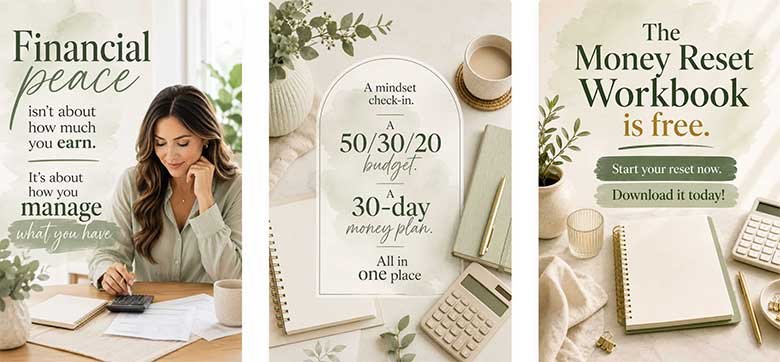
Ready to Build a Money Mindset That Works for You?
The free Money Reset Workbook helps you see your numbers clearly, so every habit you build has a solid base.
Download Free Now
Fill Your Space With Your Money Goals
Premier Print Works makes quality prints, mugs, and shirts for people building wealth with intention. Browse the collection and find what speaks to your journey today.
Visit Premier Print WorksDisclaimer
The content on this page is for informational and inspirational purposes only. It is not professional financial, investment, tax, legal, insurance, or estate planning advice, and it is not professional mental health advice of any kind. Income, costs, and resources vary widely, and some money challenges come from factors outside a person’s control. Please consult a qualified professional or a nonprofit credit counselor before making financial decisions. Results vary widely from person to person.
The stories of Kezia and Daniel are illustrative composite characters created to bring the content to life. They are not real people. Any resemblance to a real person is purely coincidental.
Some links on this page, including links to Premier Print Works and other resources, are affiliate links. If you make a purchase through one of these links, we may earn a small commission at no extra cost to you. We do not own, produce, or control any affiliate products, and we are not responsible for them — we only own and sell the products offered through our own store, Premier Print Works.
All content on A Self Help Hub is the property of Digital Marketing 215 LLC and is protected by copyright law. No part of this page may be copied, reproduced, republished, distributed, or transmitted in any form without prior written permission from the author.