9 Money Management Activities That Help You Make Smarter Financial Choices
You are about to click Buy, and some small part of you hesitates.
That hesitation is worth listening to. Many of my own money mistakes happened in a rush, when I was tired, excited, or distracted. The decisions that went well tended to share a feature. I had slowed down for a moment and asked a couple of plain questions. Smarter financial choices often come from small practices that give you a pause, and less from knowing more.
These nine activities are exercises you can do in a few minutes. Each one is a way of slowing down and looking at a money choice from a slightly different angle. Try the ones that appeal to you, and make them a habit. I am not a financial professional, so please treat this as general education.
Practice Smarter Money Choices on Real Numbers
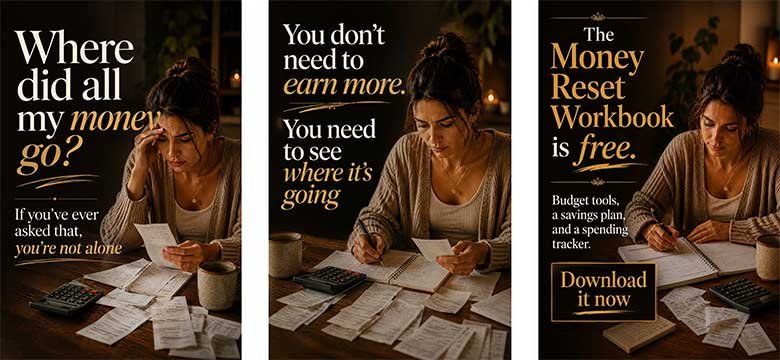
Download the free Money Reset Workbook and get a simple way to see your real numbers, so every exercise in this article has something solid to work with.
Get the Free Workbook1. Run the work-hours test, and translate a purchase into hours of your life.
Take the price of something you want, and divide it by your take-home pay per hour. If you earn $20 an hour after taxes, a $100 item costs five hours of work. Then ask yourself: would I trade five hours of my time for this?
Some purchases pass easily. Others suddenly look less appealing. It will not suit every decision, and it can be a useful way to put a price tag in a human unit.
Use your real take-home number, and include commuting time if you want a fuller picture.
Pick one item you are thinking of buying, and calculate how many hours of work it costs.
2. Use a waiting list, and give wants a day or two to settle.
Create a note on your phone called “Wait List.” When you want something that is not a need, write it down with the date and price. Wait at least forty-eight hours before you decide.
Many wants fade by then. The ones that remain are easier to think about clearly.
If you still want something after the wait, you can check your budget and decide.
Start a wait list today, and add the next non-essential thing you want.

Keep a Small Reminder to Pause First
Premier Print Works creates quality prints, mugs, and shirts for people who think before they spend. Find a small reminder to take a moment before you decide.
Visit Premier Print Works3. Ask three plain questions before any bigger purchase.
For anything larger than a small treat, try these three questions. Do I need this, or do I want it? What will I give up if I buy it? Will I still be glad I bought it in a month?
Write your answers down if you can. The act of writing slows you down.
You can adjust the questions to fit you. The aim is a short pause with a few clear prompts.
Write your own three questions on a card, and use them before your next larger purchase.
“Smarter money choices often start with a pause long enough to ask one honest question.”
4. Make a quick pros and cons table for bigger decisions, so you can see them side by side.
Draw two columns on a page. List the benefits of a decision on one side, and the costs and risks on the other. Include money, time, stress, and what else you could do with the same resources.
Be honest about both sides. Then circle the items that matter most to you. Sometimes the list makes the answer clear. Sometimes it shows you what you still need to learn.
This works for car purchases, loans, big trips, and changes in work.
Choose one money decision you are facing, and make a two-column list of costs and benefits.
Build a Steady Weekly Money Check-In
The free 7-Day Life Reset gives you a short, simple way to look back at your week, which makes a quick money check-in easier to keep.
Get the Free Reset5. Keep a short money decision journal, and learn from your own choices.
Once a week, write down your biggest money decisions, in a line or two. What did I decide? Why? How do I feel about it now? What would I do differently?
Over a few months, patterns appear. You might see that you overspend when you are tired, or that you feel good about certain kinds of purchases.
This turns your own history into a teacher.
Start a notebook or note, and record your two biggest money decisions this week.
6. Write a letter from your future self, and let it weigh in on a choice.
Imagine yourself a few years from now, looking back at a decision. Write a short note from that person to you today. What would they say about buying this, taking this loan, or putting this money toward a goal?
This is not about predicting the future. It is a way of widening your view beyond the moment.
Read the letter aloud, and notice how it feels.
Write a short note from your future self about one money decision, and read it out loud.
7. Do a monthly statement review, and ask what you notice.
Once a month, look over your bank and card statements. Scan every line. Mark charges you do not recognize, forgot about, or regret. Mark ones that you are glad about. Add them up.
Notice patterns. Where does money go that you would rather redirect? What spending brings you value?
This quiet review often leads to better choices without any forced restrictions.
Block out thirty minutes this month to review your statements, and write down three things you notice.
8. Practice a mock budget, so you can try choices on paper first.
Before you commit to a change, test it on paper. Make a one-page budget with your actual income and expenses. Then try a change. What if you moved to a cheaper plan? What if you saved fifty dollars more each month? What if you took on a car payment?
See how each change affects your overall picture. Paper is a safe place to experiment.
You can try several versions and compare.
Make a one-page budget, and test one “what if” on paper this week.
9. Teach a money idea to someone else, since explaining it shows you what you really understand.
Choose a money concept you are working on, such as how interest works, what a deductible is, or how your retirement plan works. Explain it to a friend or write a short explanation in plain words.
You may find gaps in what you know. That is useful. Fill them with reliable, non-commercial sources, such as government and nonprofit education sites.
Over time, you will build real understanding.
Pick one money concept, and explain it in plain words to someone this week.
Explore Our Top Picks for a Better Life
We have gathered the tools, resources, and products we think are genuinely worth your time, covering mindset, self-care, health, and home. All in one place, hand-picked to support thoughtful money choices.
See Our Top PicksReal Stories, Real Results
Let me share two examples I like to use. Amara had a habit of buying things late at night when she was tired. She started a wait list and the work-hours test. She told me that after seeing that a favorite online purchase cost eight hours of her pay, she put it back in the cart and closed the page. She did not stop buying things she loved. She just chose them more carefully.
Joel’s tool was the decision journal. He wrote down his biggest money decisions for two months, and he spotted a pattern. He tended to say yes to extra costs when he was rushed. He began to say, “Let me think about it,” and wait a day. Both of them said the same thing: small pauses gave them smarter choices.
Smarter Money Choices Start With a Small Pause
Picture a moment when you are about to buy something, and you take a breath. You ask a couple of plain questions, you glance at your wait list, and you decide with a clear head. Sometimes you buy it. Sometimes you do not. Either way, you chose.
Choose two or three activities from this list, and try them this week. Download the free Money Reset Workbook to see your real numbers. Thoughtful habits tend to improve choices more than any single piece of advice.
Want Ready-Made Tools to Help You Put This Into Action?
Sometimes the fastest way forward is a tool that someone has already built. Browse our hand-picked resources and downloads, chosen to help you take the next step with less guesswork.
Browse Resources and Downloads
Ready to Make Smarter Money Choices, One Exercise at a Time?
The free Money Reset Workbook helps you see your numbers clearly, so your choices rest on facts.
Download Free Now
Fill Your Space With Thoughtful Money Habits
Premier Print Works makes quality prints, mugs, and shirts for people making smarter money choices. Browse the collection and find what speaks to your journey today.
Visit Premier Print WorksDisclaimer
The content on this page is for informational and inspirational purposes only. It is not professional financial, investment, tax, legal, insurance, or estate planning advice. Prices, loan terms, and account details vary, so please check the details and consult a qualified professional before making financial decisions. Results vary widely from person to person.
The stories of Amara and Joel are illustrative composite characters created to bring the content to life. They are not real people. Any resemblance to a real person is purely coincidental.
Some links on this page, including links to Premier Print Works and other resources, are affiliate links. If you make a purchase through one of these links, we may earn a small commission at no extra cost to you. We do not own, produce, or control any affiliate products, and we are not responsible for them — we only own and sell the products offered through our own store, Premier Print Works.
All content on A Self Help Hub is the property of Digital Marketing 215 LLC and is protected by copyright law. No part of this page may be copied, reproduced, republished, distributed, or transmitted in any form without prior written permission from the author.