17 Self Confidence Building Habits That Help You Trust Yourself More
Self confidence is not the absence of doubt. It is not the feeling of certainty before you act or the guarantee that things will work out. Real self confidence is something quieter and more durable than that. It is the accumulated trust in yourself that builds through the repeated experience of showing up, making decisions, surviving the outcomes, and doing it again. It is earned, not given, and it is built through habits, not through waiting for a feeling that never quite arrives on its own.
These 17 self confidence building habits are for people who want to trust themselves more. Not perform confidence for other people. Actually trust their own judgment, their own decisions, their own ability to handle what comes. Each habit points toward a different dimension of that trust. Some of them are internal practices. Some are behavioral. All of them compound over time in ways that the single dramatic act of bravery rarely does. Read them. Pick the ones that fit where you are. Build the trust one habit at a time.
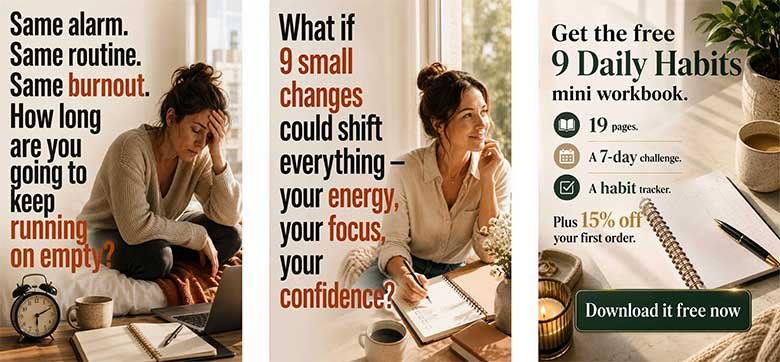
Free Download: The 9 Daily Habits Checklist
Self confidence grows from what you do every single day. The free 9 Daily Habits Checklist gives you nine proven daily practices that build the mental and emotional foundation that genuine self trust grows from. Download it free today.
Get the Free Habits Checklist1. Keep the small promises you make to yourself.
“Real self confidence is the accumulated trust in yourself that builds through the repeated experience of showing up, making decisions, surviving the outcomes, and doing it again.”
Self trust is built the same way trust in anyone else is built: through kept promises over time. Every time you tell yourself you will do something and then do not do it, a small withdrawal is made from your internal trust account. Every time you tell yourself you will do something and you do it, a deposit is made. The size of the promise matters less than the consistency. The person who commits to drinking one glass of water before coffee every morning and keeps that commitment for thirty days has built more self trust than the person who made an ambitious resolution and abandoned it in a week. Start small. Keep the promise. Repeat.
2. Stop asking for permission you do not need.
Many people with low self confidence have a habit of seeking external validation before acting on decisions that are entirely theirs to make. Checking whether the outfit is okay before leaving the house. Running a reasonable personal decision past three people before committing to it. Apologizing before sharing an opinion in a room full of people. The habit of seeking permission for things that require no permission trains you to believe that your own judgment is insufficient without external confirmation. It is not. Practice making small decisions without asking for approval. Notice that the world does not end. Let the evidence accumulate that your judgment is trustworthy enough to act on.
3. Do one uncomfortable thing each day.
“Every time you tell yourself you will do something and you do it, a deposit is made into your internal trust account. Start small. Keep the promise. The size matters less than the consistency.”
Confidence is not built in the comfortable zone. It is built at the edge of it, through the repeated experience of choosing the slightly uncomfortable option and discovering that you handled it. One uncomfortable thing per day does not have to be dramatic. Making the phone call you have been putting off. Saying the thing in the meeting you have been holding back. Introducing yourself to someone new. Taking the route you are not certain about. Each small act of moving past the comfortable edge builds the evidence that you can handle things you were not sure you could. That evidence is self confidence. You cannot think your way to it. You have to do your way to it.

Visit Premier Print Works
The reminders that you are capable of more than you currently believe are worth keeping visible. Premier Print Works offers prints, mugs, and art for people who are building self confidence and want their daily space to reflect the trust they are working to earn in themselves. Visit the shop today.
Visit Premier Print Works4. Build a skill until you are genuinely good at it.
Competence is one of the most reliable sources of self confidence, and it is one of the most consistently overlooked in conversations that focus only on mindset. The person who has genuinely developed a skill, who knows from real experience that they can do something well, has a form of confidence in that area that is not dependent on mood or external validation. It is grounded in evidence. Pick something worth being good at. Invest in it consistently over time. Let the competence build until it is undeniable. The confidence that grows from genuine skill development is not the kind that needs reassurance. It is the kind that simply knows.
5. Stop comparing your insides to other people’s outsides.
Most confidence comparisons are fundamentally unfair because they compare your internal experience, your doubt, your anxiety, your uncertainty, to other people’s visible behavior, their apparent ease, their visible results, their curated presentation. The person who seems effortlessly confident in a room is almost certainly not experiencing effortless confidence. They are experiencing the same doubt and moving through it anyway. You cannot see anyone else’s internal experience. You can only see their external behavior. Comparing your internal reality to their external appearance is a comparison that will never be accurate and never resolve in your favor. Stop making it.
6. Speak up once in every room you enter.
“Competence is one of the most reliable sources of self confidence and one of the most consistently overlooked. Genuine skill development produces the kind of confidence that does not need reassurance.”
One of the fastest ways to erode self confidence is the habit of staying silent in situations where you have something worth saying. Each time you hold back something genuine, you train yourself to believe that your contribution is not worth making. The reverse habit, committing to speaking up at least once in every room, meeting, or conversation you enter, trains you toward the opposite belief. You do not have to say the most important thing or the most impressive thing. You have to say something real. The habit of contributing your voice consistently builds the confidence that your voice belongs in the conversation. It does. But you have to keep putting it there for the belief to take hold.
7. Write down what you are proud of each week.
Self confidence requires evidence and most people are better at collecting evidence against themselves than for themselves. The weekly habit of writing down at least one thing you are genuinely proud of from the past seven days builds a running record of your own capability and character that is available on the days when doubt is loudest. It does not have to be an achievement. It can be the day you handled something hard with grace, or the moment you said the honest thing when the easy thing was available. Both count. The record builds an accurate picture of who you are that is harder to argue with than the inner critic’s version.
8. Follow through on your own decisions without second-guessing them repeatedly.
“Each time you hold back something genuine you train yourself to believe your contribution is not worth making. Speak up once in every room. The habit builds the belief that your voice belongs there.”
Making a decision and then spending the following days revisiting it, questioning it, and reopening the question that has already been answered is one of the most consistent ways to undermine self trust. It signals to yourself that you do not actually trust the decisions you make, which makes trusting them in the future harder rather than easier. The habit of making a decision and then committing to it, giving it the time to work without constant second-guessing, builds decision-making confidence that generalizes across other areas of your life. You will not always be right. Neither will the second-guessing. Make the decision. Trust it long enough to see what it produces.
9. Set and enforce one personal boundary every week.
Self confidence and personal boundaries are directly linked. Every time you set a limit and hold it, you demonstrate to yourself that your needs are worth protecting and that you are capable of protecting them. Every time you set a limit and abandon it under the first pressure, the opposite message is sent. Start with small boundaries in low-stakes situations. Build the muscle. The confidence that comes from the consistent experience of having limits that you actually hold is qualitatively different from confidence that is only verbal. It is backed by evidence that you follow through. That evidence changes how you carry yourself in a way that thinking about confidence never quite does.

Free Download: The Self-Care Starter Kit
Self confidence grows from the relationship you have with yourself, and that relationship is built through how you take care of yourself daily. The free Self-Care Starter Kit gives you simple daily practices for your mind and body that build the foundation genuine self trust grows from. Download it free today.
Get the Free Self-Care Starter Kit10. Replace self-criticism with self-correction.
Self-criticism is not the same as self-awareness and it does not produce the same results. Self-awareness says I made a mistake in that situation and I understand why, which leads to a change. Self-criticism says I am the kind of person who always makes that mistake, which leads to shame and no change. The habit of replacing the critical voice with the corrective one, what happened, why did it happen, what would I do differently, is not softer or less honest. It is more useful. It produces the actual learning that self-criticism promises but rarely delivers. You are allowed to hold yourself to a high standard. You do not have to punish yourself in order to improve.
11. Take your own preferences seriously in small daily decisions.
“Replace self-criticism with self-correction. What happened. Why did it happen. What would I do differently. This is not softer than criticism. It is more honest and more useful.”
People with low self confidence often defer their own preferences in small daily decisions as a reflex. What do you want to eat? Oh, whatever you want is fine. What movie should we watch? You choose. Where should we go? I do not mind. Repeated across hundreds of small interactions, this deference trains you to believe your own preferences do not merit expression or consideration. The confidence-building habit is the reverse: taking your own preferences seriously enough to name them, even in small situations. Not aggressively. Just honestly. I would like this. This is what I prefer. Practice it daily in the low-stakes moments so it is available in the high-stakes ones.
12. Spend time with people who see your capability clearly.
The people around you shape your beliefs about yourself in ways that are difficult to fully counteract alone. Regular time with people who consistently remind you of your limitations, who undermine your confidence, or who treat your ambitions as unrealistic is a slow but consistent drain on self trust. Regular time with people who see your capability clearly and reflect it back to you, who challenge you without diminishing you, who believe in your potential before you fully believe in it yourself, is one of the most powerful environmental supports for building self confidence that exists. You cannot always choose your work environment or your family. You can be deliberate about who gets your discretionary time.
13. Act on your own judgment before seeking external input.
“The people around you shape your beliefs about yourself in ways that are difficult to fully counteract alone. Be deliberate about who gets your time and attention.”
The habit of forming your own view of a situation before asking other people what they think is a direct practice of self trust. When you go to others for input before you have consulted your own judgment, you implicitly treat your own perspective as insufficient or unreliable. Reverse the order. Decide what you think first. Then if you want a second opinion, get one. You may revise your view based on new information. But you arrived at the conversation already knowing what you thought, which is a very different starting point than arriving empty and filling in from the outside. Your judgment is not the final authority on everything. It is the right starting point for everything that concerns you.
14. Finish what you start, even the small things.
Every unfinished project, abandoned commitment, or half-completed task is a small piece of evidence that you are someone who does not follow through. Enough of those pieces build a picture that is hard to argue with from the inside, even if it is not the whole truth from the outside. The confidence-building habit of finishing things, even small and inconsequential things, builds the opposite picture. You started it and you finished it. That is a unit of self trust. Build enough of those units and the belief that you are the kind of person who completes things becomes grounded in actual evidence rather than hope. Start fewer things. Finish more of them.
15. Stop catastrophizing the opinions of others.
“Finish what you start, even the small things. Every completed task is a unit of self trust. Build enough of them and the belief that you follow through becomes grounded in evidence rather than hope.”
A significant portion of low self confidence is maintained by the belief that other people’s negative opinions of you would be catastrophic. That if they think less of you it would be devastating. That their disapproval is something you could not survive. Examining that belief honestly almost always reveals that you have survived many instances of disapproval already and the consequences were far less devastating than the anxiety about them suggested. The fear of judgment is almost always larger than the actual impact of the judgment. You can handle people thinking less of you. You have done it before. The catastrophizing is not protecting you from anything. It is just keeping you small.
16. Celebrate your progress without minimizing it.
Most people with low self confidence are experts at minimizing their own achievements. It was not that hard. Anyone could have done it. It does not really count because. The habit of receiving your own progress honestly, without immediately shrinking it to a size that feels safe to claim, is a direct act of self trust. Acknowledging that you did something well is not arrogance. It is accuracy. And the practice of accurate self-acknowledgment over time builds a more honest internal picture of your capability than the one the inner critic keeps trying to replace it with. You did something good. Let it be good. Do not explain it away.
17. Trust yourself enough to begin before you are certain.
“Acknowledging that you did something well is not arrogance. It is accuracy. Practice accurate self-acknowledgment until it becomes more natural than the habit of shrinking your own progress.”
Certainty before action is a standard that confident people do not actually meet. They move before they are certain because they trust themselves enough to handle the uncertainty that comes after the first step. The habit of waiting for certainty before beginning is the habit of not beginning, dressed up as prudence. You will not always be right. You will not always succeed. But the repeated experience of beginning before you are certain and handling what comes is the most direct path to the kind of self trust that makes the uncertainty feel manageable rather than paralyzing. Trust yourself enough to begin. The rest becomes clearer once you are moving.
How Kezia and Joel Each Built the Habit That Finally Made Self Trust Feel Real
Kezia had spent years describing herself as someone who lacked confidence, as though it were a fixed fact about her rather than a pattern of habits she had built without noticing. The habit that shifted things was the smallest one on the list: keeping the small promises she made to herself. She started with one. Every morning she said she would drink a glass of water before coffee, and every morning she did it. Then she added a second small promise. Within six weeks she had a string of kept commitments that surprised her. Not because they were impressive but because they were consistent. For the first time in years she was behaving like someone whose word to herself meant something. The self trust that grew from those small kept promises was disproportionate to the size of the promises themselves. It was not about the water. It was about being the kind of person who did what she said she would do. She had not known she was building that person until she already was one.
Joel’s habit was stopping the second-guessing. He had a pattern of making decisions and then immediately revisiting them, running through alternative scenarios, and reopening settled questions until the anxiety of the uncertainty became worse than the original decision had been. A therapist gave him a simple rule: once a decision is made and acted on, it is closed for review for at least two weeks. Give it the time to work. He followed the rule imperfectly but consistently. The decisions that he trusted long enough to produce outcomes showed him something he had not expected: most of them were fine. Not perfect. Fine. The second-guessing had been producing more suffering than the decisions themselves. Trusting his decisions long enough to see what they produced was the evidence his self trust had been waiting for. He had been interrupting it before it could show him anything.
The Trust You Are Building in Yourself Is the Most Reliable Foundation You Will Ever Have
Self confidence is not a destination. It is a daily practice of choosing to act from your own judgment, keep your own promises, and treat your own experience as worth something. It builds quietly, in the ordinary moments, through the habits that no one sees but that compound over time into the kind of inner steadiness that does not depend on what anyone else thinks of you.
You do not have to build all seventeen of these habits at once. Pick the one or two that speak most directly to where the trust is thinnest in your life right now. Build those until they are solid. Let them show you what you are capable of. Then let that evidence be the foundation for everything that comes next.
The trust you are building in yourself is real. It is earned. And it is the most reliable foundation you will ever stand on.

Free Download: The 9 Daily Habits Checklist
Let these self confidence building habits be the reminder that the trust you want in yourself is built one day at a time. The free 9 Daily Habits Checklist gives you nine daily practices that build the foundation genuine self confidence grows from. Download it free today.
Get the Free Habits ChecklistOur Top Picks for a Better Life
We have gathered our favorite tools, resources, and recommendations for building self confidence, self trust, and the daily habits that help you show up more fully for your own life. Everything we trust enough to share, all in one place.
See Our Top Picks
Self Confidence Reminders at Premier Print Works
Keep the reminders of your own capability visible on the days when the doubt is loudest. Visit Premier Print Works for prints, mugs, and art for people who are building self trust and want their daily environment to reflect the confidence they are working to earn in themselves.
Visit Premier Print WorksDisclaimer
The content on A Self Help Hub is for informational and inspirational purposes only. The self confidence building habits and personal stories in this article offer general support for everyday personal development, self-trust, and intentional living. They are not professional mental health advice, psychotherapy, medical advice, or any form of clinical treatment.
If you are dealing with significant anxiety, depression, trauma, social anxiety disorder, or persistent low self-confidence affecting your daily functioning and relationships, please speak with a qualified mental health professional. General self-help content is not a substitute for professional care.
The stories and composite characters in this article, including Kezia and Joel, are illustrative. They are based on common experiences and created to make the content relatable. They are not real people. Any resemblance to a specific person is coincidental.
Some links on this site, including links to Premier Print Works, may be affiliate links. A Self Help Hub may earn a small commission at no extra cost to you. We only recommend things we genuinely believe in.
If you are in a mental health crisis or thinking about self-harm, please do not rely on this content for support. Contact emergency services or a crisis helpline right away. You deserve real help and it is available to you now.
All content on A Self Help Hub is copyrighted. You may not copy or republish it without written permission. By reading this article you agree to this disclaimer.