Eating Slowly on a Budget: Savoring Simple Meals and Wasting Less
Think about the last meal you ate. Can you remember how the first bite tasted? For many of us, dinner happens in front of a screen, or standing at the counter, or in the car between errands. The plate is empty before we really notice it was full.
Eating slowly on a budget is a gentle way to get more enjoyment from the food you already buy. A simple bowl of rice and beans, eaten with attention, can feel like a real meal. Slowing down also gives you a chance to notice how much you serve, what gets left behind, and what ends up in the trash.
This page shares general ideas and information, and it is not advice or a diet plan. You will find ideas for setting the table, savoring simple food, serving sensible portions, and caring for leftovers. Try one small change at a time and see what fits your home.

Plan Your Food Budget in One Place
Download the free Money Reset Workbook and give your grocery money a clear, simple plan, so simple meals feel steady and enough.
Get the Free WorkbookGive your meal a place to happen
Slow eating often starts with where you eat. A table, even a small one, can make a meal feel like an event. Clear off the mail. Set out a plate and a glass. Sit down.
You do not need nice dishes or candles, although you can use them if you have them. The point is to give the meal its own spot in your day.
Many people find that sitting at a table, instead of on the couch, makes the food easier to notice and enjoy.
Clear one spot at your table and eat your next meal there.
Set the screens aside for a few minutes
Phones and TVs pull our attention away from the plate. That is part of why a whole meal can vanish without a single remembered bite.
You might try the first five minutes of a meal with the screen off or face down. Five minutes is short enough to feel easy. After that, you can decide whether to keep going without it.
If you eat with family, a few quiet minutes or a simple chat can make the meal feel more connected.
Try eating the first five minutes of one meal today with no screen.
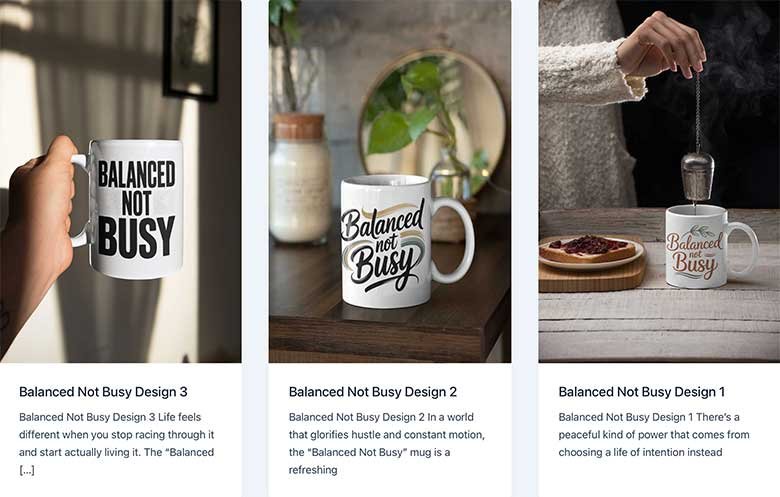
Keep a Small Reminder in Plain Sight
Premier Print Works creates quality prints, mugs, and shirts for thoughtful, thrifty people. Find a small reminder of what you are working toward.
Visit Premier Print WorksNotice the first three bites
Here is a simple practice. For the first three bites, pay full attention. Notice the temperature. Notice the flavor, the salt, the texture. Notice if it is crunchy, soft, or chewy.
Three bites is a small, doable number. Many people find that the rest of the meal goes a little slower on its own after that.
This works with any food. A plain piece of toast with butter can taste surprisingly good when you actually notice it.
Give your full attention to the first three bites of your next meal.
“A simple meal eaten slowly can feel richer than a fancy one eaten in a hurry.”
Put the fork down between bites
Another easy idea is to set your fork or spoon down after each bite. Chew. Enjoy. Then pick it up again.
It can feel a little odd at first, like learning a new dance step. Over time, it may become a natural rhythm. Meals tend to last a bit longer, and each bite gets more of your attention.
This is about enjoyment, and it is not a health or diet rule. Questions about eating and health are best talked over with a doctor or registered dietitian.
Set your fork down between bites for one meal this week.

See Where Your Food Money Goes
The free Money Reset Workbook has easy pages for tracking food costs, so you can notice waste and plan better meals.
Get the Free WorkbookCelebrate simple, low-cost meals
Budget meals are often simple. Soup, beans, eggs, pasta, rice, potatoes, oats. These foods can feel plain when eaten in a rush. Eaten slowly, they often taste warm and comforting.
You might add one small touch that makes a simple meal feel special. A sprinkle of herbs, a squeeze of lemon, a little cheese on top. Small touches can go a long way. For related reading, see affordable meals that taste good.
When you savor simple food, you may find you crave fancy or takeout meals a little less often.
Choose one simple meal and add one small touch to make it feel special.
Serve a little less and go back if you want more
Big servings often lead to leftover food on the plate, and plate scraps usually end up in the trash. Serving a smaller first portion gives you a chance to check in before taking more.
Here is an example with made-up numbers. Say a pot of chili costs $9 to make and gives eight servings. That is about $1.13 a serving. If two servings a week end up scraped into the trash, that is about $2.25 of food gone each time you make it. Serving smaller and going back for seconds can help keep more of it in the pot.
Whatever stays in the pot can become tomorrow’s lunch. You may also like turning leftovers into a new dinner.
Serve a smaller first portion at your next meal and go back only if you want more.
Care for leftovers safely
Saving food only helps if it stays safe to eat. A common food safety guideline is to put leftovers in the fridge within about two hours of cooking, or within one hour if it is above 90 degrees Fahrenheit. Many people eat refrigerated leftovers within three to four days.
When reheating, leftovers should reach 165 degrees Fahrenheit (74 Celsius). A simple food thermometer makes that easy to check.
Labeling containers with the day you cooked can help you remember what to eat first.
Label your next container of leftovers with the day it was made.
Notice what gets wasted each week
Mindful eating can reach beyond the plate. For one week, you might simply notice what gets thrown away. Wilted greens, the heel of the bread, half a pot of rice, a forgotten yogurt.
There is no judgment in this. You are just gathering information. Many people find a pattern, like always buying too much of one thing or cooking more than the family eats.
Once you see the pattern, you can adjust your shopping or cooking a little. Another place to look is meal planning on a tight budget.
Write down what food gets thrown away for one week.
Make one meal a week a slow meal
Not every meal needs to be slow. Life is busy, and some days dinner happens fast. One idea is to choose one meal each week to enjoy slowly, with the table set and the screens away.
It might be Sunday dinner, a weekday breakfast, or a quiet lunch on your day off. Over time, that one slow meal can become something you look forward to. For related reading, see low-cost family meal ideas.
A slow meal does not need to cost more. It just needs a little more of your attention.
Choose one meal this week to be your slow meal.
Explore Our Top Picks for a Better Life
We have gathered the tools, resources, and products we think are genuinely worth your time, covering mindset, self-care, health, and home. All in one place, hand-picked to support the goals you are working toward.
See Our Top PicksReal Stories, Real Results
Let me share two examples I like to use. Amara usually ate dinner on the couch while scrolling her phone. She started eating at her small kitchen table with the phone in another room for the first few minutes. She told me that her plain pasta dinners started to taste like real meals again.
Joel noticed he was scraping half-eaten plates into the trash most nights. He began serving smaller portions and saving what was left in the pot for lunch. He was surprised how many lunches came from food he used to throw out. Both of them said the same thing: slowing down helped them enjoy their food and waste less of it.
Simple Food Can Feel Like a Real Meal
Picture yourself at a cleared table, with a warm bowl of soup in front of you. The screen is off, and you notice the steam, the smell, and the first spoonful. When you finish, there is just enough left in the pot for tomorrow.
Try one slow meal this week. Download the free Money Reset Workbook to plan your food budget in one place. Small bites, slow pace, less waste.
Want Ready-Made Tools to Help You Put This Into Action?
Sometimes the fastest way forward is a tool that someone has already built. Browse our hand-picked resources and downloads, chosen to help you take the next step with less guesswork.
Browse Resources and Downloads
Ready to Enjoy Simple Meals More?
The free Money Reset Workbook helps you see your numbers clearly, so your food budget stretches further.
Download Free Now
Fill Your Space With Things You Love
Premier Print Works makes quality prints, mugs, and shirts for people who plan ahead. Browse the collection and find what speaks to you today.
Visit Premier Print WorksDisclaimer
The content on this page is for informational and inspirational purposes only. It is not professional financial, investment, tax, legal, insurance, or estate planning advice. The eating ideas here are general, and they are not medical, nutrition, or diet advice. Food needs and allergies vary, so a doctor or registered dietitian can help with questions about eating and health. Please follow food safety guidance for storing and reheating leftovers. The numbers in the examples are made up to show how the math works. Prices and terms vary and change, and results vary widely from person to person.
I am not a financial advisor, and I am not a licensed tax, legal, or investment professional. I share this information to help people learn about money and see new options. Please treat it as general information only, and talk with a qualified professional about your own situation before making financial decisions.
The stories of Amara and Joel are illustrative composite characters created to bring the content to life. They are not real people. Any resemblance to a real person is purely coincidental.
Some links on this page, including links to Premier Print Works and other resources, are affiliate links. If you make a purchase through one of these links, we may earn a small commission at no extra cost to you. We do not own, produce, or control any affiliate products, and we are not responsible for them — we only own and sell the products offered through our own store, Premier Print Works.
All content on A Self Help Hub is the property of Digital Marketing 215 LLC and is protected by copyright law. No part of this page may be copied, reproduced, republished, distributed, or transmitted in any form without prior written permission from the author.