7 Personal Finance Tips That Help You Build Better Money Habits
Good money habits do not require a finance degree or a high income. They require a few simple decisions made consistently over time. Most people struggle with money not because they do not earn enough but because no one ever taught them how to manage what they have.
These 7 tips are practical, honest, and built for real life. Each one addresses a habit that makes a real difference — not just in your bank account but in how you feel about money every day. Start with one and let the momentum build from there.
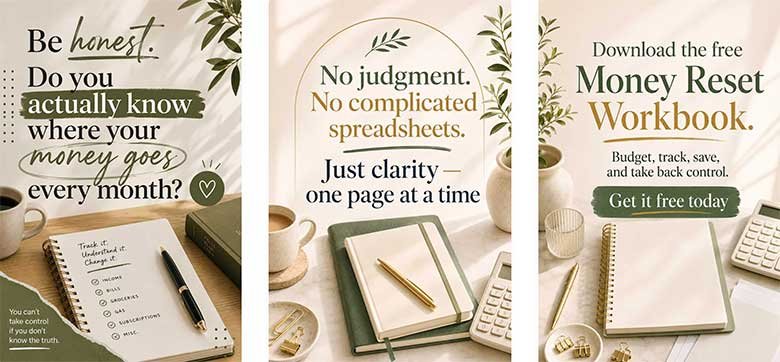
Build Better Money Habits Starting Today
Download the free Money Reset Workbook — a 13-page fillable guide to help you budget, track spending, and build the financial habits that actually last.
Get the Free Workbook1. Know your exact monthly income and expenses before you try to change anything about your finances.
Most people have a vague sense of what they earn and spend but no clear picture. They know they do not have enough at the end of the month but they cannot tell you exactly where it went. Financial clarity starts with one honest look at the numbers.
Write down your take-home income. Then write down every fixed expense — rent, utilities, subscriptions, loan payments. Then estimate your variable spending on food, gas, and everything else. The difference between those two numbers is your financial reality. You cannot change what you cannot see clearly.
2. Automate your savings before your spending so the decision is made once and never again.
Willpower is unreliable. Automation is not. The most effective financial habit you can build is one that removes the daily decision to save. Set up an automatic transfer from your checking to your savings account on the day your paycheck arrives. Even $50 a month automated beats $200 you plan to save manually but never quite do.
Set it up once. Leave it alone. Raise the amount every few months as your budget allows. The habit runs itself and the savings build without you having to think about it every single payday.
“Financial freedom does not begin with a big income. It begins with the decision to be intentional about the income you already have.”
3. Build a starter emergency fund of at least $500 before you focus on any other financial goal.
Without an emergency fund every unexpected expense becomes a financial setback. A car repair goes on a credit card. A medical bill creates stress for months. A small cushion breaks that cycle. It gives you options when something goes wrong instead of sending you backward every time.
Start with $500 as your first target. It is achievable in weeks or months for most people with a clear plan. Once you hit it, work toward one month of expenses. Then three. Build the cushion first and everything else becomes easier to manage.
4. Pay yourself first and treat your savings transfer as a non-negotiable bill every single month.
Most people save whatever is left at the end of the month. There is usually nothing left. Flipping that approach — saving first and spending what remains — changes the entire dynamic. When savings come out before you spend, you stop treating them as optional.
Give your savings transfer the same status as your rent or electricity bill. It is not negotiable. It is not skipped because things are tight. It is a commitment to your future self that gets honored first before everything else gets divided up.

Surround Yourself With What Keeps You Focused
Premier Print Works creates quality prints for people who are serious about building a better life. Find something that keeps your goals visible every single day.
Visit Premier Print Works5. Spend less than you earn every month and treat that gap as your most important financial metric.
This is the simplest rule in personal finance and the one most people violate without realizing it. If your spending equals or exceeds your income every month, nothing else you do with your money matters very much. The gap between what you earn and what you spend is where financial progress lives.
Track that gap every month. Even a small positive gap — $50, $100 — means you are moving forward. A zero or negative gap means something needs to change. That number tells you more about your financial health than your income, your credit score, or anything else.
6. Review your finances once a week for 15 minutes to stay aware and catch problems before they grow.
Most financial problems get worse because people do not look at them. An overspent category becomes a crisis when you do not catch it until the end of the month. A weekly 15-minute money check keeps you connected to your finances in a low-stress, consistent way.
Every Sunday, open your bank account and budgeting app. Look at what you spent last week. Compare it to your plan. Adjust the coming week if needed. This habit catches small problems early, celebrates small wins, and keeps your financial goals alive and in front of you all year long.
7. Learn one new personal finance concept each month to gradually build the knowledge that changes your long-term outcomes.
Financial literacy is a skill built over time. Most people were never taught how money actually works — how compound interest grows savings, how debt avalanche versus snowball works, what an index fund is, how insurance deductibles work. That missing knowledge costs real money over a lifetime.
Pick one concept each month and spend 30 minutes learning about it. A free article, a YouTube video, a library book. The knowledge compounds just like interest does. A year from now you will understand money in a way that gives you real advantages that most people around you do not have.
“The habits you build around money today are the financial life you will be living five years from now. Build them with intention.”
Explore Our Top Picks for a Better Life
We have gathered the best tools, resources, and products to help you build better money habits, take control of your finances, and create the secure life you deserve. All in one place, hand-picked just for you.
See Our Top PicksReal Stories, Real Results
Amara had avoided looking at her finances for nearly two years. She knew things were not good but the anxiety of looking felt worse than not knowing. Then one Sunday evening she sat down with her bank statements and wrote out every number. It took 45 minutes and it was uncomfortable. But when she was done she had something she had never had before — a clear picture. She knew exactly what she owed, what she earned, and where the money was going. That clarity was the beginning of everything. She did not fix it all at once. But she stopped being afraid of the numbers. And that made all the difference.
Joel had been meaning to start saving for three years. He always planned to start next month when things were less tight. Things were never less tight because the money always expanded to fill whatever was available. Then he set up a $75 automatic transfer to a separate savings account on the day his paycheck landed. He did not miss it. Three months later he had $225 saved — more than he had ever held onto before. He raised the transfer to $100 the following month. The habit had started. And once it started it kept going on its own.
Better Money Habits Build a Better Life — One Month at a Time
Every tip in this article builds toward the same outcome — a relationship with money that feels less stressful, more intentional, and more hopeful. You do not have to fix everything at once. You just have to start somewhere and stay consistent. The habits that seem small right now compound into something significant over time. That is how every person who ever turned their finances around actually did it.
Pick one tip from this list and act on it today. Download the free Money Reset Workbook to build a simple plan that gives your money direction and your goals a real chance. Your financial life does not change all at once. It changes one good habit at a time — starting with the one you build today.

Your Better Money Habits Start With a Simple Plan
The free Money Reset Workbook is a 13-page fillable guide with budget tools, spending trackers, and savings goal planners built to help you build lasting financial habits.
Download Free Now
Put Something on Your Wall That Reminds You Where You Are Headed
Premier Print Works makes quality prints for people who are building something better every day. Browse the collection and find what keeps you moving toward your goals.
Visit Premier Print WorksDisclaimer
The content on this page is for informational and inspirational purposes only. It is not professional financial, legal, or personal advice of any kind. Results vary significantly from person to person. Content is not personalized financial advice. Every financial situation is different. Consult a qualified financial professional before making major financial decisions.
The stories of Amara and Joel are illustrative composite characters created to bring the content to life. They are not real people. Any resemblance to a real person is purely coincidental.
Some links on this page, including links to Premier Print Works and other resources, are affiliate links. If you make a purchase through one of these links, we may earn a small commission at no extra cost to you. We only recommend things we genuinely believe in.
If you are in crisis, please contact emergency services or a crisis helpline in your area immediately. You are not alone and help is available.
All content on A Self Help Hub is protected by copyright. It may not be copied, republished, or distributed without written permission from the author.