15 Time Blocking Habits That Help You Protect Your Focus
Your attention is one of the most valuable things you have. But most people give it away freely — to notifications, interruptions, other people’s urgencies, and the constant pull of a to-do list with no clear order. Time blocking is the practice of taking that attention back and deciding in advance where it goes.
These 15 habits will help you build a time blocking practice that actually sticks. You do not need a perfect schedule or a complicated system. You need a few simple structures that protect the hours that matter most so your best work gets your best energy every single day.

Build the Daily Habits That Protect Your Best Hours
Download the free 9 Daily Habits guide and build a simple morning routine that sets you up to focus, protect your time, and get your most important work done every day.
Get the Free Guide1. Start every week by mapping your non-negotiable blocks before anything else gets scheduled.
Non-negotiables are the things that must happen no matter what — deep work sessions, family commitments, health habits, and the tasks that directly move your most important goals forward. When these go into your calendar first, everything else has to work around them instead of the other way around.
Spend 15 minutes every Sunday blocking these out for the coming week. Treat them as appointments with yourself that you would never cancel. The week looks completely different when your priorities are already protected before anyone else’s requests arrive.
2. Block your peak energy hours for your most important and cognitively demanding work every single day.
Most people do their hardest work whenever it lands on their schedule — which is often during their lowest energy hours. Peak energy hours are the two to four hours each day when your brain is sharpest. For many people that is the first half of the morning. For others it is late afternoon.
Identify yours and protect them fiercely. No meetings, no email, no admin during that window. Use those hours only for the work that requires your best thinking. Everything else can happen in your off-peak hours when the work is less demanding.
“A calendar that reflects your priorities is a plan. A calendar that reflects everyone else’s priorities is a problem. Decide which one you have.”
3. Create a daily shutdown ritual that ends your workday at a consistent time and closes all open loops.
Without a clear endpoint, work expands into your evenings and your rest time. A shutdown ritual is a brief end-of-day routine that closes out the day intentionally. You review what got done, capture anything still open, write tomorrow’s top three tasks, and then stop.
The ritual tells your brain that work is finished so it can actually rest. Without it, your mind keeps running in the background all evening looking for the closure it never got. A 10-minute shutdown saves hours of mental noise every week.
4. Batch all email and messages into two set windows each day instead of checking them constantly.
Constant checking of email and messages is one of the biggest focus killers in a modern workday. Every time you check and respond you break your flow and cost yourself the time it takes to re-enter focused work — often 15 to 20 minutes per interruption.
Set two email windows — one in the mid-morning and one in the mid-afternoon. Check, respond, and close. Outside those windows the inbox stays closed. It feels uncomfortable at first. Within a week it becomes one of the most freeing habits you have ever built.
5. Schedule a buffer block of 30 minutes between major tasks to handle overruns and transitions.
Most time blocking attempts fail because the schedule is too tight. Tasks run over. Transitions take time. Unexpected things come up. A 30-minute buffer block between major tasks absorbs that reality without derailing the whole day.
Think of the buffer as a shock absorber. When a block runs long, the buffer catches the overflow. When nothing runs over, the buffer becomes bonus focused time or a genuine rest. Either way it keeps the rest of your day intact when the inevitable happens.

Build a Space That Supports Your Focus
Premier Print Works creates quality prints for people who are serious about how they spend their time and energy. Find something that keeps your focus sharp and your goals visible today.
Visit Premier Print Works6. Block one uninterrupted hour of deep work first thing every morning before checking any messages or notifications.
The first hour of your day is the most valuable. Your mind is fresh, the world has not yet made its demands, and your attention has not been fragmented by a dozen small inputs. Using that first hour for your most important focused work — before email, before social media, before anything reactive — changes what your days produce.
Make this block non-negotiable. Keep your phone in another room or on silent. Close all browser tabs. Work on the one thing that matters most right now. Even five days a week of first-hour deep work produces more meaningful progress than most people make in a month of scattered, reactive workdays.
7. Use time blocking for personal and family commitments just as you would for work tasks.
If your calendar only shows work blocks, your personal life will always lose to work. Blocking time for exercise, meals, family, rest, and relationships is not optional — it is what makes a sustainable schedule. Without those blocks, they get squeezed out by whatever feels most urgent in the moment.
Block dinner with your family. Block your workout. Block the walk you keep saying you will take. Block time to read. When these appear on your calendar with the same weight as work meetings, they stop getting cancelled and start actually happening.
8. Turn off all non-essential notifications during every focus block to protect your attention from external pulls.
Notifications are the enemy of deep focus. Each one — even one you do not respond to — pulls your attention and costs you recovery time. During a focus block your phone should be on Do Not Disturb. Your computer notifications should be silenced. Your environment should be quiet enough to think.
You do not need to be unreachable forever. You just need to be unreachable for the duration of the block. Let people know you have focused work hours. Most things that feel urgent can wait 90 minutes without any real consequence.
9. Review and adjust your time blocks at the end of each day to build a more accurate schedule over time.
Your first time blocking schedule will not be perfect. Tasks take longer than expected. Priorities shift. Blocks that made sense on Sunday look different by Wednesday. Reviewing and adjusting at the end of each day makes your schedule progressively more accurate and realistic.
This daily review takes five minutes. Look at what got done and what did not. Move unfinished blocks forward. Ask honestly whether your plan matched reality. Over time your schedule becomes something that actually fits your life rather than an idealized version of it.
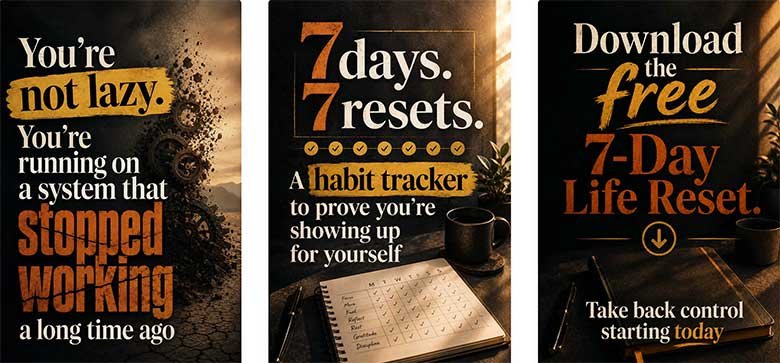
Reset Your Schedule and Reclaim Your Focus
The free 7-Day Life Reset gives you a simple daily plan to clear the chaos from your schedule, rebuild your daily structure, and start protecting the time that matters most.
Get the Free Reset Guide10. Schedule your least important tasks in your lowest energy hours to make the most of every part of your day.
Not every task requires deep focus. Answering routine emails, filing, scheduling, light admin, and simple errands can be done during your low-energy hours when focused work would be impossible anyway. Matching task difficulty to energy level is one of the most underrated productivity strategies available.
Map your typical energy curve across the day. Put your hardest work in your peak hours. Put your easiest tasks in your valleys. You get more done and you feel less drained at the end of the day because your energy was used where it had the most impact.
11. Block a weekly planning session of 30 minutes every Sunday to design your week before it designs you.
People who time block effectively do not just plan day by day. They plan the whole week at once on Sunday so each day already has direction when it starts. A 30-minute Sunday session to review goals, block priorities, and set up the week ahead is one of the highest-leverage habits you can build.
When Monday arrives and your week is already mapped, you start with intention instead of reacting to whatever arrives first. That difference — designed week versus default week — is the difference between feeling in control and feeling perpetually behind.
12. Block a no-meeting day each week to give yourself a full day of uninterrupted focused work.
Meetings fragment your day in ways that make deep work almost impossible. Even one meeting in the middle of the day breaks your focus into two unusable halves. A no-meeting day — one day each week with no calls, no meetings, no commitments — gives you a runway long enough for your most important work to actually take flight.
Many high performers name Wednesday as their no-meeting day. It breaks the week in a way that gives a long run both before and after. Talk to your team or clients about protecting one day. The output quality that comes from it often speaks for itself.
13. Use a physical or digital timer to stay inside your blocks and resist the urge to drift to other tasks.
A timer turns a time block into something concrete and bounded. When the timer is running you know exactly how much of the block remains and you have a clear signal for when it ends. That structure reduces the urge to check your phone or drift to something easier mid-block.
Set the timer for the length of your block. Work until it goes off. Then take a real break before the next block begins. The timer makes the block feel doable and the boundary feel real. Both of those things matter more than most people realize.
14. Protect your lunch break as a true rest block — not a working lunch — so your afternoon focus stays sharp.
Working through lunch feels productive but it costs you the afternoon. Your brain needs a genuine mid-day break to reset and maintain focus quality through the rest of the day. Eating while working is not a break — it is just a slower form of work with food.
Block your lunch break. Step away from your desk. Eat without screens if you can. Even 20 to 30 minutes of genuine rest in the middle of the day returns far more value in afternoon focus than the half hour of extra output you think you are gaining by working through it.
15. Start with just two or three intentional blocks per day and build from there rather than trying to schedule every minute.
The biggest mistake people make with time blocking is going too ambitious too fast. A fully scheduled day sounds appealing in theory but it collapses the moment anything unexpected happens — which is every day. Starting with two or three protected blocks for your most important work gives you structure without rigidity.
Block your morning deep work. Block your email windows. Block your shutdown ritual. That is enough to start. Once those three blocks feel natural, add one more. Build gradually and let the system prove itself before you expand it. Simple and consistent beats complex and abandoned every time.
“You do not find time for what matters. You make it — by blocking it, protecting it, and showing up for it even when something easier is calling your name.”
Explore Our Top Picks for a Better Life
We have gathered the best tools, resources, and products to help you build better daily habits, protect your focus, and make real progress on the things that matter most to you. All in one place, hand-picked just for you.
See Our Top PicksReal Stories, Real Results
Kezia worked from home and struggled with distraction every single day. Her schedule had no structure — she would answer emails, get pulled into calls, scroll for a few minutes, then try to do deep work — and end the day feeling like she had been busy but had barely moved anything forward. She started with just two blocks. A 9 to 11am deep work block with her phone in the other room, and a 4 to 4:30pm email block. The first week was uncomfortable. By the end of the second week she had finished a project that had been sitting incomplete for six weeks. She had not found more time. She had just stopped letting other things eat the time she already had.
Daniel was always in meetings. His calendar was a patchwork of other people’s priorities with almost no room for the work only he could do. He blocked every Wednesday as a no-meeting day and protected it firmly for three months. His team pushed back at first. But his output during those Wednesdays was so visibly different that the pushback stopped. He started producing work that actually moved things forward instead of just maintaining the pace of everyone else’s agendas. One day a week of protected focus gave him back something he thought he had lost — the feeling of actually getting somewhere.
When You Protect Your Focus You Take Back Your Life
Every habit in this article is about one thing — putting you back in charge of where your most important resource goes. Your attention is finite. Your time is irreplaceable. When you spend both reactively, you end up working hard and feeling behind at the same time. When you spend them intentionally, your days feel different. You feel different. You move forward instead of just staying busy.
Pick one habit from this list and start it tomorrow morning. Just one. Download the free 9 Daily Habits guide to build a morning structure that supports focused, intentional work every single day. Your best work is waiting on the other side of a protected block. Go build it.

Your Most Focused Days Start With the Right Morning Habits
The free 9 Daily Habits guide gives you nine simple morning practices to build the structure, energy, and momentum that carry you through a focused and productive day.
Download Free Now
Put Your Goals on the Wall Where They Cannot Be Ignored
Premier Print Works makes quality prints for people who take their time and their work seriously. Browse the collection and find what keeps you locked in on what matters most.
Visit Premier Print WorksDisclaimer
The content on this page is for informational and inspirational purposes only. It is not professional advice of any kind. Results vary from person to person. What works for one person may not work for another. Always use your own judgment and consult a qualified professional when needed.
The stories of Kezia and Daniel are illustrative composite characters created to bring the content to life. They are not real people. Any resemblance to a real person is purely coincidental.
Some links on this page, including links to Premier Print Works and other resources, are affiliate links. If you make a purchase through one of these links, we may earn a small commission at no extra cost to you. We only recommend things we genuinely believe in.
If you are in crisis, please contact emergency services or a crisis helpline in your area immediately. You are not alone and help is available.
All content on A Self Help Hub is protected by copyright. It may not be copied, republished, or distributed without written permission from the author.