17 Emergency Fund Tips for People Starting From Scratch
Not having an emergency fund means every unexpected expense becomes a crisis. A flat tire. A medical bill. A job loss. Without a financial cushion, these things do not just cost money — they cost you sleep, peace of mind, and sometimes months of financial recovery.
Building an emergency fund from zero feels overwhelming at first. But it does not have to be. These 17 tips show you exactly how to start small, stay consistent, and build a cushion that finally gives you real financial breathing room — no matter where you are starting from today.

Build Your Emergency Fund With a Real Plan
Download the free Money Reset Workbook and get a simple fillable system to set your savings goal, track your progress, and build your financial cushion step by step.
Get the Free Workbook1. Start with a goal of $500 and treat it as your first real financial milestone.
Three to six months of expenses sounds like a lot when you have zero saved. So do not start there. Start with $500. That single amount covers most minor emergencies — a car repair, a medical copay, a broken appliance — and breaks the cycle of putting everything on credit.
Five hundred dollars is achievable in weeks or months for most people with a clear plan. Once you hit it, the next milestone feels possible in a way it never did before. Start small. Build momentum. Let the wins lead you forward.
2. Open a separate savings account specifically for your emergency fund and never mix it with spending money.
If your emergency fund lives in the same account as your everyday spending, it will get spent on non-emergencies. Separation is one of the most important structural decisions you can make. A dedicated account with a clear label keeps the money protected and purposeful.
Open a free savings account at your bank or at an online bank. Name it “Emergency Fund.” Transfer money in. Do not link a debit card to it. Make accessing it slightly inconvenient — that friction protects it.
“An emergency fund is not just money in an account. It is the difference between a setback and a disaster. Build it before you need it.”
3. Automate a small transfer to your emergency fund on every payday without exception.
The most reliable way to build any savings is to make it automatic. Set up a transfer — even $25 or $50 — to go to your emergency fund the moment your paycheck hits. You never see it in your spending account and you never have to decide to save it. It just happens.
Start with whatever feels comfortable and raise it by $10 every few months. Automation removes the biggest barrier to saving — the moment of decision. Take that moment away and the habit runs itself.
4. Define what counts as a real emergency so you do not drain your fund on things that are not.
A true emergency is something unexpected, necessary, and urgent — a job loss, a medical situation, a critical car repair that affects your ability to work, or a major home repair you cannot defer. A sale at your favorite store is not an emergency. A concert ticket is not an emergency.
Write down your definition before you need it. When the urge to dip in arrives, check your definition. If it does not meet the criteria, find another way to handle it. Your future self will thank you for protecting what you built.
5. Find one recurring expense to cut this month and redirect that money directly into your emergency fund.
You do not have to earn more to save more. You can redirect money you are already spending. Look at your monthly expenses and find one thing you can cut — a subscription you barely use, a habit you can scale back, a service you can pause. Move that exact dollar amount to your emergency fund instead.
Even $30 a month is $360 a year. That is more than halfway to your first $500 goal without earning a single extra dollar. Look for the cut. Make the redirect. Watch the fund grow.

Build Your Financial Security and Your Space at the Same Time
Premier Print Works creates quality prints for people who are building a better and more secure life. Find something that keeps you motivated and inspired every day.
Visit Premier Print Works6. Use a high-yield savings account so your emergency fund earns interest while it sits and waits.
A regular savings account at a big bank often pays almost no interest. A high-yield savings account at an online bank can pay 4 to 5 percent or more. Your emergency fund should be safe and liquid — not locked away — and a high-yield account gives you both of those things plus growth.
Banks like Ally, Marcus, and SoFi consistently offer competitive rates with no minimum balance and no monthly fees. Switching takes about 15 minutes. Your money works for you while it waits for a real emergency to arise.
7. Save your tax refund before you spend a single dollar of it to give your emergency fund a major boost.
Tax refunds are one of the best opportunities to accelerate your emergency fund. Most people receive a refund in the range of $1,500 to $3,000. If you transfer all or most of it to your emergency fund the day it arrives, you can hit a major milestone in a single move.
Before refund season, decide in advance what percentage will go to your emergency fund. Commit to it before the money is in your account. Once you see a lump sum sitting in checking, the temptation to spend it grows fast. Make the decision ahead of time.
8. Try a no-spend challenge for one week and move every dollar you save into your emergency fund.
A no-spend week means you only pay for true necessities — rent, utilities, groceries, and fuel if needed for work. No dining out, no shopping, no entertainment spending. Whatever you would have spent goes directly to your emergency fund instead.
Most people save $50 to $200 in a single no-spend week depending on their usual habits. Do it once a month and that adds up to $600 to $2,400 a year. It also resets your spending habits and reminds you how little you actually need to be comfortable.
9. Sell things you no longer use and put the money directly toward your emergency fund goal.
Look around your home. There are almost certainly items you have not used in a year or more — clothes, electronics, furniture, books, sporting goods, kitchen gadgets. These items have value sitting on Facebook Marketplace, eBay, or a local consignment shop.
Set a goal: sell enough to add $100 or $200 to your emergency fund this month. Photograph the items, post them, and move the money the day you receive it. One good decluttering session can fund weeks of regular savings contributions in a single afternoon.
“Every dollar in your emergency fund is a vote for your future peace of mind. Cast as many votes as you can afford to cast right now.”
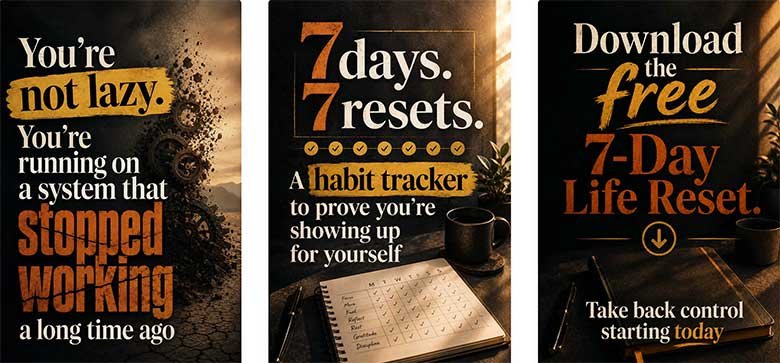
Reset Your Habits and Start Building Security
The free 7-Day Life Reset gives you a simple daily plan to clear old habits, reset your spending, and start building the financial foundation you have been putting off.
Get the Free Reset Guide10. Pick up one extra shift, gig, or side income opportunity and dedicate that money entirely to savings.
If cutting expenses alone is not enough, adding a small temporary income source can accelerate your progress significantly. One extra shift a week, a weekend gig, or a few hours of freelance work can add $200 to $600 a month that goes directly and entirely to your emergency fund.
You do not have to do this forever. Give it three to six months while you are building your initial cushion. Once you hit your first goal, you can scale back and maintain savings through your regular income alone.
11. Track your emergency fund balance weekly to stay connected to your progress and motivated to keep going.
Savings goals that go untracked get forgotten. Check your emergency fund balance once a week — every Sunday works well. Note the number. Celebrate when it goes up. Investigate when it does not. This weekly habit keeps your goal alive and visible all year long.
You can track it in a notebook, a spreadsheet, or a savings app. Some people find it motivating to draw a simple thermometer graph and color it in as the balance rises. Visual progress feels real in a way that numbers alone sometimes do not.
12. If you dip into the fund, make replenishing it your top financial priority immediately after.
Real emergencies happen. That is what the fund is for. Using it for a genuine emergency is not a failure. But the moment the emergency is handled, replenishing the fund becomes your number one financial goal again — above new savings goals, above discretionary spending, above everything non-essential.
Treat replenishment like a bill you owe yourself. Set up a temporary increased automatic transfer until the balance is fully restored. Then return to your regular contribution. The fund only works when it is funded.
13. Build to one month of expenses first then expand to three then six as your income and stability grow.
The standard advice is three to six months of expenses. That is the right long-term target. But if you are starting from zero that number can feel paralyzing. Break it into stages instead. First goal: one month. Second goal: three months. Final goal: six months.
Each stage is a real achievement worth acknowledging. And each stage gives you more protection than you had before. You do not have to get to six months all at once. You just have to keep moving forward from wherever you are right now.
14. Keep your emergency fund liquid — in cash or a savings account — not in investments that can lose value.
Your emergency fund is not an investment. It is insurance. That means it needs to be stable, accessible, and not subject to market fluctuations. Keep it in a savings account or money market account where the balance does not go down and you can access it within a day or two when you need it.
Do not put your emergency fund in the stock market, crypto, or any investment that can lose value. If the market drops 30 percent the same week your car breaks down, you will be in worse shape than if you had kept it in a basic savings account all along.
15. Tell yourself that every dollar saved is one fewer dollar you would ever have to borrow in a crisis.
Reframing helps. Every $100 in your emergency fund is $100 you will not have to put on a credit card at 20 percent interest. Every $500 saved is $500 worth of options when something breaks or falls through. You are not just saving money. You are buying freedom from debt and panic.
When saving feels slow or pointless, come back to that reframe. The value of an emergency fund is not just the money inside it. It is the stress it prevents, the sleep it protects, and the decisions it makes available to you that would not exist without it.
16. Celebrate every milestone — $100, $500, $1,000 — to make the process feel rewarding along the way.
Long savings goals are hard to sustain without acknowledgment along the way. Build in celebrations at every meaningful milestone. Not big spending celebrations — something meaningful and low-cost. A special dinner at home. A relaxing evening. A moment of genuine pride in what you built.
The celebration reinforces the behavior and makes the next milestone feel worth pursuing. You are doing something hard. Acknowledge it. Then keep going.
17. Remember that an imperfect emergency fund started today beats a perfect one planned for someday.
People delay starting an emergency fund because they feel like they cannot do it properly yet. They are waiting for a raise, a better month, a cleaner budget. But someday rarely comes. And while you wait, the next unexpected expense arrives and goes on a credit card.
Start with $10 if that is all you can do right now. Open the account. Make the first transfer. Make it real. An imperfect start is infinitely better than a perfect plan that never begins. The hardest part is always the first dollar. Once it is there, the next one is easier.
Real Stories, Real Results
Amara had no savings at all when her car broke down and the repair cost $740. She put it on her credit card and spent the next four months paying it off with interest. That experience finally pushed her to act. She opened a separate savings account, named it Emergency Fund, and set up a $40 automatic transfer every payday. She sold three items from her closet for $85 and put it all in. Four months later she had $485 saved. When her phone screen cracked two months after that, she paid cash from the fund and felt something she had not felt in years around money — calm. She said it was the best $485 she had ever saved.
Joel had tried to build an emergency fund twice before and raided it both times for things that were not real emergencies. The third time he tried something different. He opened the account at a completely different bank with no debit card attached. He also wrote down his definition of a real emergency and taped it inside his wallet. When temptation hit, he had to read the definition before he could act. That small barrier changed everything. His fund grew for the first time without interruption. He reached $1,000 in six months and called it the most financially secure he had ever felt in his adult life.
Your Emergency Fund Is the Foundation Everything Else Is Built On
Every tip in this article moves you toward one thing — a financial cushion that changes how you experience every unexpected moment in your life. When you have an emergency fund, a flat tire is just a flat tire. A medical bill is just a bill. You handle it, replenish the fund, and move on. Without one, every surprise becomes a setback that can take months to recover from. The fund does not just protect your money. It protects your peace.
Pick one tip from this list and act on it today. Open the account. Make the transfer. Download the free Money Reset Workbook to build a simple savings plan with clear goals and a tracking system that keeps you moving forward. Your financial security starts with one decision made right now.

Your Emergency Fund Needs a Plan Behind It
The free Money Reset Workbook is a 13-page fillable guide with savings goal trackers, spending tools, and a budget system that helps you build your emergency fund faster.
Download Free NowExplore Our Top Picks for a Better Life
We have gathered the best tools, resources, and products to help you build financial security, manage your money with confidence, and create the stable life you deserve. All in one place, hand-picked just for you.
See Our Top Picks
Put Something on Your Wall That Reminds You What You Are Protecting
Premier Print Works makes quality prints for people who are building something solid and lasting. Browse the collection and find what keeps you focused on your financial goals.
Visit Premier Print WorksDisclaimer
The content on this page is for informational and inspirational purposes only. It is not professional financial, legal, or personal advice of any kind. Results vary significantly from person to person. Content is not personalized financial advice. Every financial situation is different. Consult a qualified financial professional before making major financial decisions.
The stories of Amara and Joel are illustrative composite characters created to bring the content to life. They are not real people. Any resemblance to a real person is purely coincidental.
Some links on this page, including links to Premier Print Works and other resources, are affiliate links. If you make a purchase through one of these links, we may earn a small commission at no extra cost to you. We only recommend things we genuinely believe in.
If you are in crisis, please contact emergency services or a crisis helpline in your area immediately. You are not alone and help is available.
All content on A Self Help Hub is protected by copyright. It may not be copied, republished, or distributed without written permission from the author.