17 Money Saving Ideas That Help You Live Well on a Budget
Living well on a budget is not the same thing as living small. It gets confused for that constantly, largely because most budgeting advice focuses on what to cut rather than on how to protect what actually matters while trimming the rest. The two are not the same project, and mixing them up is exactly why so many budgets feel like a countdown to failure instead of a genuine improvement in daily life.
The seventeen ideas below span nearly every category of daily spending — food, transportation, housing costs, entertainment, and the small recurring expenses that hide in between. None of them ask you to give up the parts of life that actually make it enjoyable.
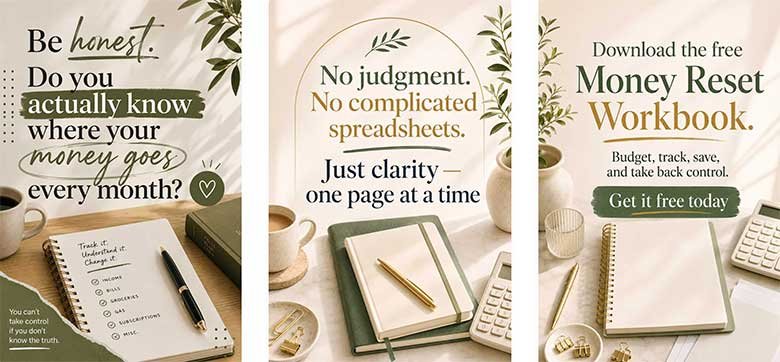
Build the Budget That Lets You Live Well, Not Just Get By
Download the free Money Reset Workbook and get a simple, step-by-step way to see where your money goes and build a budget that protects what you actually care about.
Get the Free Workbook1. Plan meals around what is already in your kitchen before writing a grocery list, so the list fills real gaps instead of duplicating what you have.
Grocery lists written without checking the pantry and fridge first tend to duplicate food that is already sitting there, quietly slowly going to waste while newer versions get purchased anyway. A ten-minute inventory before shopping turns the list into something that fills actual gaps rather than repeating what is already owned.
Do a quick inventory of your kitchen before your next grocery trip and build the list around what needs to be used up first. This single habit reduces both spending and waste at the same time.
2. Shop with a specific list and a set amount of cash, since a physical limit tends to prevent overspending far more reliably than good intentions alone.
Card payments make spending feel abstract in a way that cash does not, which is part of why a set spending limit is much easier to stick to when it is physically visible, running out, rather than an invisible number tracked in an app after the fact. Shopping with cash and a specific list creates a natural stopping point that a card simply does not provide.
Try one grocery trip this month using only cash and a written list. Notice whether the physical limit changes what ends up in the cart.

Surround Yourself With What Supports Your Budget Goals
Premier Print Works creates quality prints, mugs, and shirts for people who are building the daily money habits that support a good life on a real budget. Find what speaks to your journey today.
Visit Premier Print Works3. Compare insurance rates once a year, because loyalty rarely earns a better price and rates tend to drift upward without regular review.
Insurance rates, whether for a car, a home, or renters coverage, tend to increase gradually over time even when nothing about the policy has actually changed, and many providers offer new customers better rates than long-term ones. A yearly comparison, done in an hour or two, often reveals savings that would otherwise go completely unnoticed.
Set a yearly reminder to compare your current insurance rates against at least two other providers. The savings are often larger than they seem worth the effort until the comparison is actually done.
4. Use the library for books, movies, and other media instead of buying or subscribing to everything separately, treating it as a free entertainment budget.
Public libraries have expanded well beyond physical books in most areas, often including digital audiobooks, movies, and even museum passes or equipment rentals, all at no direct cost. Treating the library as a genuine entertainment resource rather than an occasional afterthought can meaningfully reduce spending on subscriptions and purchases that overlap with what is already freely available.
Look into what your local library offers beyond physical books this week, and see how much of your current entertainment spending it could realistically replace.

Get Clear on What Living Well Actually Means for You
The free 7-Day Life Reset gives you one short prompt a day for a week, helping you get honest about what actually adds to your life before deciding where the budget goes.
Start the Free Reset5. Cook double portions and freeze half, turning the same amount of cooking effort into two future meals instead of one.
Cooking a double batch takes only slightly more time and effort than cooking a single portion, but it produces a second meal that is already paid for and ready to go on a night when cooking otherwise feels like too much. This single habit steadily reduces the number of expensive last-minute takeout decisions over the course of a month.
Pick one meal this week and double the recipe, freezing the extra portion for a night you know will be busy.
6. Negotiate your rent or explore a roommate arrangement, since housing is typically the single largest line item most budgets carry.
Because housing usually represents the largest recurring expense in a budget, even a modest reduction there tends to have a larger overall impact than cutting several smaller expenses combined. Whether through direct negotiation at renewal time or a roommate arrangement that splits costs, addressing the largest line item first often produces the most meaningful savings for the least ongoing effort.
Before your next lease renewal, research comparable rental rates in your area and consider whether a direct conversation about the renewal price is worth having.
7. Use a rewards or cashback program for spending you would already be doing, converting routine purchases into a small ongoing return.
Cashback and rewards programs do not change how much gets spent, but for purchases that were already going to happen regardless, they convert a portion of that spending back into value that would otherwise have simply been lost. The savings only make sense when tied to spending that was already planned, not as a reason to spend more to chase a reward.
Look into whether a cashback program exists for the category you spend most on regularly, such as groceries or gas, and consider whether it fits your existing habits.
8. Batch errands into a single trip each week, reducing both the gas spent and the small impulse purchases that tend to happen along the way.
Multiple separate trips for small errands add up in gas costs that rarely get tracked as a specific line item, and each additional trip out of the house is also another opportunity for an unplanned purchase. Consolidating errands into a single, planned trip each week reduces both categories of spending at once.
Plan one errand day this week that covers everything you would normally split across several separate trips.
9. Review and adjust your phone plan annually, since data needs and provider pricing both change more often than most people check for.
Phone plans are frequently set once and left unreviewed for years, even as actual data usage changes and providers introduce new, often cheaper plans that existing customers are never automatically moved onto. A short annual review of both usage and current pricing options often reveals an easy, ongoing monthly saving.
Check your actual phone data usage from the past few months and compare it against your current plan and at least one competitor this month.
10. Buy generic or store-brand versions of staple items, reserving name brands only for the specific products where the difference actually matters to you.
Generic and store-brand products are frequently made in the same facilities as their name-brand counterparts, with a price difference that reflects marketing costs more than any meaningful difference in quality. Being selective — generic for staples, name brand only where a real preference exists — captures most of the savings without sacrificing the specific products that genuinely matter.
Try switching to the generic version of three staple items you buy regularly this month, and notice whether you can actually tell the difference.
11. Use a slow cooker or batch-cooking method for cheaper cuts of meat, turning less expensive ingredients into meals that taste like they cost more.
Cheaper cuts of meat often require longer, slower cooking methods to become tender, which is exactly why they are priced lower even though the flavor, once properly cooked, can rival more expensive cuts. A slow cooker handles this transformation with almost no active effort, making inexpensive ingredients genuinely enjoyable rather than a compromise.
Try one slow-cooked recipe this week using a less expensive cut of meat, and compare the cost per meal against your usual choices.
12. Set a specific, small monthly amount for guilt-free spending, protecting your budget from the resentment that comes with zero flexibility.
A budget with no room for personal, unaccounted-for spending tends to generate resentment that eventually leads to a larger, unplanned break from the budget entirely. A small, specific amount set aside for guilt-free spending each month prevents this resentment by building enjoyment into the plan on purpose, rather than treating it as something to feel bad about.
Decide on one small, realistic amount you can set aside each month purely for enjoyment, and spend it without guilt because it was already planned for.
13. Audit your streaming and app subscriptions every few months, since these small recurring charges tend to accumulate quietly over time.
Streaming services and app subscriptions are easy to sign up for and easy to forget about, which means the combined monthly total often grows well past what any individual subscriber intended when they added the third or fourth service. A regular review, done every few months, catches this accumulation before it becomes a significant recurring expense.
List every streaming service and subscription currently being charged, and cancel anything that has not genuinely been used in the past month.
14. Walk or bike for short trips instead of driving, saving on gas while adding a small amount of built-in movement to your day.
Short car trips are disproportionately expensive relative to the distance covered, since a cold engine uses more fuel and wear accumulates regardless of trip length. Replacing a portion of these short trips with walking or biking reduces both gas spending and vehicle wear, while adding a small amount of daily movement that would otherwise require a separate trip to the gym.
Identify one regular short car trip you could realistically replace with walking or biking, and try it for the next two weeks.
15. Host gatherings at home instead of going out, keeping the social connection while cutting the cost of restaurant markups.
Restaurants and bars charge a significant markup over the actual cost of food and drinks, a markup that covers real overhead but also means the same evening with the same friends can cost a fraction as much when hosted at home instead. The social value of the evening does not depend on the venue nearly as much as it depends on the company.
Plan one gathering at home this month instead of meeting somewhere that would normally involve a restaurant or bar tab.
16. Wait for seasonal sales on predictable annual purchases, planning ahead rather than buying at full price out of last-minute necessity.
Many categories of goods — clothing, electronics, home goods — follow predictable seasonal sale patterns that reward planning ahead and penalize last-minute, full-price purchases made out of necessity. Knowing roughly when a category typically goes on sale allows a genuinely needed purchase to be timed rather than rushed.
For one upcoming purchase you know you will need, research whether it follows a predictable seasonal sale pattern before buying it at full price.
17. Track your spending for one full month without changing anything yet, since an honest baseline is the foundation every other budgeting habit depends on.
Attempting to cut spending before actually knowing where it currently goes tends to produce guesses rather than genuine changes, since the categories that feel like they cost the most are not always the categories that actually do. A single month of honest tracking, with no changes attempted yet, provides the accurate baseline that makes every other idea in this article far more effective.
Track every purchase for one full month without trying to change your habits yet. The clarity this produces is often more valuable than any single cost-cutting tip.
Explore Our Top Picks for a Better Life
We have gathered the tools, resources, and products we think are genuinely worth your money — covering finances, mindset, health, and home. All in one place, hand-picked with the same standard we apply to our own spending.
See Our Top PicksReal Stories, Real Results
Amara had always treated her budget as a list of things she was not allowed to do, which meant every month eventually included one large, guilty splurge that undid most of the previous weeks of careful cutting. What changed things was setting aside a small, specific amount each month purely for guilt-free spending, planned for rather than felt bad about after the fact. The splurges stopped almost immediately, not because she wanted less, but because the wanting now had a legitimate, already-approved outlet instead of building up into a monthly rebellion against her own budget. She said the strangest part was how much lighter the whole process felt once one small category of spending was allowed to simply exist without judgment.
Joel had never tracked his spending closely, relying instead on a general sense of what felt affordable in the moment, and that general sense had been steadily wrong for longer than he realized. Tracking every purchase for one full month, without trying to change anything yet, revealed that a category he had assumed was minor — small app subscriptions and impulse food delivery orders — was actually one of the largest line items in his entire budget. Seeing the actual number, rather than his previous guess, made the fix obvious and immediate in a way that vague budgeting advice never had. He said the tracking month had taught him more than every other financial habit he had tried before it, combined.
Living Well on a Budget Is Built Idea by Idea, Not Sacrifice by Sacrifice
Each idea in this article targets a different category of spending — food, housing, entertainment, transportation, the small recurring charges that hide in between. None of them ask you to give up the parts of your life that genuinely make it enjoyable. Most of them simply remove waste that was never adding much value in the first place.
Choose two or three ideas that match your own spending patterns most closely, and build them into your month. Download the free Money Reset Workbook to give the process a clear, simple structure to follow. Living well on a budget is not about doing without. It is about spending on purpose.

Ready to Build a Budget You Actually Enjoy Living On?
The free Money Reset Workbook walks you through the same ideas in this article, step by step, with room to write down your own numbers and your own plan.
Download Free Now
Fill Your Space With What Supports Your Budget Goals
Premier Print Works makes quality prints, mugs, and shirts for people building a good life on a real budget. Browse the collection and find what speaks to your journey today.
Visit Premier Print WorksDisclaimer
The content on this page is for informational and educational purposes only. It is not financial, investment, tax, insurance, legal, or estate planning advice, and should not be treated as a recommendation to buy, sell, or hold any product, security, or service. Please speak with a qualified professional who is licensed in your state before making decisions about budgeting, saving, investing, debt, taxes, insurance, or estate planning. Results and experiences vary significantly from person to person.
The stories of Amara and Joel are illustrative composites created to bring the content to life. They are not real people. Any resemblance to a real person is purely coincidental.
Some links on this page, including links to Premier Print Works and other resources, are affiliate links. If you make a purchase through one of these links, we may earn a small commission at no extra cost to you. We do not own, produce, or control any affiliate products, and we are not responsible for them — we only own and sell the products offered through our own store, Premier Print Works.
All content on A Self Help Hub is the property of Digital Marketing 215 LLC and is protected by copyright law. No part of this page may be copied, reproduced, republished, distributed, or transmitted in any form without prior written permission from the author.