17 Self Reflection Quotes That Help You Grow With More Honesty
Most people are comfortable with growth as an idea. The part that is harder is the honest self reflection that real growth requires. Looking at yourself clearly, without the defense of excuses or the comfort of self-deception, takes a specific kind of courage that does not get talked about enough. It is easier to stay busy. It is easier to look outward. It is much harder to slow down and ask yourself the questions that actually matter.
These 17 self reflection quotes are for the people willing to do that harder thing. They speak to self-awareness, honest examination, the discomfort of seeing yourself clearly, and what becomes possible when you do. Some of them will challenge you. Some of them will feel uncomfortably accurate. All of them point toward the same truth: the most important work you will ever do is the work you do on yourself.

Free Download: The 9 Daily Habits Checklist
Self reflection is not a one-time event. It is a daily practice that grows stronger every time you show up for it. The free 9 Daily Habits Checklist gives you nine daily practices that build the kind of self-awareness and intentional living that honest growth requires. Download it free today.
Get the Free Habits Checklist1. “Knowing yourself is the beginning of all wisdom.”
“The most important work you will ever do is the work you do on yourself. Everything else builds on top of it.”
Aristotle said this and placed self-knowledge not just as one useful thing among many but as the foundation of wisdom itself. Not intelligence. Not information. Not experience alone. Knowing yourself. The person who understands their own patterns, motivations, blind spots, and values is in a completely different position than the person who does not, regardless of how smart or educated they are. Self-knowledge is the starting point. Everything else builds on top of it.
2. “The unexamined life is not worth living.”
Socrates said this at his own trial, where the charge against him was essentially that he would not stop asking uncomfortable questions. He meant it literally. A life that is never examined, never questioned, never held up honestly against what actually matters, is a life that is being lived on autopilot. Most people spend more time planning a vacation than they spend honestly examining whether the life they are living is the one they actually chose. The examined life starts with the willingness to ask and to stay with the answer.
3. “Everything that irritates us about others can lead us to an understanding of ourselves.”
“A life that is never examined is a life being lived on autopilot. The examined life starts with the willingness to ask uncomfortable questions and stay with the answers.”
Carl Jung wrote this and it is one of the most practically useful ideas in all of psychology. The things that bother you most about other people are frequently pointing directly at something in yourself that you have not fully looked at yet. Not always. But often enough that the irritation is worth treating as information rather than just a verdict on the other person. The next time something someone does makes you unreasonably angry, it is worth asking what it is reflecting back about you before deciding what it says about them.

Visit Premier Print Works
The reminders that keep you honest with yourself are worth having close. Premier Print Works offers prints, mugs, and art for people who are committed to honest growth, deeper self-awareness, and showing up more fully for their own lives. Visit the shop today.
Visit Premier Print Works4. “We do not see things as they are. We see them as we are.”
Anaïs Nin wrote this and it is one of the most important ideas in self-reflection. Your perception of the world is filtered through who you are, what you have experienced, what you believe, and what you are afraid of. Two people can observe the same situation and see completely different things, and both are seeing it accurately through their own lens. Self-reflection is partly the practice of becoming aware of your own lens so that you can account for it rather than mistake it for objective reality.
5. “The greatest of faults, I should say, is to be conscious of none.”
Thomas Carlyle wrote this and it names the specific failure of self-awareness that makes growth impossible. It is not the person who knows their faults and is working on them who is most stuck. It is the person who has decided they have none. The certainty that you are not the problem is the surest sign that you have stopped looking honestly. Awareness of your own faults is not self-criticism. It is the beginning of the only kind of change that actually lasts.
6. “Your visions will become clear only when you can look into your own heart. Who looks outside, dreams; who looks inside, awakes.”
“Awareness of your own faults is not self-criticism. It is the beginning of the only kind of change that actually lasts.”
Carl Jung wrote this too and it draws the clearest possible line between dreaming and waking. Looking outside, at what other people are doing, at what success looks like from the outside, at the life you think you should want, produces a kind of pleasant fog. Looking inside, honestly and without flinching, produces clarity. The clarity is harder to come by and much more useful. It is the difference between knowing what you think you want and knowing what you actually need.
7. “Without self-knowledge, without understanding the working and functions of his machine, man cannot be free, he cannot govern himself and he will always remain a slave.”
George Gurdjieff said this in language that is deliberately stark. Without self-knowledge you are not in charge of your own life in any meaningful way. You are being driven by patterns, impulses, and beliefs that you have never examined and therefore cannot choose. The freedom to actually govern your own choices, to act from values rather than habit, starts with understanding how your own mind works. That understanding only comes from honest and sustained self-reflection.
8. “In the middle of difficulty lies opportunity.”
“The freedom to actually govern your own choices starts with understanding how your own mind works. That understanding only comes from honest self-reflection.”
Albert Einstein said this and it connects directly to self-reflection in a specific way. The difficult moments in your life, the ones where something went wrong, where a relationship broke down, where you failed at something you cared about, are the most information-rich moments available to you. They are opportunities to understand yourself at a depth that the easy moments never provide. Self-reflection turns difficulty from something that just happened to you into something that is actively teaching you, if you are willing to look.
9. “One does not become enlightened by imagining figures of light, but by making the darkness conscious.”
Carl Jung again, and this is perhaps the most direct statement he ever made about what honest self-reflection actually requires. The parts of yourself that are hardest to look at, the impulses you are not proud of, the patterns you keep repeating, the fears you would rather not name, are not healed by being ignored. They are healed by being seen. Making the darkness conscious is not comfortable. It is the only thing that actually works.
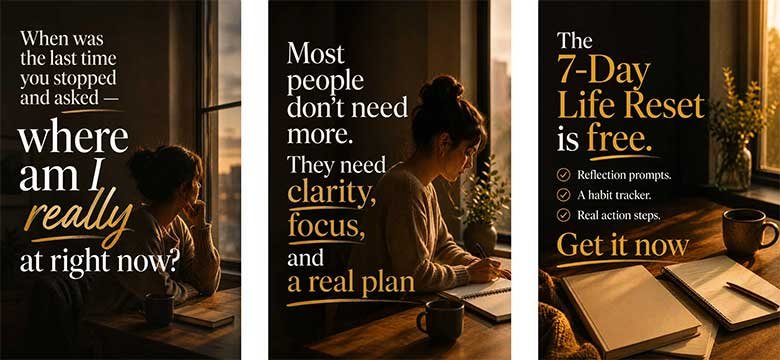
Free Download: The 7-Day Life Reset
Self reflection without action stays in your head. The 7-Day Life Reset gives you seven days of practical steps to take what you discover about yourself and start building something different from it. A clearer direction, better habits, and a life more aligned with what actually matters to you. Download it free today.
Get the Free 7-Day Life Reset10. “Be yourself; everyone else is already taken.”
Oscar Wilde said this with his usual lightness, but the truth underneath it is serious. Self-reflection is partly the process of separating who you actually are from who you have been performing for other people. Most of us carry a version of ourselves that was shaped more by what others needed from us than by what we actually are. The work of reflection is the work of finding the person underneath all of that and choosing to be them, even when a more performed version would be easier to present.
11. “The privilege of a lifetime is to become who you truly are.”
“Self-reflection is partly the process of separating who you actually are from who you have been performing for other people.”
Carl Jung wrote this and called it a privilege for good reason. Many people go their entire lives without doing the work of becoming who they actually are. They become who their parents needed them to be, or who their culture approved of, or who kept the peace in their family of origin. Becoming who you truly are requires first finding out who that is, and that finding out is the work of honest, sustained self-reflection. It is hard work. It is also the most worthwhile work available to a human being.
12. “We are what we pretend to be, so we must be careful about what we pretend to be.”
Kurt Vonnegut wrote this at the beginning of Mother Night and it has stayed because it is uncomfortably accurate. The roles you play, the identities you perform, the versions of yourself you present consistently enough eventually become what you are. Self-reflection is the practice of noticing what you have been pretending to be and asking honestly whether it is the person you actually want to become. The answer to that question is more important than almost anything else you will ever figure out.
13. “Follow effective action with quiet reflection. From the quiet reflection will come even more effective action.”
“The roles you play and the versions of yourself you present consistently enough eventually become what you are. Self-reflection is how you notice what you have been pretending to be.”
Peter Drucker said this and it places reflection not as a substitute for action but as the thing that makes action better. The person who acts without reflecting keeps making the same kinds of mistakes. The person who reflects without acting stays stuck in their own head. The combination, action followed by honest reflection followed by better action, is what actual growth looks like in practice. The quiet reflection is not a break from the work. It is part of the work.
14. “Almost everything will work again if you unplug it for a few minutes, including you.”
Anne Lamott wrote this with the humor she is known for, but it points toward something real. Self-reflection requires stillness, and most people are so consistently plugged in, to their phones, their obligations, their noise, that the stillness never comes. The clarity that honest self-reflection produces cannot happen in the middle of constant distraction. Unplugging is not laziness. It is the specific condition under which you can actually hear what you think and feel and need. You cannot reflect on a life you never slow down enough to examine.
15. “There is nothing noble in being superior to your fellow man; true nobility is being superior to your former self.”
“The clarity that honest self-reflection produces cannot happen in the middle of constant distraction. You cannot reflect on a life you never slow down enough to examine.”
Ernest Hemingway said this and it reorients the whole direction of self-reflection away from comparison and toward genuine growth. The question is not whether you are doing better than the person next to you. It is whether you are doing better than the person you were last year. That is the only comparison that actually produces growth, because it is the only one you have any control over. Self-reflection makes that comparison honest. It shows you exactly where you have grown and exactly where you have not yet.
16. “What you resist, persists.”
Carl Jung said this in a number of forms across his writing and it is one of the most practically useful ideas in all of his work. The things you refuse to look at do not go away. They simply move underground and continue operating from there, showing up in your behavior, your relationships, and your choices in ways you cannot see or manage because you have chosen not to see them. Honest self-reflection is the practice of stopping the resistance. What you are willing to look at, you can change. What you refuse to look at runs you.
17. “The soul usually knows what to do to heal itself. The challenge is to silence the mind.”
“What you are willing to look at, you can change. What you refuse to look at runs you.”
Caroline Myss wrote this and it captures what most people find when they finally slow down enough to reflect honestly. The answers are often already there. The direction is already known. What is drowning it out is the noise, the busyness, the constant forward motion, the refusal to be still long enough to hear what you already know. Self-reflection is not the process of finding answers that do not exist. It is mostly the process of getting quiet enough to hear the ones that were already there.
How Kezia and Joel Each Found the Quote That Made Them Stop and Look at Themselves Honestly
Kezia had been in the same pattern in her closest relationships for as long as she could remember. She would give everything she had, feel taken for granted, build resentment quietly until something snapped, and then either explode or disappear. Every time it happened she had a clear explanation for why the other person was the problem. The Jung quote about irritation as a mirror arrived at exactly the wrong moment for her defenses and exactly the right moment for her growth. Everything that irritates us about others can lead us to an understanding of ourselves. She sat with it for a long time. What she found when she looked was uncomfortable and accurate and the beginning of the first real change she had made in that pattern in years.
Joel’s moment came from the Gurdjieff quote about self-knowledge and freedom. He had been making the same professional mistakes repeatedly, choosing the wrong environments, undervaluing himself in negotiations, and staying too long in situations that were clearly not working. He had always framed this as bad luck or difficult circumstances. The Gurdjieff framing reoriented it completely. He was not free because he did not know himself well enough to be free. He was being governed by patterns he had never examined. He started a journaling practice that month, not because anyone told him to but because for the first time he genuinely wanted to understand how his own machine worked. The mistakes did not disappear. But they stopped surprising him. And that was where the change began.
The Most Honest Thing You Can Do Is Look at Yourself Clearly and Keep Going Anyway
Honest self-reflection is not the same as self-criticism. It is not about finding everything wrong with yourself and cataloguing it. It is about seeing yourself as clearly as possible so that your choices come from understanding rather than habit, from intention rather than pattern, from who you actually are rather than who you have been on autopilot.
The seventeen quotes in this article all point toward the same practice from different angles. Slow down. Look inward. Ask the uncomfortable questions. Stay with the answers long enough to let them mean something. Then act from what you find.
You do not need to have everything figured out before you start. You just need to be willing to look. That willingness is where all honest growth begins.

Free Download: The 9 Daily Habits Checklist
Let these self reflection quotes be the reminder you needed that honest growth is a daily practice, not a one-time event. The free 9 Daily Habits Checklist gives you nine daily practices to build the self-awareness and intention that real growth requires. Download it free today.
Get the Free Habits ChecklistOur Top Picks for a Better Life
We have gathered our favorite tools, resources, and recommendations for building a deeper self-awareness, a more honest inner life, and the daily practices that support real and lasting personal growth. Everything we trust enough to share, all in one place.
See Our Top Picks
Self Reflection Reminders at Premier Print Works
Keep the reminders that matter most visible on the days when it is tempting to look everywhere except inward. Visit Premier Print Works for prints, mugs, and art for people who are doing the honest inner work that real growth requires.
Visit Premier Print WorksDisclaimer
The content on A Self Help Hub is for informational and inspirational purposes only. The self reflection quotes and personal stories in this article offer general support for everyday self-awareness, personal development, and intentional living. They are not professional mental health advice, psychotherapy, medical advice, or any form of clinical treatment.
If you are dealing with significant depression, anxiety, trauma, or persistent difficulty affecting your daily functioning, please speak with a qualified mental health professional. General self-help content is not a substitute for professional care.
The stories and composite characters in this article, including Kezia and Joel, are illustrative. They are based on common experiences and created to make the content relatable. They are not real people. Any resemblance to a specific person is coincidental.
Some links on this site, including links to Premier Print Works, may be affiliate links. A Self Help Hub may earn a small commission at no extra cost to you. We only recommend things we genuinely believe in.
If you are in a mental health crisis or thinking about self-harm, please do not rely on this content for support. Contact emergency services or a crisis helpline right away. You deserve real help and it is available to you now.
All content on A Self Help Hub is copyrighted. You may not copy or republish it without written permission. By reading this article you agree to this disclaimer.