7 Life Balance Habits That Help You Feel More in Control
By Wednesday, most of my weeks used to belong to somebody else.
Requests, messages, and small emergencies would fill every gap, and whatever I had planned for myself got pushed to “later.” Nothing was wrong in any dramatic way. I just felt like a passenger in my own schedule. What changed things for me was a handful of habits that decided, ahead of time, what my week was for, and a better to-do list had little to do with it.
These seven habits are about feeling in control, which is different from being in charge of everything. Life will still send surprises. But a steady weekly rhythm, a few clear rules, and one thing protected just for you can make those surprises easier to absorb. Try one or two at a time, and adjust them to fit your life.

Build the Daily Habits That Put You Back in Control
Download the free 9 Daily Habits guide and get nine simple morning practices that give your days a steady, self-directed shape.
Get the Free Guide1. Pick your two or three non-negotiables, so the rest of the week has something to bend around.
Not everything can be equally important. Decide on the two or three things that must happen for your week to feel okay. For one person, it might be sleep, time with family, and one workout. For another, it might be a project deadline, a call with a parent, and a quiet evening.
Write them down. When the week gets crowded, these are the things you protect first. Everything else can flex.
Choosing your non-negotiables takes a few minutes, and it can change how you decide on every request that comes in.
Write down your two or three non-negotiables for this week, and put them where you will see them.
2. Plan your week on one set evening, so you steer it instead of reacting to it.
Choose a regular time, maybe Sunday evening, to look ahead. Open your calendar, and put your non-negotiables in first. Then add fixed commitments. Then notice where the gaps are, and decide what to do with them.
Keep it to fifteen or twenty minutes. The goal is a rough shape for the week, and perfection is unnecessary.
A short plan made in advance beats a long list made in a panic.
Pick a regular time for a fifteen-minute weekly plan, and do your first one this week.

Keep a Reminder That You Steer Your Week
Premier Print Works creates quality prints, mugs, and shirts for people steering their own days. Find a small reminder that you get a say in how your week goes.
Visit Premier Print Works3. Set a firm shutdown time for work, so evenings can belong to you.
Work tends to expand to fill whatever space you give it. A set stopping time puts a boundary around it. Choose a time that is realistic for your job, and treat it like an appointment.
At that time, close your laptop, put away your work phone if you can, and take a few moments to mark the shift. Write down tomorrow’s first task, so your mind can let go.
If your work makes this hard, do what you can, and talk with your employer if needed.
Choose a shutdown time for work, and keep it for the next five days.
“Feeling in control seldom comes from doing more. It comes from deciding ahead of time what your week is for.”
4. Handle small tasks in batches, so they stop nibbling at your whole day.
Small tasks, such as replying to messages, paying bills, making calls, and filing papers, can scatter your attention. Group them into one or two short blocks a day or a week.
When a small task pops up outside the block, write it on your list, and wait. Most things can.
Batching gives you long stretches of attention for the work that matters, and a sense of being on top of the little things.
Choose one thirty-minute block this week to handle all your small tasks together.
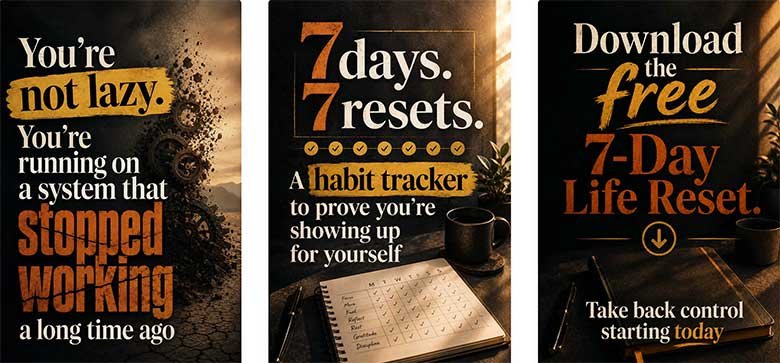
Plan a Steadier Week With a Quick Reset
The free 7-Day Life Reset gives you a short, simple way to look at your week and decide what gets your time before the week starts.
Get the Free Reset5. Protect fifteen minutes a day that belong only to you.
Control also means having some part of the day that is yours. It does not have to be long. It might be a walk, a cup of tea in silence, a few pages of a book, or a short hobby session.
Put it on your calendar like any other appointment. Choose a time when it is easiest to keep, such as early morning or right after dinner.
Many people find that this small, reliable pocket of time makes the rest of the day feel more manageable.
Choose a fifteen-minute slot for yourself each day, and put it on your calendar for the week.
6. Use a simple rule for new commitments, such as adding one only when you remove one.
Calendars get crowded because we keep adding and rarely subtract. A one-in, one-out rule can help. When you agree to something new, look for something to drop, shrink, or hand off.
You might also pause before answering. “Let me check my calendar and get back to you” gives you time to decide.
A simple rule keeps your life from filling up by accident.
Adopt a one-in, one-out rule for the next month, and notice what you choose to drop.
7. Finish each week with a short reset, and carry forward only what matters.
At the end of the week, spend ten minutes looking back. What went well? What took more energy than you expected? What did not get done, and does it still matter?
Move what matters to next week, and let the rest go. Tidy your workspace, and clear your head by writing down loose thoughts.
Starting the new week from a clear page helps you feel in charge of it.
At the end of this week, spend ten minutes on a reset, and write down what you will carry forward.
Explore Our Top Picks for a Better Life
We have gathered the tools, resources, and products we think are genuinely worth your time, covering mindset, self-care, health, and home. All in one place, hand-picked to support a steadier, more balanced life.
See Our Top PicksReal Stories, Real Results
Let me share two examples I like to use. Amara felt that her weeks were always being decided for her. She chose three non-negotiables, sleep, a weekly dinner with her sister, and one morning for herself, and she planned her week on Sunday evening. She told me that the weeks were just as busy, and she felt much less like a passenger.
Joel’s biggest change was the shutdown time. He had been answering work messages until bedtime, and his evenings had vanished. He picked six o’clock, wrote down tomorrow’s first task, and closed his laptop. He said the first few days felt uncomfortable, and then he began to enjoy his evenings again. Both of them said the same thing: a few clear habits gave them back a feeling of control.
Feeling in Control Comes From Deciding Ahead of Time What Your Week Is For
Picture a Sunday evening where you spend fifteen minutes with your calendar and decide how the week will go. Your non-negotiables are in place, your shutdown time is set, and you have a few minutes just for you each day. The week will still surprise you. You will meet it from steadier ground.
Choose one or two habits from this list, and start with your non-negotiables. Download the free 9 Daily Habits guide to give your mornings a steady base. Control tends to grow from small, repeated choices.
Want Ready-Made Tools to Help You Put This Into Action?
Sometimes the fastest way forward is a tool that someone has already built. Browse our hand-picked resources and downloads, chosen to help you take the next step with less guesswork.
Browse Resources and Downloads
Ready to Feel More in Control of Your Days?
The free 9 Daily Habits guide gives you simple morning practices that make a steadier, more balanced life easier to keep.
Download Free Now
Fill Your Space With Steady Intention
Premier Print Works makes quality prints, mugs, and shirts for people who run their lives with intention. Browse the collection and find what speaks to your journey today.
Visit Premier Print WorksDisclaimer
The content on this page is for informational and inspirational purposes only. It is not professional mental health, medical, or career advice of any kind. If you are experiencing persistent stress, exhaustion, anxiety, or low mood, please consider seeking support from a qualified professional. Results and experiences vary significantly from person to person.
The stories of Amara and Joel are illustrative composite characters created to bring the content to life. They are not real people. Any resemblance to a real person is purely coincidental.
Some links on this page, including links to Premier Print Works and other resources, are affiliate links. If you make a purchase through one of these links, we may earn a small commission at no extra cost to you. We do not own, produce, or control any affiliate products, and we are not responsible for them — we only own and sell the products offered through our own store, Premier Print Works.
All content on A Self Help Hub is the property of Digital Marketing 215 LLC and is protected by copyright law. No part of this page may be copied, reproduced, republished, distributed, or transmitted in any form without prior written permission from the author.