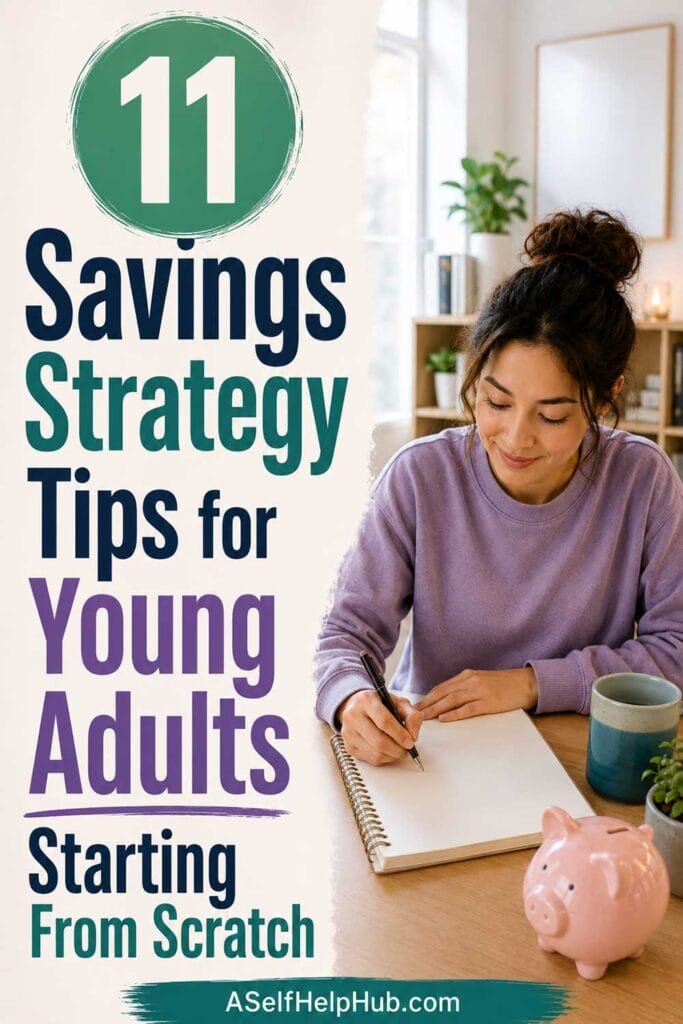
7 Personal Finance Habits That Help Young Adults Build Confidence
Financial confidence is not something most young adults are handed. It is built — slowly, through the accumulation of better habits applied to whatever income and circumstances exist right now. The habits that build it are not complicated and they are not contingent on having a high income or a perfect financial starting point. They are available to anyone who is willing to start where they are and build consistently from there.
The earlier these habits are established the more time compounding works in their favor — both the financial compounding of savings and investment and the habit compounding of skills and self-trust built through years of managing money deliberately. These 7 habits are the foundation. Build them now and they will carry you further than almost any other financial decision made later can compensate for.

Build the Financial Foundation That Creates Real Confidence From the Ground Up
Download the free Money Reset Workbook and get the practical tools to understand your real financial picture, build the habits that create genuine control over your money, and develop the steady financial confidence that comes from knowing your finances are actively managed.
Get the Free Workbook1. Know your actual numbers — total monthly income, total monthly expenses, total debt, total savings — and update them monthly so you always have an accurate financial picture rather than a rough guess.
Financial confidence begins with accurate information. The young adult who knows their exact monthly income, their actual monthly spending by category, the precise balance and interest rate of every debt they carry, and the current total of every savings account they hold has the foundation for every good financial decision available. The one who operates from rough estimates and avoidance has no reliable foundation for any of it — and the anxiety produced by not knowing is almost always worse than the anxiety produced by knowing and having to face what is there.
Build a simple financial snapshot this week: total all income, total all recurring expenses, list every debt with its balance and minimum payment, list every savings account with its balance. Update it every month on the same day. The monthly update takes fifteen minutes and produces the accurate, current financial picture that financial confidence is built from. You cannot manage what you have not clearly seen. See it clearly first, then manage it from there.
2. Build a starter emergency fund before pursuing any other financial goal — because the cushion that covers one significant unexpected expense is the most important financial safety net available at any income level.
The starter emergency fund is the single most impactful financial habit for young adults because it converts the first significant unexpected expense — the car repair, the medical bill, the appliance failure — from a crisis that goes on a credit card at high interest into a covered expense that goes through savings. Without it, every unexpected event sets back whatever other financial progress was being made. With it, unexpected events are handled and the financial progress continues.
Set a specific, modest savings target as the starter fund — enough to cover one significant unexpected expense — and pursue that single goal with every available dollar above minimum obligations until it is funded. Do not simultaneously pursue multiple savings goals until this one is established. The sequential approach — one goal fully funded before the next begins — is more effective than the parallel approach that spreads thin resources across multiple targets and reaches none of them quickly enough to feel real.
“Financial confidence for young adults is not built from having more money. It is built from knowing what you have, managing it deliberately, and building the habits early that compound into genuine financial security over the years that follow.”
3. Build and protect your credit score — by paying every bill on time, keeping credit utilization low, and understanding what affects the number that will determine the cost of credit for decades.
Credit scores affect the cost of borrowing across a lifetime — the interest rate on student loans, car loans, mortgages, and credit cards is directly influenced by the credit score at the time of application. A strong credit score built early and maintained consistently produces significantly lower lifetime borrowing costs than a score neglected and then repaired later. The habits that build it are simple and their benefit compounds across the decades they are applied.
Pay every bill on time every month — automate minimum payments so nothing is missed. Keep the balance on any credit card below 30 percent of the credit limit — ideally below 10 percent — to maintain a low utilization ratio. Do not close old credit accounts that are in good standing, as account age contributes positively to the score. Check your credit report annually for errors and dispute any inaccuracies. These four habits, maintained consistently, produce one of the highest-value long-term financial returns available to any young adult with the discipline to apply them.
4. Start saving for retirement as early as possible — even a small amount — because the compounding effect of early investment produces wealth that later contributions at higher amounts cannot replicate.
The most powerful financial advantage available to young adults is time. A small retirement contribution started at twenty-two produces significantly more wealth at sixty-five than a much larger contribution started at thirty-five — because the earlier contribution has more years to compound. This mathematical reality is one of the most well-documented in personal finance and one of the most consistently underutilized because the retirement feels distant enough that the urgency is hard to feel from the present moment.
Start contributing to a retirement account this month, even if the amount is small. If your employer offers a 401(k) match, contribute at least enough to receive the full match — that match is an immediate 50 to 100 percent return on the contribution that no other investment reliably provides. If no employer match is available, open a Roth IRA and contribute whatever is currently manageable. The habit of contributing consistently — adjusted upward as income grows — is more important than the initial amount. Start now and increase over time.
5. Spend below your income consistently — by building a simple budget that ensures your monthly expenses are always less than your monthly take-home — and save or invest the difference deliberately.
The most fundamental personal finance habit available is also the most consistently difficult to maintain in a consumer culture that treats spending at the limit of income as normal: spend less than you earn. The gap between income and spending is the source of all financial progress — every emergency fund, every debt payment, every investment, every future option depends on that gap existing and being directed deliberately rather than being absorbed into expanded spending as income grows.
Build a simple budget that shows you clearly whether your spending is below your income. If it is not, identify the specific categories to reduce until it is. If it is, identify where the gap is going — if it is not going anywhere specific, it is being absorbed somewhere untracked. Direct the gap deliberately: a percentage to the emergency fund until it is funded, a percentage to debt above the minimum, a percentage to retirement. The deliberate direction of the gap between income and spending is what converts a financially functional young adult into a financially secure one over the years of consistent application.

Celebrate the Financial Foundation You Are Building Right Now
Premier Print Works creates quality prints, mugs, and shirts for people who are doing the intentional work of building a financially confident life — including the young adults who are starting early and building well. Find what keeps your motivation strong today.
Visit Premier Print Works6. Learn the basic vocabulary of personal finance — budgeting, compound interest, credit utilization, emergency fund, index fund, net worth — so you can make informed decisions rather than uninformed ones.
Financial literacy is not a prerequisite for starting good financial habits — the habits in this article can be applied without knowing the vocabulary behind them. But the vocabulary, once learned, makes every subsequent financial decision more informed: the understanding of compound interest that makes starting retirement savings urgent, the understanding of credit utilization that makes keeping card balances low obvious, the understanding of net worth that gives the monthly financial picture a long-term context. Knowledge does not replace habits but it makes the habits make sense in ways that improve both motivation and application.
Commit to learning one personal finance concept per month. Not a textbook commitment — a reasonable one. One well-written article, one short video, one chapter of an accessible personal finance book. The twelve concepts learned across a year of consistent attention produce the functional financial literacy that school rarely provides and that makes every financial decision better than the uninformed equivalent. Start with whatever concept is most immediately relevant to your current financial situation.
7. Approach financial mistakes with curiosity rather than shame — because the shame produces avoidance, the avoidance produces more mistakes, and the curiosity produces the learning that breaks the cycle.
Financial mistakes are a universal feature of financial life — especially early financial life, when the skills and knowledge are still being built and the consequences of errors are lower than they will ever be again. The young adult who approaches their financial mistakes with shame tends to avoid the financial situation more broadly — avoiding the accounts, avoiding the planning, avoiding the honest look at what is happening — which produces more of the same mistakes rather than fewer. The one who approaches mistakes with genuine curiosity — what happened here, what pattern does this reveal, what would I do differently — extracts the learning that makes each mistake less likely to repeat.
When you make a financial mistake — and you will, because everyone does, especially early — sit with it long enough to extract the specific lesson without indulging the self-punishment that takes you away from the financial situation rather than further into understanding it. What happened? What contributed to it? What change would prevent it next time? Then make the change and move forward. The person who learns consistently from financial mistakes builds the financial skill that the person who avoids looking at them cannot develop.
“The young adult who builds these habits now is not just building a better financial situation for later. They are building the financial identity — the self-concept of someone who manages money well — that makes every subsequent financial decision come from a different and more solid place.”
Explore Our Top Picks for a Better Life
We have gathered the best tools, resources, and products to help young adults build the personal finance habits that create real financial confidence — the kind that comes not from having the perfect income or the ideal circumstances but from managing whatever you have deliberately and consistently from wherever you are starting. All in one place, hand-picked just for you.
See Our Top Picks
Reset Your Financial Habits and Start Building Real Confidence With Your Money This Week
The free 7-Day Life Reset gives you a simple daily plan to break the old money patterns that are holding your financial confidence back and build the consistent habits that create the steady inner certainty that comes from managing money well.
Get the Free Reset GuideReal Stories, Real Results
Kezia graduated with a modest income and a financial situation she had been avoiding for six months. The avoidance had not made anything better — it had allowed small manageable issues to accumulate into a picture that was more concerning than it would have been if she had looked honestly six months earlier. What broke the avoidance was a simple challenge from a friend: just write the numbers down. Total income. Total expenses. Total debt. Total savings. She did it on a Sunday afternoon expecting it to be worse than she could handle. It was uncomfortable and it was also, once written, specific enough to be addressed. She identified three changes she could make immediately: cancel two unused subscriptions, start the automatic savings transfer her employer had been offering and she had been ignoring, and pay more than the minimum on her highest-interest debt. None of the changes required a higher income or a dramatically different lifestyle. They required looking honestly at what was there and making three decisions about it. Six months later her financial picture was measurably different. She said the most important moment was not any of the three decisions — it was the Sunday afternoon when she wrote the numbers down and found out the situation was specific rather than formless. Specific situations have specific solutions. The avoidance had kept the situation formless and therefore unaddressable for six months longer than it needed to be.
Daniel had been told to start saving for retirement in his mid-twenties and had not done it because the amount he could contribute felt too small to matter. He started at twenty-six with a contribution that genuinely seemed negligible — a small percentage of a modest income into an employer-sponsored retirement account that his employer partially matched. He increased the percentage whenever he received a raise, directing the increase to the retirement account before it could become lifestyle inflation. He did not think much about it for several years. When he did the math in his early thirties, the combination of his contributions, his employer’s match, and the compounding of several years of investment had produced an account balance that surprised him — not because any individual year had been dramatic but because the consistent habit applied over time had produced what no later attempt at a larger single contribution could have replicated. He said the math had not been real to him when he started. It became real when he could see it in the account balance. He wished he had started six months earlier than he did and he was deeply grateful he had not waited the additional years he had been tempted to.
Financial Confidence Built Early Compounds Into Financial Freedom Later
Every habit in this article is most powerful when it begins early — not because the early version produces immediate dramatic results but because the compounding of consistent application across years produces results that later starting cannot replicate. The emergency fund that prevents the first debt spiral. The credit score built early that reduces borrowing costs across decades. The retirement contribution started now that grows into the financial security future-you will need. The habits built in your twenties are the foundation of the financial life you will live in your forties and fifties.
Choose the habit from this list that is most immediately actionable in your current situation and start it this week — not when the conditions feel more favorable, this week. Download the free Money Reset Workbook to build the honest financial picture that gives every habit on this list accurate numbers to work from. Financial confidence is not something that arrives later when things improve. It is built now, from exactly where you are, through exactly these habits applied consistently over time.

Build the Financial Foundation That Sets You Up for Lasting Confidence and Security
The free Money Reset Workbook gives you the practical tools to see your complete financial picture clearly, build the habits that create genuine control over your money, and develop the financial confidence that grows stronger the longer you apply it.
Download Free Now
Surround Yourself With What Reminds You What You Are Building
Premier Print Works makes quality prints, mugs, and shirts for people who are doing the intentional work of building a financially confident life and want the daily reminder of the foundation they are putting down. Browse the collection and find what speaks to where you are headed today.
Visit Premier Print WorksDisclaimer
The content on this page is for informational and educational purposes only. It is not professional financial, investment, or legal advice of any kind. Every financial situation is unique and individual results vary significantly. Please consult a qualified financial professional before making significant financial or investment decisions. Information about retirement accounts, credit scores, and other financial products is general in nature and may not reflect current regulations or offerings in your area.
The stories of Kezia and Daniel are illustrative composite characters created to bring the content to life. They are not real people. Any resemblance to a real person is purely coincidental.
Some links on this page, including links to Premier Print Works and other resources, are affiliate links. If you make a purchase through one of these links, we may earn a small commission at no extra cost to you. We only recommend things we genuinely believe in.
If you are in crisis, please contact emergency services or a crisis helpline in your area immediately. You are not alone and help is available.
All content on A Self Help Hub is protected by copyright. It may not be copied, republished, or distributed without written permission from the author.