17 Habit Building Tools That Help You Live More Intentionally
Living more intentionally starts with having the right tools to help you build habits that actually align with the life you are working to create, rather than the one you keep falling back into by default. The default life is not bad. It is just not chosen, and there is a significant difference between a life that happens to you and one that is built deliberately from the inside out.
These 17 habit building tools cover trackers, accountability systems, journaling frameworks, and mindset strategies that make showing up for your goals feel less like a struggle and more like a natural part of who you are becoming. The right tools do not build your habits for you. They simply make it easier to show up for them every single day.
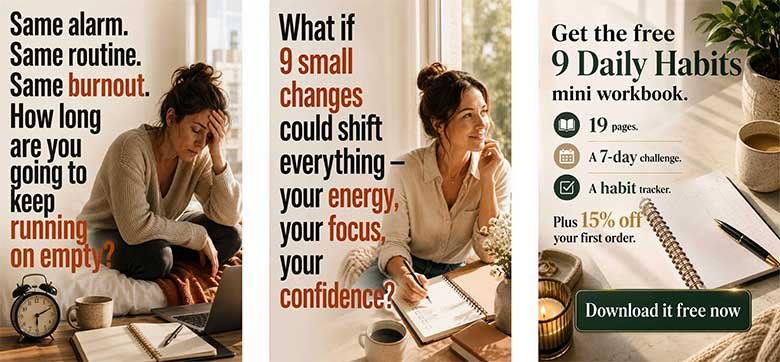
Free Download: The 9 Daily Habits Checklist
Intentional living is not an accident, it is the result of building systems that keep pulling you back to what matters most, and the 9 Daily Habits Checklist is one of the simplest systems available. Download the free checklist and start building the habits that build the life. Download it free today.
Get the Free Habits Checklist1. A Paper Habit Tracker
“The right tools do not build your habits for you, they simply make it easier to show up for them every single day.”
A simple paper habit tracker, a grid with dates across the top and habits down the side, uses the visual satisfaction of marking each completed day to build the “don’t break the chain” momentum that sustains habits through the early weeks when motivation alone is insufficient. Paper trackers outperform their digital counterparts for many people because the physical act of marking the completion is more satisfying and more visible than a checkbox in an app that can be ignored without consequence.
2. A Weekly Planning Session
A twenty-minute weekly planning session, conducted at the same time each week, reviews what happened in the past week, identifies the top priorities for the coming one, and ensures that the most important habits and commitments have protected time in the schedule before the less important things fill it. The weekly review is the operating system for an intentional life. Without it, days default into whatever arrives first rather than what matters most.
3. Habit Stacking
“Intentional living is not an accident, it is the result of building systems that keep pulling you back to what matters most.”
Habit stacking, attaching a new habit to an existing one, uses the cue from an established behavior to trigger the new one. After I pour my morning coffee, I will write three things I am grateful for. After I sit down at my desk, I will review my top three priorities for the day. The existing habit provides a reliable cue that removes the need to remember to do the new habit or to find the motivation to initiate it independently.

Visit Premier Print Works
Keep the reminder that intentional living is the result of building systems that keep pulling you back to what matters most visible where your daily habits happen. Premier Print Works offers prints, mugs, and art for the person building a more deliberate and purposeful life. Visit the shop today.
Visit Premier Print Works4. Environment Design
The most reliable way to make a habit easier is to reduce the friction between you and the behavior you want to perform. Leave the running shoes by the door. Put the book on the pillow. Keep the journal on the desk rather than in the drawer. Remove the things that support habits you are trying to break from visible, accessible positions. The environment shapes the behavior far more consistently than motivation does, and designing it deliberately is one of the highest-leverage habit-building tools available.
5. An Accountability Partner
An accountability partner who is genuinely working toward their own goals, with whom you check in weekly about progress and obstacles, introduces a social component to habit-building that most people underestimate. The knowledge that someone else is aware of your commitment changes the calculation around skipping, and the shared experience of working toward meaningful goals provides both motivation and the kind of honest feedback that solo goal-pursuit rarely generates.
6. A Daily Intention Statement
A single sentence written each morning that states one specific way you intend to show up today, “Today I will approach difficult conversations with patience” or “Today I will take a twenty-minute walk before checking email,” is a habit-building tool that operates through the principle that intention stated explicitly is significantly more likely to produce the corresponding behavior than intention held only in general terms.
How Kezia and Daniel Found the Tools That Actually Made Their Habits Stick
Kezia and Daniel had each tried many times to build better habits and had found the same pattern each time: strong start, gradual erosion, quiet abandonment followed by a period of feeling bad about the abandonment before the next attempt. The habits themselves were not the problem. The systems around them were absent, which meant the habits had to run entirely on motivation and willpower, both of which are finite and inconsistent.
They tried environment design first, the simplest tool on the list. Kezia placed her journal on the kitchen table where she had her morning coffee. Daniel put his running shoes directly in front of the bedroom door. Both changes took less than five minutes and produced immediate behavioral changes with no additional effort. The habits had not gotten easier. The friction between them and the habits had gotten lower.
They added a weekly fifteen-minute check-in with each other three weeks later. Not a performance review, just an honest exchange about what was working and what was not. The combination of designed environment and social accountability produced more sustained habit maintenance than any previous attempt had achieved, because it was not relying on the two most unreliable habit-building ingredients: motivation and memory.
7. A Morning Pages Practice
“The right tools do not build your habits for you, they simply make it easier to show up for them every single day.”
Morning pages, three pages of uncensored longhand writing completed first thing in the morning before any other input arrives, is one of the most consistently effective tools for building self-awareness, clearing mental clutter, and identifying what actually matters versus what is simply loud. The practice does not require good writing. It requires only showing up and writing whatever arrives, without editing, until the three pages are done.
8. A Two-Minute Rule for New Habits
The two-minute rule, making any new habit take two minutes or less to start, reduces the activation energy required to begin the behavior to the point where starting becomes easier than not starting. Meditate for two minutes rather than twenty. Write two sentences rather than a page. Walk to the end of the driveway rather than around the block. The two-minute version is not the final goal. It is the reliable start that makes the longer version consistently possible.
9. A Values-Based Goal List
Goals built directly from your core values tend to maintain motivation through difficulty in a way that goals built from external comparison or social pressure rarely do. A values-based goal list names two or three specific goals in each of the core value areas you have identified, and regularly checks whether the current habits are moving toward those goals or away from them. When the goal connects visibly to the value, the daily habit that serves it carries a different quality of motivation.

Free Download: The Self-Care Starter Kit
Building habits that last is supported by genuinely taking care of yourself each day. The free Self-Care Starter Kit gives you simple daily practices for your mind and body that support the intentional life you are building. Download it free today.
Get the Free Self-Care Starter Kit10. An Evening Review Practice
“Intentional living is not an accident, it is the result of building systems that keep pulling you back to what matters most.”
A brief evening review, three to five minutes of honest reflection on what habits were completed, what was missed, and what tomorrow needs, closes the loop on the day deliberately rather than letting it simply end. The review does not need to be harsh or elaborate. It needs to be honest enough to catch drift early, when a single missed habit is a moment to note rather than a pattern to be undone.
11. Temptation Bundling
Temptation bundling pairs an activity you want to do with one you need to do, in order to make the latter more appealing. Only listening to a favorite podcast while exercising. Only watching a specific show while folding laundry. The enjoyable activity becomes the reward for engaging with the less desirable one, and the result is that both happen more reliably than either would have in isolation.
12. A Done List Alongside a To-Do List
A done list, maintained alongside the standard to-do list, records what was actually accomplished each day, including the habits completed, the decisions made, and the small invisible progress that to-do lists do not capture because it was never written as a task. The done list produces a more accurate and often more motivating picture of the day than the to-do list alone, because it makes visible the work that gets done but is rarely acknowledged.
13. Implementation Intentions
Implementation intentions, specific if-then statements that define exactly when, where, and how a habit will occur, dramatically increase the follow-through rate compared to general intention. “I will meditate for ten minutes” becomes “When I sit at my desk with my first coffee each morning, I will close my eyes and meditate for ten minutes before opening my laptop.” The specificity removes the on-the-spot decision-making that is often what prevents good intentions from becoming consistent behavior.
How Daniel’s Two-Minute Rule Changed the Habit He Had Been Failing at for Two Years
Daniel had been trying to build a consistent reading habit for two years with consistent lack of success. He had tried scheduling it, setting phone reminders, buying appealing books, and allocating dedicated reading time that consistently got absorbed by other things. The habit kept failing at the same point, the activation energy required to pick up the book when other options were available.
He tried the two-minute rule. The only commitment was to open the book and read for two minutes. Not a chapter, not thirty minutes, two minutes. The first week he almost always read longer than two minutes once he had started, because starting had been the problem, not sustaining. The barrier between him and the habit had been the threshold of beginning, and the two-minute rule had simply lowered that threshold to the point where not starting required more effort than starting.
Two years later the habit was so thoroughly established that he had stopped thinking of it as a habit. It had simply become part of the evening, as automatic as brushing his teeth, built entirely from a two-minute commitment made daily until the commitment was no longer necessary because the behavior had become the default.
14. A One-In One-Out Rule for Commitments
A one-in one-out rule, adding a new habit or commitment only when an existing one is released, prevents the accumulation of more commitments than available time and energy can sustain. Habit overload is one of the most consistent reasons that new habits fail within the first month. The one-in one-out rule is not a restriction on growth. It is the protection of the conditions under which sustainable growth is possible.
15. A “Never Miss Twice” Policy
“The right tools do not build your habits for you, they simply make it easier to show up for them every single day.”
Missing a habit once is not a failure. It is a data point. Missing it twice in a row is the beginning of a pattern. A personal policy of never missing the same habit two days in a row removes the perfectionism that causes people to abandon habits after a single missed day, while maintaining enough accountability to prevent the casual slide that turns one miss into a month of not showing up.
16. Identity-Based Habit Framing
Framing habits in terms of identity rather than outcomes, “I am a person who moves every day” rather than “I am trying to exercise more,” produces a different quality of motivation and a different response to missed days. The outcome-based framer who misses a workout has failed to meet a goal. The identity-based framer who misses a workout is simply acting out of character and has a strong incentive to return to character at the earliest opportunity.
17. A Quarterly Habit Audit
A quarterly habit audit reviews every current habit against the question of whether it is still serving the life and the goals you are currently working toward. Not whether it was a good habit when you started it, but whether it remains the right habit now. Habits that were appropriate at one stage of growth are not always appropriate at the next one, and the quarterly audit is the tool that catches misalignment before it has been silently operating for years.
The Right Tools Make Showing Up for Your Habits Feel Like Who You Are Becoming
A paper habit tracker. A weekly planning session. Habit stacking. Environment design. An accountability partner. A daily intention statement. Morning pages. The two-minute rule. A values-based goal list. An evening review. Temptation bundling. A done list. Implementation intentions. A one-in one-out rule. A never-miss-twice policy. Identity-based framing. A quarterly habit audit. Seventeen tools. The right tools do not build your habits for you, they simply make it easier to show up for them every single day, and intentional living is not an accident, it is the result of building systems that keep pulling you back to what matters most.

Free Download: The 9 Daily Habits Checklist
Start using these habit building tools to create a more deliberate, purposeful, and meaningful life one small habit at a time. The free 9 Daily Habits Checklist gives you nine proven daily practices to build from. Download it free today.
Get the Free Habits ChecklistOur Top Picks for a Better Life
We have gathered our favorite tools, resources, and recommendations for building the habits and systems that make intentional living possible. Everything we trust enough to share, all in one place.
See Our Top Picks
Intentional Living Reminders at Premier Print Works
Keep the reminder that intentional living is the result of building systems that keep pulling you back to what matters most visible where your daily habits happen. Visit Premier Print Works for prints, mugs, and art for the person building a deliberate and purposeful life.
Visit Premier Print WorksDisclaimer
The content on A Self Help Hub is for informational and inspirational purposes only. The habit building tools and personal stories in this article offer general support for everyday personal development and intentional living. They are not professional mental health advice, medical advice, or any form of clinical treatment.
If you are dealing with significant depression, anxiety, ADHD, or other conditions affecting your daily functioning and capacity to build and maintain habits, please speak with a qualified mental health or medical professional. General self-help content is not a substitute for professional care.
The stories and composite characters in this article, including Kezia and Daniel, are illustrative. They are based on common experiences and created to make the content relatable. They are not real people. Any resemblance to a specific person is coincidental.
Some links on this site, including links to Premier Print Works, may be affiliate links. A Self Help Hub may earn a small commission at no extra cost to you. We only recommend things we genuinely believe in.
If you are in a mental health crisis or thinking about self-harm, please do not rely on this content for support. Contact emergency services or a crisis helpline right away. You deserve real help and it is available to you now.
All content on A Self Help Hub is copyrighted. You may not copy or republish it without written permission. By reading this article you agree to this disclaimer.