9 How to Budget Habits That Help You Stay Ahead of Bills
I remember a stretch when I paid the same late fee three months in a row. The first time, I was annoyed and promised myself it wouldn’t happen again. By the third time, I was annoyed and a little embarrassed. I wasn’t careless with money in general. I just kept forgetting the lesson.
It turns out that’s common. Economists Sumit Agarwal, John Driscoll, Xavier Gabaix, and David Laibson studied four million monthly credit card statements. They found that people do learn from fees. Paying a fee one month cut the chance of paying one the next month by about 40 percent. Over the first four years of an account, monthly fee payments fell by about 75 percent. But the lesson didn’t last. The researchers estimated that what people learned faded by about 10 percent a month or more, so a fee from last month changed behavior far more than a fee from many months ago.
They also found that higher-income borrowers learned about twice as fast and forgot about half as quickly as lower-income borrowers. The study doesn’t say why, and I won’t guess. What I take from it is that remembering is hard for everyone, and forgetting a lesson isn’t a character flaw.
So the nine habits below don’t depend on you remembering. They build the lesson into your month, so a bill gets handled whether or not last month’s fee is still fresh in your mind. The research is about credit card fees. Everything beyond that comes from my own trial and error, and I’ll tell you which is which as we go.
Get Your Bills and Numbers on One Page
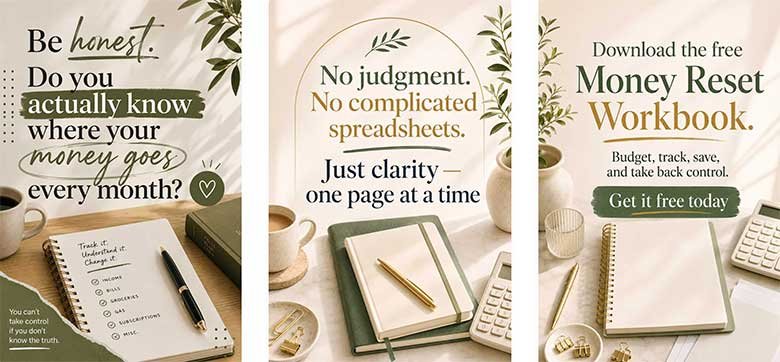
Grab my free Money Reset Workbook. It’s a good place to start putting your bills and due dates on paper.
Get the Free Workbook1. Write down the lesson the same day you pay a fee
The research says we learn from a fee, and then the lesson fades. A written note is a way to stop the fade. The day you get hit with a late fee, write down exactly what happened. “Due on the 14th, I thought it was the 18th.” One sentence is enough.
I keep a note on my phone called “Bill lessons.” When I read back through it, I can see my patterns. Most of my mistakes came from the same two or three causes. The note is my own habit, but it fits what the researchers found, which is that a fee teaches the most right after it happens. So capture the lesson then.
Try this: Start a note called “Bill lessons” and add one line about the last fee you paid.
2. Put every due date in one place you’ll actually see
Bills hide in different apps, envelopes, and emails. I remember finding a bill in a coat pocket weeks after it was due. Nothing was wrong with my budget. The bill just lived somewhere I never looked.
Make one list of every bill with four things: the name, the amount, the due date, and how you pay it. A calendar works. So does a sheet of paper on the fridge or a page in the Money Reset Workbook. The goal is one place, checked on purpose.
Try this: Spend 20 minutes today listing every bill you have, with its amount and due date.

A Small Reminder to Check Your Due Dates
I make prints, mugs, and shirts at Premier Print Works. Some people like a reminder where they can see it.
Visit Premier Print Works3. Set a reminder a few days before each due date
A reminder on the due date is often too late. Some payments can take a day or two to post, so paying on the last day is risky. Set the reminder three to five days ahead, so you have room to pay and to fix a mistake.
This one is my own approach, but the reason comes from the study. People slip when the lesson fades, and a reminder brings the lesson back at the right moment. You don’t have to remember. Your phone does.
Try this: Add a reminder to your phone for your next three bills, set a few days before each due date.
Learning from a fee is easy. Remembering the lesson next month is the hard part.
4. Turn on autopay for the bills that stay the same each month
Rent, insurance, phone, and internet bills usually cost the same each month. Those are good candidates for autopay, because the payment happens whether or not you remember.
Autopay has one catch. If your account doesn’t have enough money that day, you can end up with a bounced payment and a fee. So check your statements now and then, and pair autopay with the cushion in habit 6.
Try this: Pick your two most predictable bills and set them up on autopay this week.

Take a Week to Look at Your Money Habits
My free 7-Day Life Reset is a short week of reflection on your own routines. It’s a good place to start seeing what gets in your way.
Start the Free Reset5. Pay the minimum automatically on credit cards, then pay more by hand
Credit card bills change every month, so a fixed autopay amount doesn’t always fit. One option is to set autopay to the minimum payment. That protects you from a late fee if you forget. Then you pay extra yourself when you can.
Paying only the minimum every month can get expensive, since interest keeps building on what’s left. So treat the automatic minimum as a safety net, not as your plan. This is my own approach, and it’s a simple way to make sure one forgotten date never turns into a fee.
Try this: Log in to one credit card and set up an automatic minimum payment.
6. Keep a small cushion in checking so autopay never bounces
I remember a month when an autopay came out a day before my paycheck landed, and my account went negative. The bill was paid. The overdraft fee was not something I’d planned for.
A small cushion prevents that. Keep an extra amount in checking, enough to cover your bills if a paycheck comes late. Start with whatever you can manage, even $50, and let it grow over time. The right size is up to you.
Try this: Decide on a cushion number, move that amount into checking, and leave it alone.
7. Do a five-minute bill check once a week
Habits work best with a rhythm. Once a week, open your bill list and look at the next two weeks. Is anything due soon? Is anything already paid? Does your account have enough?
It takes about five minutes. I do mine on Sunday night. The check won’t fix a problem, but it lets you see one coming while you still have time to act. That’s the whole point.
Try this: Pick a day and time for your weekly bill check and put it on your calendar.
8. Treat a late fee as a signal, and then fix the system behind it
If you do get hit with a fee, don’t just feel bad. The study found that a fee teaches, so ask what it’s telling you. Did you miss the date, forget to fund the account, or lose track of the bill?
Then change something, so you aren’t relying on next month’s memory. It also never hurts to call the company and ask about removing the fee, since some will do it, especially for a first mistake.
Try this: Look at your last fee and write down the one change that would have prevented it.
9. Review your statements for fees once a month and look for patterns
Once a month, scan your statements for anything labeled fee, late, or over-limit. If you find one, look at the pattern. Is it always the same bill? Always the same time of month?
The researchers found that what people learn from a fee fades fast. A monthly look is my own way of refreshing the lesson before it slips away. Five minutes is usually enough to spot a pattern and plug the gap before the next fee.
Try this: At the end of this month, scan your statements for fees and write down anything you see twice.
Explore Our Top Picks for a Better Life
I put together a list of tools and products I think are worth your time, covering mindset, self-care, health, and home.
See Our Top PicksTwo People Who Stopped Paying Fees
I know a woman named Kezia who kept paying a late fee on a utility bill. The bill was due on the 3rd, and she kept thinking it was due on the 13th. She put every due date on one calendar, set a reminder two days before each one, and put that bill on autopay. She told me she hasn’t paid that fee in over a year.
I also think about a guy named Daniel who set up autopay on everything and then got an overdraft fee when one payment hit before payday. He didn’t drop autopay. He added a small cushion to his checking account and started a five-minute check on Sundays. He told me the surprise fees stopped, and so did the feeling of waiting for the next one.
Picture a Month With No Surprises
Imagine opening your banking app and knowing exactly what’s due this week. The bills are paid, the cushion is there, and nothing is waiting in a drawer. You aren’t counting on remembering. Your system remembers for you.
You don’t need all nine habits today. Start with the list of due dates, and add one more habit next week. If you’d like a place to keep it all, get my free Money Reset Workbook.
Want to Go Further?
I’m building out some deeper, paid resources for people who want more than a single article can cover. They’re not live yet, but you can see everything I currently have ready for you, free and otherwise, on my Top Picks page.
See What’s Available
Ready to Stay Ahead of Your Bills?
Download my free Money Reset Workbook and put your due dates in one place.
Download Free Now
A Small Reminder to Check Your Due Dates
Take a look at Premier Print Works for prints, mugs, and shirts made for people who like a small daily reminder.
Visit Premier Print WorksDisclaimer
This page is for information only. It is not financial, tax, legal, insurance, investment, or estate planning advice. Everyone’s finances are different, so consider speaking with a qualified professional, such as a certified financial planner or a nonprofit credit counselor, before making major money decisions. The research referenced here comes from the published work of Sumit Agarwal, John C. Driscoll, Xavier Gabaix, and David Laibson, “Learning in the Credit Card Market” (NBER Working Paper No. 13822, 2008, revised 2013), summarized here in plain language. It studied four million monthly credit card statements, so it covers credit card fees and may not apply to every kind of bill. The habits labeled as my own are based on my experience, not on research. Autopay can cause overdraft or bounced-payment fees if your account lacks funds, so check your statements regularly. Results vary from person to person.
Kezia and Daniel are made-up characters used to bring this content to life. They are not real people.
Some links on this page, including links to Premier Print Works, are affiliate links. If you buy something through one, we may earn a small commission at no extra cost to you. We only own and sell products through our own store, Premier Print Works.
All content on A Self Help Hub belongs to Digital Marketing 215 LLC and is protected by copyright law. No part of this page may be copied or reused without written permission.