15 Words of Encouragement That Help You Believe in Better Days
Believing in better days is not something that happens all at once. It is rebuilt gradually, often in fragments, through words that meet you honestly where you are rather than demanding a hope you cannot yet feel. On the days when better feels distant, sometimes what helps most is not a solution but simply a companion — words that sit with the difficulty and, without dismissing it, gently point toward the possibility that things will not always feel this way.
These 15 words of encouragement are offered in that spirit. Take whichever one meets you where you are today. Let it be enough. There will be another one tomorrow, if you need it.

Build the Daily Practice That Helps You Hold Onto Hope for Better Days
Download the free Self-Care Starter Kit and build a simple daily routine that nurtures your resilience, protects your peace, and gives you something steady to return to while you work toward believing in better days ahead.
Get the Free Starter Kit1. “You do not have to believe in better days fully today. You only have to leave a little room for the possibility, and let that small room be enough for now.”
Full belief in better days can feel entirely out of reach during a genuinely difficult stretch, and demanding that full belief before allowing yourself any hope at all often makes hope feel even less accessible than it already does. A smaller, more honest ask is available: not full belief, just a little room for the possibility. That smaller room is enough to hold onto for today, without requiring the complete conviction that may not be available yet.
If full belief in better days feels impossible right now, aim for something smaller: just a little room for the possibility. That is enough. It does not need to be more than that today.
2. “The fact that you are reading this, looking for something to hold onto, is itself a sign that some part of you is still reaching toward better. Trust that part, even if it is small.”
The act of seeking encouragement is itself meaningful information — it means some part of you, however small or quiet, is still reaching toward something better than the current difficulty. That reaching part deserves to be trusted and honored, even when the louder, more exhausted parts of you feel like they have given up. The small reaching part is not naive. It is the part of you still oriented toward hope, and it is worth listening to.
Notice the part of you that led you to seek encouragement today. That part is still reaching toward better days, even in the middle of a hard stretch. Trust it, even if it currently feels quiet or small compared to everything else you are carrying.
“Better days are not something you have to force yourself to believe in all at once. You can believe in them one small piece at a time — today, and then again tomorrow, for as many days as it takes.”
3. “You are not required to have hope in a big, sweeping way. Small hope counts too — the hope that tomorrow might be slightly easier than today, nothing more dramatic than that.”
Hope is sometimes presented as a large, sweeping conviction — a full belief that everything will work out well. This standard is unnecessary and often unreachable during a genuinely hard time. Small hope counts just as much: the modest, unglamorous hope that tomorrow might simply be a little easier than today. This smaller, more honest form of hope is genuinely sufficient and it is significantly more accessible than the sweeping version during a difficult stretch.
Let your hope today be small if that is what is available. The hope that tomorrow might be slightly easier is enough. It does not need to be more dramatic than that to be genuine and valuable.
4. “You have gotten through every hard day you have faced so far. That is not luck. That is a demonstrated capacity, and it is still yours.”
Every difficult day you have already lived through is direct, personal evidence of a capacity that remains yours regardless of how the current difficulty feels. This is not a comforting exaggeration — it is a simple factual record of your own demonstrated resilience, available to be remembered and drawn on even when the current moment makes it hard to access.
Recall, specifically, one hard day you have already gotten through. That was not luck. It was your own capacity, demonstrated. That same capacity is still yours, available to carry you through today and whatever days come after it.
5. “It is okay if today is not a good day. It does not have to be. It only has to be a day you get through, and getting through is enough for today.”
The pressure to make each day a good day, or at least a productive or meaningful one, adds an unnecessary additional burden to days that are already difficult enough on their own terms. Some days simply need to be gotten through. That is a legitimate and sufficient goal for a hard day — not thriving, not meaning-making, simply getting through it. That is genuinely enough.
If today is not a good day, release the requirement that it needs to be. Let the goal simply be getting through it. That is a legitimate, sufficient goal, and reaching it is a real accomplishment on a genuinely hard day.

Put Words of Encouragement Right Where You Can See Them Every Day
Premier Print Works creates quality prints, mugs, and shirts for people who need daily reminders of hope and encouragement to help them believe in better days. Find what speaks to what you need to hear right now.
Visit Premier Print Works6. “You are allowed to ask for help believing in better days when you cannot manage it alone. Borrowing someone else’s hope for a while is not weakness.”
There are periods where genuine hope feels entirely inaccessible from your own resources, and the instinct in those periods is often to feel that this inaccessibility is a personal failing rather than a normal feature of a genuinely hard season. It is not a failing. It is entirely acceptable to borrow hope from someone else during these periods — to let a trusted friend, a therapist, a community hold the belief in better days for you until you can access it again yourself.
If you cannot access hope in better days on your own right now, consider who in your life might be willing to hold that hope for you temporarily. Borrowing it is not weakness. It is simply what community and connection are, in part, actually for.
7. “The version of you who eventually looks back on this hard time will likely have compassion for how difficult it currently is. You are allowed to have that same compassion for yourself right now.”
People often extend, in retrospect, a genuine compassion toward their past struggling selves that they were unable to access while actually in the middle of the struggle. This retrospective compassion is available now, in the present, if you deliberately choose to extend it to yourself rather than waiting for the distance of hindsight to make it accessible. The compassion you will eventually feel looking back is available to feel right now, in the middle of it.
Practice extending, right now, the same compassion toward your current struggling self that you would likely feel looking back on this time from some future distance. You do not have to wait for hindsight to access that compassion. It is available to you today.
8. “Better days do not require you to become a different person first. They simply require the days to keep turning, and they will, whether or not you feel ready for them.”
There is sometimes an unspoken belief that better days must be earned through significant personal transformation — that you need to become more resilient, more healed, more prepared before better days are allowed to arrive. This is not how time or circumstances actually work. Days continue turning regardless of your current state of readiness, and better days arrive as part of that ordinary progression, not as a reward requiring you to become someone different first.
Release the belief that you need to transform yourself before better days are allowed to arrive. They will come as the days continue turning, regardless of whether you currently feel ready for them. You do not need to earn them through prior transformation.

Reset Your Habits and Build the Foundation for Believing in Better Days
The free 7-Day Life Reset gives you a simple daily plan to break the patterns that are making hope feel distant and build the daily habits that gradually help you believe in and move toward better days ahead.
Get the Free Reset Guide9. “You do not have to feel grateful for how hard this is to still believe something good is coming. Those two things are not connected the way they sometimes seem to be.”
There is a common but inaccurate belief that hope for the future requires some form of acceptance or gratitude for the current difficulty — as though you must find meaning or thankfulness in the hard time before you are allowed to hope for something better beyond it. This connection is not actually required. You can find the current difficulty entirely without value or meaning and still genuinely believe that something good is coming afterward. The two beliefs do not depend on each other.
Release any requirement that you find gratitude or meaning in the current difficulty before allowing yourself to hope for what comes after it. You are allowed to simply want this hard part to be over and to believe, separately, that better is still coming.
10. “Better days are built from small moments, not sudden transformations. Notice the small good moments as they arrive, even now, and let them be evidence that better is already beginning.”
The expectation that better days will announce themselves through a single dramatic turning point often causes people to miss the smaller, quieter moments of genuine improvement that are actually accumulating along the way. Better days, in practice, are built from an accumulation of small moments rather than a single sudden transformation. Noticing these small moments as they arrive, rather than waiting for the dramatic turning point, is one of the most reliable ways to actually experience the better days that are gradually building.
Notice one small good moment today, however minor it might seem. Let it count as evidence that better days are already beginning to build, in small pieces, even while the larger difficulty is still present.
11. “You are not falling behind by needing more time than you expected. Healing and recovery do not run on a schedule that anyone else gets to set for you.”
The comparison to an expected or imagined timeline for how quickly you should be feeling better is one of the more common additional burdens carried during a difficult period. There is no genuine external schedule that healing or recovery is required to follow, and needing more time than expected is not falling behind — it is simply the actual pace this particular process is taking for you, which is the only pace that is genuinely relevant.
Release the comparison to an expected timeline for how quickly you should be feeling better. There is no schedule that applies to you but your own actual, unfolding pace. Needing more time is not a failure. It is simply what this is currently taking.
12. “The hardest part of a hard time is often not knowing when it will end. You do not have to know when. You only have to trust that it will, eventually, even without a date attached.”
Not knowing when a difficult period will end is frequently more distressing than the difficulty itself, because the uncertainty removes the sense of a visible endpoint to hold onto. This uncertainty is genuinely hard and it does not require a specific date to be managed. Trusting, generally, that the difficulty will eventually end — without needing to know exactly when — is a form of hope that does not depend on information you do not currently have access to.
Practice trusting that this difficult time will eventually end, without requiring a specific date attached to that trust. The general trust, held without the specific timeline, is enough to hold onto through the uncertainty of not knowing exactly when.
13. “You are allowed to want things to be different without that wanting meaning you are failing to accept your current reality. Wanting better and accepting what is right now can coexist.”
There is sometimes a belief that genuine acceptance of a difficult current reality requires giving up the desire for things to be different — as though wanting better and accepting the present moment are contradictory. They are not. You can fully accept the honest reality of your current difficulty while simultaneously, genuinely wanting things to be different and believing they eventually will be. Both can be true at the same time.
Let yourself want things to be different, fully and honestly, without treating that wanting as a failure to accept your current reality. Both the acceptance and the wanting can coexist, and neither one needs to be suppressed to make room for the other.
14. “The version of hope that survives hard times is usually quiet. It does not need to be loud or certain to be real. Quiet hope, held gently, is still hope.”
The hope that people imagine during easier times — bold, confident, certain — is rarely the version of hope that is actually accessible during genuinely hard periods. The hope that survives hard times tends to be quieter, more tentative, held more gently than fiercely. This quieter version is not a lesser form of hope. It is simply the form that hope tends to take when it is being carried through genuine difficulty, and it is entirely legitimate.
If the hope you can currently access feels quiet and tentative rather than bold and certain, let that be enough. Quiet hope, held gently, is still genuine hope. It does not need to be loud to be real.
15. “You will look back on this time and recognize your own strength in ways you cannot fully see right now. That recognition is coming, even though it feels distant today.”
The strength being demonstrated through a genuinely hard time is often invisible from inside it — visible only in retrospect, once enough distance has accumulated to see the full shape of what was actually navigated. This recognition, though currently inaccessible, is genuinely coming. The strength being built and demonstrated right now, even when it does not feel like strength, will eventually be visible to you the way it may already be visible to the people watching you move through this.
Trust that the recognition of your own strength through this time is coming, even though it feels distant or inaccessible today. What you are demonstrating right now, simply by continuing, is real. The recognition will catch up eventually, even if it has not yet.
“Better days are not a distant, uncertain hope reserved for people whose circumstances are easier than yours. They are already, quietly, beginning to build — in the small moments, in the days you continue getting through, in the resilience you are demonstrating right now without fully seeing it.”
Explore Our Top Picks for a Better Life
We have gathered the best tools, resources, and products to help you build the daily resilience and self-care habits that support genuine hope and help you believe in the better days that are gradually building, even now. All in one place, hand-picked just for you.
See Our Top PicksReal Stories, Real Results
Kezia had reached a point where the idea of better days felt not just distant but almost theoretical — something she knew intellectually was supposed to be true but could not access emotionally in any genuine way. A friend, sensing this, offered something small: instead of asking Kezia to believe in better days fully, she asked her to simply notice one small good moment each day, however minor. Not to feel grateful for it, not to build a whole positive outlook around it — just notice it, and say it out loud. The first several days the moments she found were genuinely tiny: a warm cup of coffee, a moment of quiet, a text from someone who cared. She kept noticing them anyway, more out of habit than conviction. Weeks later, without any single dramatic turning point, she realized the small moments had accumulated into something that felt, unmistakably, like the beginning of better days — not a complete transformation, but a genuine, gradual shift she could trace directly back to the small noticing practice. She said the lesson had been that better days do not arrive as one large event. They arrive in small pieces, and noticing the pieces as they arrive is what makes it possible to actually experience them building.
Daniel had struggled specifically with the shame of needing more time than he felt he should — comparing his own pace of recovery from a difficult period to an internalized, unrealistic timeline that made him feel like he was failing simply by still being in the middle of it longer than he expected. What helped was a specific reframe offered by a therapist: healing does not run on a schedule that anyone else gets to set for you, including your own past expectations. He began deliberately releasing the comparison to the timeline he had imagined, and simply trusting the actual pace his own process was taking. The difficulty did not resolve faster because of this reframe, but the additional layer of shame about the pace itself lifted significantly, which made the actual difficulty more bearable to carry. He said the insight had been specific and important: the timeline he had been measuring himself against had never been a real requirement. It had been an invented standard that was making an already hard time harder than it needed to be.
Believing in Better Days Is Built Gradually, Word by Word, Day by Day
Every word of encouragement in this article meets the difficulty honestly rather than demanding a hope you may not yet feel. Believing in better days is not a single decision made once. It is rebuilt gradually, through small moments of hope held gently, small good things noticed as they arrive, and the patient trust that days continue turning regardless of how ready you currently feel for them.
Choose one word of encouragement from this list that meets you where you are today and let it be enough for today. Download the free Self-Care Starter Kit to build the daily foundation of resilience and self-care that helps carry you toward the better days that are already, quietly, beginning to build. You are getting through this. That is enough for today.
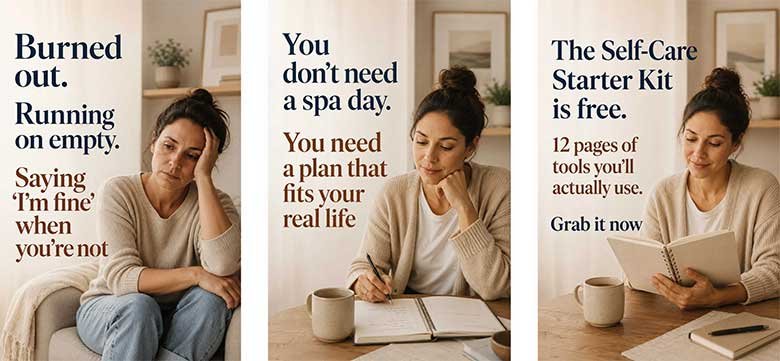
Build the Daily Practice That Helps Better Days Feel More Possible
The free Self-Care Starter Kit gives you simple, practical tools to build a daily routine that nurtures your resilience, protects your peace, and gives you something steady to return to while you work toward believing in better days ahead.
Download Free Now
Fill Your Space With Words That Remind You Better Days Are Coming
Premier Print Works makes quality prints, mugs, and shirts for people who need daily reminders of hope and encouragement close by. Browse the collection and find what speaks to what you need to hear right now.
Visit Premier Print WorksDisclaimer
The content on this page is for informational and inspirational purposes only. It is not professional mental health, medical, or personal advice of any kind. If you are experiencing significant or persistent depression, hopelessness, or other mental health challenges, please consider seeking support from a qualified mental health professional. Results and experiences vary significantly from person to person.
The stories of Kezia and Daniel are illustrative composite characters created to bring the content to life. They are not real people. Any resemblance to a real person is purely coincidental.
Some links on this page, including links to Premier Print Works and other resources, are affiliate links. If you make a purchase through one of these links, we may earn a small commission at no extra cost to you. We only recommend things we genuinely believe in.
If you are in crisis, please contact emergency services or a crisis helpline in your area immediately. You are not alone and help is available.
All content on A Self Help Hub is protected by copyright. It may not be copied, republished, or distributed without written permission from the author.