15 Smart Money Choices That Help You Build More Stability
Financial stability is rarely the product of one large, dramatic decision. It is built through a series of smaller, smarter choices, repeated consistently enough that they eventually add up to something solid. None of the choices below are flashy on their own, but together they form the kind of steady foundation that holds up when life inevitably throws something unexpected at it.
The fifteen choices below span several areas of financial life, from everyday spending to longer-term planning. Each one is a specific, actionable decision rather than a vague piece of general advice, chosen for how directly it contributes to genuine, lasting stability.
Build the Choices Behind Real Financial Stability
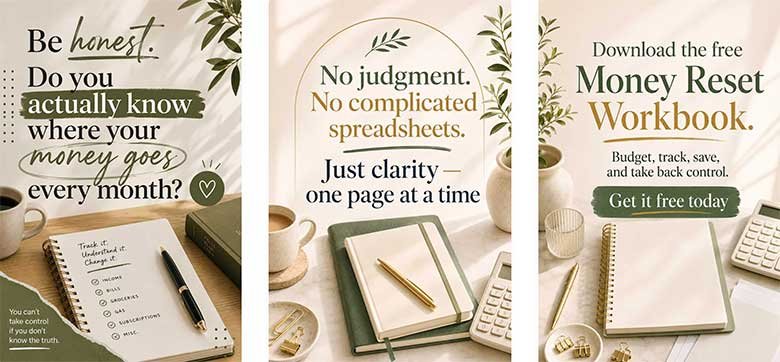
Download the free Money Reset Workbook and get a simple, step-by-step way to see where your money goes and start making the choices that build lasting stability.
Get the Free Workbook1. Build an emergency fund before pursuing any other financial goal, protecting every other goal from being derailed by an unexpected expense.
Financial goals pursued without a genuine emergency fund behind them remain vulnerable to any unexpected expense along the way, which frequently derails months of progress toward a completely unrelated goal. Prioritizing even a modest emergency fund first protects every subsequent goal from this kind of disruption, making it arguably the single most stabilizing financial choice available.
If you do not yet have an emergency fund, make building even a modest one your first financial priority before pursuing any other goal.
2. Choose a fixed-rate option over a variable one when the difference is small, trading a slightly higher cost now for genuine predictability later.
Variable-rate financial products can offer a lower cost in the short term, but that lower cost comes attached to genuine uncertainty about what the cost will actually be in the future, which works directly against the predictability that stability depends on. A fixed-rate choice, when the cost difference is reasonably small, trades that uncertainty for a known, stable number that will not change regardless of what happens in broader financial conditions.
The next time you are choosing between a fixed and variable rate option, weigh the value of predictability against a modest cost difference, rather than defaulting purely to whichever number is lowest today.

Surround Yourself With What Supports Your Stability
Premier Print Works creates quality prints, mugs, and shirts for people who are building the daily money habits that support real financial stability. Find what speaks to your journey today.
Visit Premier Print Works3. Keep your fixed monthly expenses well below your income, building in margin rather than budgeting right up to the exact edge of what you earn.
A budget with fixed expenses stretched right up to the edge of income leaves no margin for a slow month, a reduced paycheck, or any other ordinary income fluctuation, which makes the entire financial picture fragile even when nothing has technically gone wrong yet. Deliberately keeping fixed expenses below income, rather than matched exactly to it, builds in the margin that genuine stability requires.
Review your fixed monthly expenses against your income, and look for ways to widen the gap between them if that margin is currently thin.
4. Diversify where your income comes from, reducing your dependence on any single source that could unexpectedly disappear.
Income concentrated entirely in a single source carries a specific kind of fragility, since the loss of that one source removes the entire foundation at once, with nothing else in place to soften the impact. Even a modest secondary source of income reduces this concentration risk meaningfully, providing at least some continued income if the primary source is ever disrupted.
Consider one realistic way you could diversify your income sources, even modestly, to reduce your dependence on any single one.
“Stability is rarely built through one big win. It is built through consistently choosing the option with less downside.”

Get Clear on What Financial Stability Actually Means to You
The free 7-Day Life Reset gives you one short prompt a day for a week, helping you get honest about what genuine financial stability would actually look like in your life.
Start the Free Reset5. Pay off high-interest debt before aggressively pursuing other financial goals, since compounding interest works directly against stability while it remains unpaid.
High-interest debt compounds continuously, which means it works actively against financial stability the entire time it remains unpaid, regardless of what other progress might be happening elsewhere in a budget. Prioritizing this debt ahead of most other financial goals prevents it from continuing to grow and undermine the stability those other goals are meant to build.
If you are carrying high-interest debt, evaluate whether prioritizing it ahead of other financial goals would build more overall stability than pursuing multiple goals simultaneously.
6. Review your insurance coverage annually, closing the specific gaps that could otherwise turn a single incident into a genuine financial crisis.
Insurance coverage that has never been reviewed since it was first set up frequently contains gaps that only become apparent after an incident has already occurred, at which point the gap has already done its damage. An annual review, done proactively rather than reactively, closes these gaps before they are ever tested, protecting stability from a single incident that could otherwise undo years of careful planning.
Set a yearly reminder to review your insurance coverage across every major category, checking specifically for gaps rather than only comparing prices.
7. Choose experiences and purchases with predictable ongoing costs over ones with unpredictable future costs attached to them.
Some purchases come with hidden or unpredictable future costs attached — maintenance, upgrades, ongoing fees — that are easy to overlook at the moment of purchase but that undermine stability later when those costs eventually surface. Weighing the full, predictable cost of a purchase, not just its upfront price, protects future stability from these often-overlooked ongoing obligations.
Before your next significant purchase, consider not just the upfront cost but any predictable ongoing costs attached to it, and weigh those into the decision.
8. Keep your housing costs below a fixed, conservative percentage of income, protecting the largest line item in most budgets from becoming genuinely destabilizing.
Housing is typically the single largest expense in most budgets, which means even a modest overextension in this one category has an outsized effect on overall financial stability compared to overextension in almost any other category. Holding housing costs to a conservative, fixed percentage of income, rather than stretching toward the maximum that could technically be afforded, protects the entire budget’s stability from its single largest line item.
Calculate your current housing costs as a percentage of your income, and consider whether that percentage leaves enough margin for genuine stability elsewhere.
9. Build a simple, written plan for a job loss scenario, having a concrete plan ready rather than facing that possibility with no preparation at all.
A job loss faced with no prior planning tends to trigger panic-driven decisions made under significant pressure, which frequently produce worse outcomes than the same decisions made calmly and in advance. A simple, written plan for this scenario, built during a calm moment, provides a concrete starting point that removes at least some of the pressure if the scenario ever actually happens.
Spend thirty minutes this month writing a simple plan for what you would do financially in the event of a job loss, even if it currently feels unlikely.
10. Avoid financial decisions made under significant emotional pressure, building in a deliberate pause before any large decision made in a heightened state.
Major financial decisions made during a period of significant emotional pressure — grief, excitement, anger, fear — are disproportionately likely to be regretted later, since heightened emotional states are known to distort judgment around risk and long-term consequence. A deliberate pause before any major decision made in this kind of state protects stability from choices that a calmer version of the same person might not have made.
Commit to a mandatory waiting period before any major financial decision made during a period of significant emotional pressure, regardless of how urgent it feels in the moment.
11. Choose quality over price for the assets you depend on most, avoiding the destabilizing pattern of repeated, unexpected replacement costs.
The cheapest version of an asset you genuinely depend on — a vehicle, a major appliance, a piece of work equipment — often carries a higher long-term cost through more frequent breakdowns and replacements, a pattern that produces repeated, unpredictable expenses that work directly against stability. A higher upfront investment in quality, for the specific assets that are actually depended on regularly, tends to reduce this destabilizing pattern of frequent, unplanned costs.
Identify one asset you depend on regularly that might be worth a higher upfront investment in quality to avoid a pattern of frequent, unpredictable replacement costs.
12. Keep some portion of savings genuinely liquid and accessible, rather than locking everything away in accounts that are difficult to access quickly if needed.
Savings locked entirely into accounts with penalties or delays for early access can leave a household unable to respond quickly to a genuine emergency, even when the total amount saved looks perfectly adequate on paper. Keeping some meaningful portion genuinely liquid ensures that stability during an actual emergency does not depend on navigating penalties or delays at the exact moment speed matters most.
Review your current savings and confirm that a meaningful portion remains genuinely liquid and quickly accessible, separate from any longer-term, less accessible accounts.
13. Build relationships with people who have relevant financial or professional expertise, since access to good advice is itself a form of stability.
Financial and professional decisions made in complete isolation, without access to anyone who has relevant expertise or experience, are more likely to overlook important considerations that someone with that specific knowledge would have caught. Building even a small network of people with relevant expertise provides access to better guidance when significant decisions arise, which is itself a meaningful form of stability, distinct from any dollar amount saved.
Identify one person in your existing network with relevant financial or professional expertise, and make a point of maintaining that relationship deliberately.
14. Choose to under-commit rather than over-commit when income is uncertain, protecting stability during the exact stretches it is most at risk.
Financial commitments made during a period of strong, stable income can become genuinely destabilizing if that income later becomes less certain, since the commitment does not automatically shrink alongside a reduced income. Deliberately under-committing relative to current income, especially during periods of genuine uncertainty, protects stability from exactly the scenario that would otherwise threaten it most.
During any period of income uncertainty, choose the more conservative option for new financial commitments, even if a more optimistic income projection would technically support more.
15. Revisit your definition of stability periodically, since what stability actually requires tends to change as circumstances and life stage evolve.
A definition of financial stability set once, early on, can become outdated as life circumstances genuinely change — a growing family, a shifting career, changing health needs — continuing to guide decisions based on a version of stability that no longer reflects current reality. Periodically revisiting and updating this definition keeps financial choices aligned with what stability actually requires now, rather than what it required years earlier.
Spend time this year honestly reconsidering what financial stability actually means for your current life stage, rather than assuming an earlier definition still fully applies.
Explore Our Top Picks for a Better Life
We have gathered the tools, resources, and products we think are genuinely worth your money — covering finances, mindset, health, and home. All in one place, hand-picked with the same standard we apply to our own spending.
See Our Top PicksReal Stories, Real Results
Kezia had spent years pursuing several financial goals at once, spreading her extra money across savings, investments, and a small amount toward existing debt, without ever making decisive progress on any single one of them. Reordering her priorities to pay off her highest-interest debt first, ahead of everything else, felt like a step backward at first, since it meant temporarily slowing her other goals. Within a year, the compounding interest that had quietly worked against her for years was gone, and the money that had once gone toward it was now flowing freely into the goals she had originally been splitting her attention across. She said the reordering had not actually cost her progress. It had simply stopped one specific thing from working against every other thing at once.
Daniel had never reviewed his insurance coverage since first setting it up years earlier, assuming that once purchased, it would simply cover whatever came up. A routine annual review, prompted by a friend’s suggestion, revealed a specific and significant gap in his coverage that he had never noticed and that could have been genuinely costly if it had ever been tested by an actual incident. Closing that gap took less than an hour once it was identified. He said the review had cost him almost nothing and had potentially protected him from a financial setback that would have taken years to recover from.
Stability Is Built Choice by Choice, Not Windfall by Windfall
Each choice in this article reduces a different specific source of financial fragility — the missing emergency fund, the unreviewed insurance gap, the single income source, the decision made under pressure. None of these require a dramatic increase in income to matter. Most of them are available regardless of how much is currently coming in.
Choose two or three choices that address your own biggest sources of financial fragility, and build them into your plan this month. Download the free Money Reset Workbook to give the process a clear, simple structure to follow. Stability is built through a long series of smart, specific choices, not through a single lucky break.

Ready to Build Your Own Foundation of Stability?
The free Money Reset Workbook walks you through the same ideas in this article, step by step, with room to write down your own numbers and your own plan.
Download Free Now
Fill Your Space With What Supports Your Stability
Premier Print Works makes quality prints, mugs, and shirts for people building a steadier, more resilient financial life. Browse the collection and find what speaks to your journey today.
Visit Premier Print WorksDisclaimer
The content on this page is for informational and educational purposes only. It is not financial, investment, tax, insurance, legal, or estate planning advice, and should not be treated as a recommendation to buy, sell, or hold any product, security, or service. Please speak with a qualified professional who is licensed in your state before making decisions about budgeting, saving, investing, debt, taxes, insurance, or estate planning. Results and experiences vary significantly from person to person.
The stories of Kezia and Daniel are illustrative composites created to bring the content to life. They are not real people. Any resemblance to a real person is purely coincidental.
Some links on this page, including links to Premier Print Works and other resources, are affiliate links. If you make a purchase through one of these links, we may earn a small commission at no extra cost to you. We do not own, produce, or control any affiliate products, and we are not responsible for them — we only own and sell the products offered through our own store, Premier Print Works.
All content on A Self Help Hub is the property of Digital Marketing 215 LLC and is protected by copyright law. No part of this page may be copied, reproduced, republished, distributed, or transmitted in any form without prior written permission from the author.