9 Wise Words That Help You Feel More Grounded
We’re usually better at giving advice than taking it. Ask most people what they’d tell a struggling friend, and the answer comes quickly and kindly. Ask what they’d tell themselves, and it gets harder.
Psychologists Lauren Eskreis-Winkler, Ayelet Fishbach, and Angela Duckworth found that this gap can work in your favor. In a 2018 paper in Psychological Science, they studied 2,274 people who were struggling with goals. In one experiment, middle-school students who gave motivational advice to younger students spent more time on homework over the following month than students who received motivational advice from expert teachers. The same pattern showed up with adults who were trying to save money, control their tempers, lose weight, or find a job. People who gave advice felt more motivated than people who received it. They also predicted the opposite, expecting advice from others to help them more.
The researchers’ explanation is that giving advice raises the giver’s confidence. To give advice, you have to think through what has worked for you and lay out a plan. That may be what lifts you.
Here’s how I’m using that. The study measured motivation and confidence, and not whether anyone felt “grounded.” I’m using the word loosely, to mean steadier and more sure of yourself. So the 9 sentences below are my own, written as advice you might give a friend. Try saying them to yourself, or better yet, write your own and send them to someone. I’ll mark where I’m going beyond the research.

Get a Simple Plan for Steadier Days
Grab my free Self-Care Starter Kit. It’s a set of small daily practices you can fit into a busy day.
Get the Free Kit1. “Start with the next small thing. You don’t have to fix the whole day.”
When you give advice, you tend to be practical. You’d never tell a friend to solve everything at once. You’d say to pick one thing and begin. The study found that giving advice involves forming specific plans, which is what this sentence does.
Use it when the day feels too big. Name the next small thing out loud, and then do just that one.
2. “Being tired doesn’t mean you’re failing.”
A friend who says she’s exhausted rarely needs a lecture. She needs to hear that tired is a normal state. We’re often much harder on ourselves than on anyone else.
This sentence is my own, not a finding. I say it to myself at the end of a long week. It doesn’t fix anything, but it stops me from adding guilt to tiredness.

A Small Reminder of Your Own Good Advice
I make prints, mugs, and shirts at Premier Print Works. Some people like a reminder where they can see it.
Visit Premier Print Works3. “You can take a break and still be serious about your goals.”
Some people worry that resting means they don’t care. The advice you’d give a friend is usually the opposite. You’d tell them a break is part of keeping going.
Write this one on a sticky note if you tend to push too hard. Early on, I used to treat every break as a failure, and this sentence helped me relax about it.
Giving advice can lift the person giving it.
4. “Ask for help. Most people are glad to give it.”
We often assume asking is a burden. We’d never think that about a friend who asked us. When you give this advice, you remind yourself how it feels on the other side.
Pick one thing you’ve been handling alone, and ask one person for help with it this week. This is a habit, not a finding.

Build Small Habits That Keep You Steady
My free 9 Daily Habits guide has nine morning practices you can pick from, so you can start with one small habit.
Get the Free Guide5. “Your worth doesn’t go up and down with your to-do list.”
On a bad day, it’s easy to treat unfinished tasks as proof that you’re not enough. A friend would tell you that you’re more than your list.
Say it when you’re ticking things off and feeling behind. If you keep a list, try ending it with one item that isn’t work, like “sit outside for five minutes.”
6. “You’ve gotten through hard days before. Use what you learned.”
One reason giving advice helps, according to the researchers, is that you search your own experience for what has worked. This sentence does that on purpose.
Try writing down two things that helped you get through your last hard stretch. A few weeks ago, I did this and was surprised at how much I already knew.
7. “Say what you need out loud, even if it feels awkward.”
People can’t guess what you need. A good friend would encourage you to speak up. Giving that advice reminds you that your needs count.
Start small, like saying “I need some quiet for ten minutes” or “Could you help me with this?” It’s a skill that gets easier with practice. That last part is my own experience.
8. “Progress can be slow and still be real.”
When a friend is frustrated, you’d remind them that slow counts. We don’t say “you should be further along” to people we care about.
Look back at where you were a year ago. List two things that are different. Seeing the distance can steady you, and that’s my own exercise.
9. “Be as patient with yourself as you’d be with someone you love.”
This sentence sums up the whole idea. You already know how to be kind and practical with a person you care about. The research suggests you can borrow that voice and benefit from it.
Try this: the next time you’re struggling, write the note you’d send to a friend in the same spot. Then read it back to yourself. I do this more often than I’d admit.
Explore Our Top Picks for a Better Life
I put together a list of tools and products I think are worth your time, covering mindset, self-care, health, and home.
See Our Top PicksTwo People Who Wrote Their Own Advice
I know a woman named Kezia who felt stuck after a hard week at work. She wrote a short note to a coworker who’d had a similar week, and then realized she’d just written what she needed to hear. She told me she kept a copy on her desk.
I also think about a guy named Daniel who felt awkward asking for help. He told his younger cousin, “Ask for help. Most people are glad to give it,” and then he laughed and said he should take his own advice. He asked a friend for help that weekend, and the friend said yes right away.
Picture the Steadier Voice
Imagine a hard moment where the voice in your head sounds like a wise, kind friend. It doesn’t rush you or scold you. It says, “Start with the next small thing,” and you do.
Pick one of the nine sentences today. Write it on a sticky note, or write your own and send it to someone you care about. If you’d like some simple daily practices to go with it, get my free Self-Care Starter Kit.
Want to Go Further?
I’m building out some deeper, paid resources for people who want more than a single article can cover. They’re not live yet, but you can see everything I currently have ready for you, free and otherwise, on my Top Picks page.
See What’s Available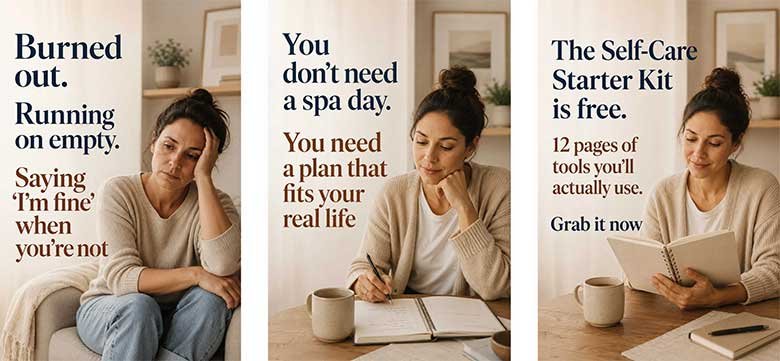
Ready to Feel More Grounded?
My free Self-Care Starter Kit walks you through simple daily practices, with room to make them your own.
Download Free Now
A Small Reminder of Your Own Good Advice
Take a look at Premier Print Works for prints, mugs, and shirts made for people who like a small daily reminder.
Visit Premier Print WorksDisclaimer
This page is for informational and inspirational purposes only. It is not professional therapy or mental health advice. The research referenced here comes from the published work of Lauren Eskreis-Winkler, Ayelet Fishbach, and Angela L. Duckworth, “Dear Abby: Should I Give Advice or Receive It?” (Psychological Science, 2018), summarized here in plain language. The study measured motivation and confidence, not feelings of being grounded, so applying it to that is my own extension. The 9 sentences and the personal stories are my own and are not findings from the study. If you’re struggling with low mood or thoughts of hurting yourself, please reach out to a doctor or a licensed mental health professional, or, in the U.S., call or text 988. Results vary from person to person.
The 9 sentences above are original words written for this site. They are not attributed to, or the words of, any real person.
Kezia and Daniel are made-up characters used to bring this content to life. They are not real people.
Some links on this page, including links to Premier Print Works, are affiliate links. If you buy something through one, we may earn a small commission at no extra cost to you. We only own and sell products through our own store, Premier Print Works.
All content on A Self Help Hub belongs to Digital Marketing 215 LLC and is protected by copyright law. No part of this page may be copied or reused without written permission.