17 Personal Growth Habits That Help You Build Inner Confidence
Open your phone. Within a minute, you will probably meet someone whose life looks better than yours.
That small moment matters more than we usually admit. In 2014, psychologist Erin Vogel and her colleagues published two studies on social comparison and self-esteem. In the first, a survey of college students, people who used Facebook most often tended to have lower trait self-esteem, and this link was explained by how much they were exposed to upward comparisons, meaning comparisons with people who appear to be doing better. In the second, an experiment, students who viewed profiles showing upward comparison information, such as a busy social life and healthy habits, had lower state self-esteem than students who viewed profiles showing downward comparison information. These studies used college students and Facebook as it was around 2013, and the first one shows a link, not proof of cause. But the experiment gave me pause, because even a short look at someone else’s best moments moved how people felt about themselves.
Inner confidence is confidence that does not rise and fall with every comparison. It is built from your own standards, your own growth, and your own relationships. These seventeen habits are meant to build that kind of steadiness. You do not have to quit social media or any other part of modern life. You simply need ways to keep your sense of worth from being handed to whoever posted last.

Build the Daily Habits Behind Confidence From the Inside
Download the free 9 Daily Habits guide and get nine simple morning practices that give your confidence a steady, inner foundation.
Get the Free Guide1. Notice what you feel after you scroll, and treat your mood as information.
Before changing anything, just watch. After a few minutes on your phone, stop and ask how you feel. Calmer? Inspired? Envious? Behind? Restless? There is no right answer. You are gathering data about what these feeds do to you.
Try this for a week. Jot down the app, the time, and your mood afterward. Patterns usually appear fast. You may find that some accounts or apps leave you drained, while others leave you encouraged.
The research suggests that upward comparison can lower how we feel about ourselves. Your own notes will tell you whether that is true for you.
For one week, write down your mood after each time you use social media, and look for patterns on the weekend.
2. Curate what you see, because your feed is a room you chose to sit in.
You are allowed to change what shows up on your screen. Mute, unfollow, or hide accounts that regularly leave you feeling worse. It is a way to protect your attention, and nobody needs to take it personally.
Then add things that leave you feeling informed, calm, or encouraged. Follow people who share honest struggles, practical ideas, or topics you love.
Think of your feed as a room in your home. You would not keep furniture that makes you feel bad.
Unfollow or mute five accounts that leave you feeling worse, and follow three that leave you feeling better.

Keep Your Own Path in View
Premier Print Works creates quality prints, mugs, and shirts for people building confidence from the inside. Find a reminder that your path is your own.
Visit Premier Print Works3. Remember that you are seeing someone’s highlight reel, and not their whole life.
The profiles in the experiment showed upward comparison information, like a busy social network and healthy habits. Profiles are made of chosen moments. You rarely see the boring Tuesday, the argument, the worry, or the bad hair day.
When you feel the sting of comparison, remind yourself what you are looking at. A highlight reel is a real part of someone’s life, and it is also a small part.
A useful habit is to say to yourself, “This is one slice.” Then look up from the screen.
Next time you feel the pull of comparison, say “This is one slice,” and look away from the screen for a minute.
“Confidence built from the inside does not need anyone’s permission, or anyone’s applause.”
4. Set time limits for the apps that drain you, and keep them gentle.
You do not have to quit to feel better. Many phones have built-in tools that let you set a daily time limit for certain apps. Pick a limit that feels reasonable, not punishing.
Choose times that matter most. For example, you might avoid scrolling first thing in the morning, when you are most open to the day’s tone, or right before bed.
If you break the limit, do not scold yourself. Just try again tomorrow.
Set a gentle daily limit on one app that tends to drain you, and avoid it for the first thirty minutes of your day.
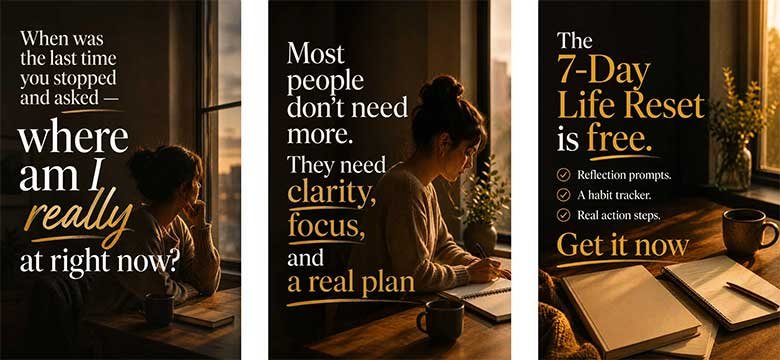
Take a Week to Measure Your Life by Your Own Yardstick
The free 7-Day Life Reset gives you a short, simple way to look at your week through your own values instead of someone else’s highlight reel.
Get the Free Reset5. Compare yourself with your own past instead, because that is a fair measuring stick.
Comparing with others uses a yardstick built from different lives, different resources, and different starting points. Comparing with who you were a year ago uses your own.
Write down three ways you are different from the person you were a year ago. These might be skills, habits, relationships, or how you handle hard moments. Keep them concrete.
Revisit the list every few months. It is quiet evidence that you are growing.
Write three ways you have changed or grown in the past year, with one specific example for each.
6. Define success in your own words, so you are not borrowing someone else’s.
If you have never written down what a good life looks like for you, someone else’s definition may be filling the space. Take thirty minutes and write your own.
Include how you want to spend your days, what kind of person you want to be, who you want near you, and what you want to work toward. Do not worry about how it looks to others.
Then check your list against your feed. Does what you scroll past match what you actually want?
Write a one-page description of success as you define it, and keep it where you will see it.
7. Keep a private growth log that nobody else sees.
Much of what we share online is for an audience. A private log is for you. Each week, write down what you learned, what you tried, and what you are proud of.
Because nobody will see it, you can be honest about the messy parts. That honesty makes the progress feel real. It is also a place to notice small gains that would never make a post.
Read it back every few months. It is a record of your own path.
Start a private notebook or note file, and write your first entry about something you tried this week.
8. Practice being happy for others, because it loosens the grip of comparison.
When someone else succeeds, comparison says it took something from you. Practice the opposite. Notice a friend’s good news, and let yourself feel glad for them.
This is a skill. It may feel forced at first. A simple step is to send a short, real congratulation. Over time, it can make other people’s wins feel less like threats.
If you notice envy, treat it as information. It may point to something you want for yourself.
Send a short, sincere congratulation to someone this week, and notice how it feels.
9. Turn envy into a clue about what you want.
Envy is uncomfortable, but it can be informative. When you feel a pang, ask, “What exactly am I envious of?” It might be freedom, recognition, a skill, a relationship, or a lifestyle.
Then ask whether you actually want that thing for yourself, or whether you only want what it looks like. If you do want it, you can take a small step toward it. If not, you can let it go.
This turns a painful feeling into a useful signpost.
The next time you feel envy, write down what exactly you are envious of and one small step you could take.
10. Spend more time with people in person, since real relationships give you honest feedback.
Online, we see edited versions. In person, we see whole people. Time with friends and family reminds us that everyone has struggles, and that we are valued for more than our best moments.
Make small plans that you can keep, like a walk, a coffee, or a shared meal. Pay attention to how it feels to be known.
These relationships are a source of confidence that does not depend on likes or comments.
Make one plan this week to spend time in person with someone you care about.
11. Build a skill that is yours, with no audience required.
Confidence grows when you get better at something real. Choose a skill you care about, and practice it without the need to show anyone. Cook, draw, garden, play music, fix things, write, or learn a language.
Because there is no audience, your only measure is your own progress. That makes it a safe place to build trust in your own growth.
A little each day works better than a lot once in a while.
Pick one private skill, and practice it for fifteen minutes today.
12. Practice gratitude for what is already yours, so your attention rests on what you have as well as what others have.
Comparison draws our eyes to what we lack. Gratitude gently turns them toward what we have. Each evening, write down three specific things you are glad about.
Keep them real and small, like a good conversation, a warm meal, or something that went right. Specifics are more convincing than general statements.
This does not erase wants. It adds balance.
Tonight, write down three specific things you are grateful for, and be as detailed as you can.
13. Ask for honest feedback from someone you trust, so your self-view is not built only from guesses.
Inner confidence needs accurate information. Ask a trusted friend, mentor, or colleague what they see as your strengths and what you could work on. Choose someone kind and honest.
Listen without defending. You do not have to agree with everything, but you may learn something. Often, people see strengths in us that we overlook.
Write down what you hear, and look at it again later.
Ask one trusted person to tell you one strength and one thing to grow, and write down the answers.
14. Give your attention to a cause or person beyond yourself, since contribution builds a steady kind of worth.
Helping others can shift your focus away from how you look and toward what you can offer. Volunteer, mentor, help a neighbor, or support a friend. Small, regular acts count.
When you feel useful, your confidence has a different source. It is rooted in what you do, not in how you are seen.
Choose something that fits your time and energy, and keep it sustainable.
Choose one small way to help someone or something this month, and put it on your calendar.
15. Take a break from social media from time to time, and notice what changes.
Try a day, a weekend, or a week without certain apps. Notice how you feel. Do you sleep better? Have more energy? Feel calmer? Feel a bit lost? All of these are useful to know.
You may decide to keep some of the change. You may also discover you miss some connections, and find another way to keep them.
The point is to find out what works for you.
Pick a day this month to take a break from one app, and write down how you feel at the end of it.
16. Return to your own values when you feel shaky, because they do not change with the feed.
Write down three to five values that matter most to you, such as honesty, kindness, curiosity, courage, or family. When you feel unsure, ask, “What would a person who lives by these values do next?”
This gives you a stable compass. Likes and comments rise and fall. Your values stay.
Check your week against your values. Where did you act in line with them? Where did you drift?
Write down your top three values, and name one action this week that fits each one.
17. Be patient with the pace, since confidence tends to build slowly and quietly.
Research that follows people across their lives suggests that, on average, self-esteem grows over many years. That means you may not feel dramatic change, and that is normal.
Keep your habits small and steady. Look back now and then to see how far you have come. Celebrate small steps.
Inner confidence is a quiet knowing that you are on your own path, with nothing to perform.
Pick the three habits from this list that feel easiest, and commit to them for a month.
Explore Our Top Picks for a Better Life
We have gathered the tools, resources, and products we think are genuinely worth your time, covering mindset, self-care, health, and home. All in one place, hand-picked to support the confidence you build from the inside.
See Our Top PicksReal Stories, Real Results
Let me share two examples I like to use. Amara noticed she felt worse after every long scroll, so she kept a one-week mood log. The pattern was clear: certain accounts left her feeling behind. She muted them, followed a few that were honest and practical, and set a morning rule of no scrolling for thirty minutes. She told me the change was small and the effect was real. Her days started with her own thoughts.
Joel’s habit was measuring himself against colleagues. He wrote his own definition of success, one page long, and started a private growth log. When he felt that old sting, he looked at the page. He said the difference came when he stopped asking, “Am I ahead?” and started asking, “Am I heading where I want to go?” Both of them said the same thing: their confidence felt steadier once it depended on their own yardstick.
Inner Confidence Is Built From Your Own Standards, Not Someone Else’s Highlights
Picture a day when you see a friend’s good news, feel glad, and go back to your own work without a sting. Your feed is quieter, your growth log is growing, and your measure of a good life is your own. You still see other people. You just do not need them to tell you who you are.
Choose two or three habits from this list, and start with watching how you feel after you scroll. Download the free 9 Daily Habits guide to give your confidence a steady daily base. Inner confidence tends to grow where you keep returning to your own path.
Want Ready-Made Tools to Help You Put This Into Action?
Sometimes the fastest way forward is a tool that someone has already built. Browse our hand-picked resources and downloads, chosen to help you take the next step with less guesswork.
Browse Resources and Downloads
Ready to Build Confidence That Does Not Depend on Anyone Else?
The free 9 Daily Habits guide gives you simple morning practices that make steady inner confidence easier to build.
Download Free Now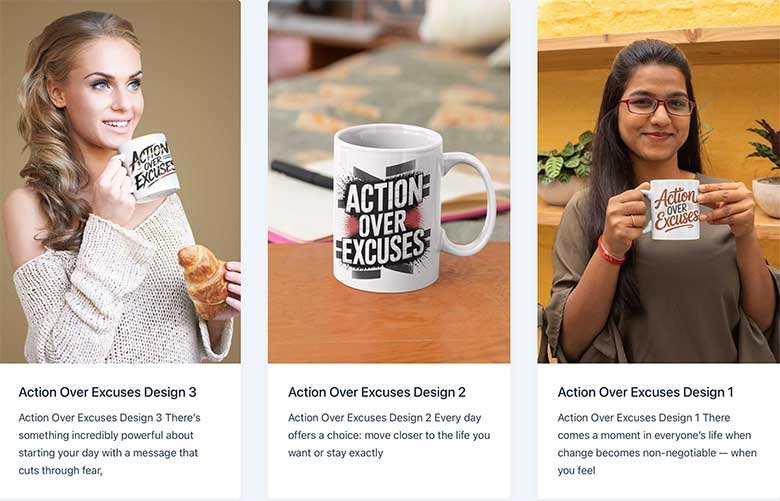
Fill Your Space With Your Own Kind of Confidence
Premier Print Works makes quality prints, mugs, and shirts for people growing in inner confidence. Browse the collection and find what speaks to your journey today.
Visit Premier Print WorksDisclaimer
The content on this page is for informational and inspirational purposes only. It is not professional mental health or medical advice of any kind. If you are experiencing persistent low self-worth, anxiety, depression, or other mental health challenges, please consider seeking support from a qualified mental health professional. Results and experiences vary significantly from person to person. The research mentioned in this article involved college students and Facebook around 2013, and one of its two studies showed a link and not cause and effect, so it may not apply the same way to every person or platform.
The stories of Amara and Joel are illustrative composite characters created to bring the content to life. They are not real people. Any resemblance to a real person is purely coincidental.
Some links on this page, including links to Premier Print Works and other resources, are affiliate links. If you make a purchase through one of these links, we may earn a small commission at no extra cost to you. We do not own, produce, or control any affiliate products, and we are not responsible for them — we only own and sell the products offered through our own store, Premier Print Works.
All content on A Self Help Hub is the property of Digital Marketing 215 LLC and is protected by copyright law. No part of this page may be copied, reproduced, republished, distributed, or transmitted in any form without prior written permission from the author.