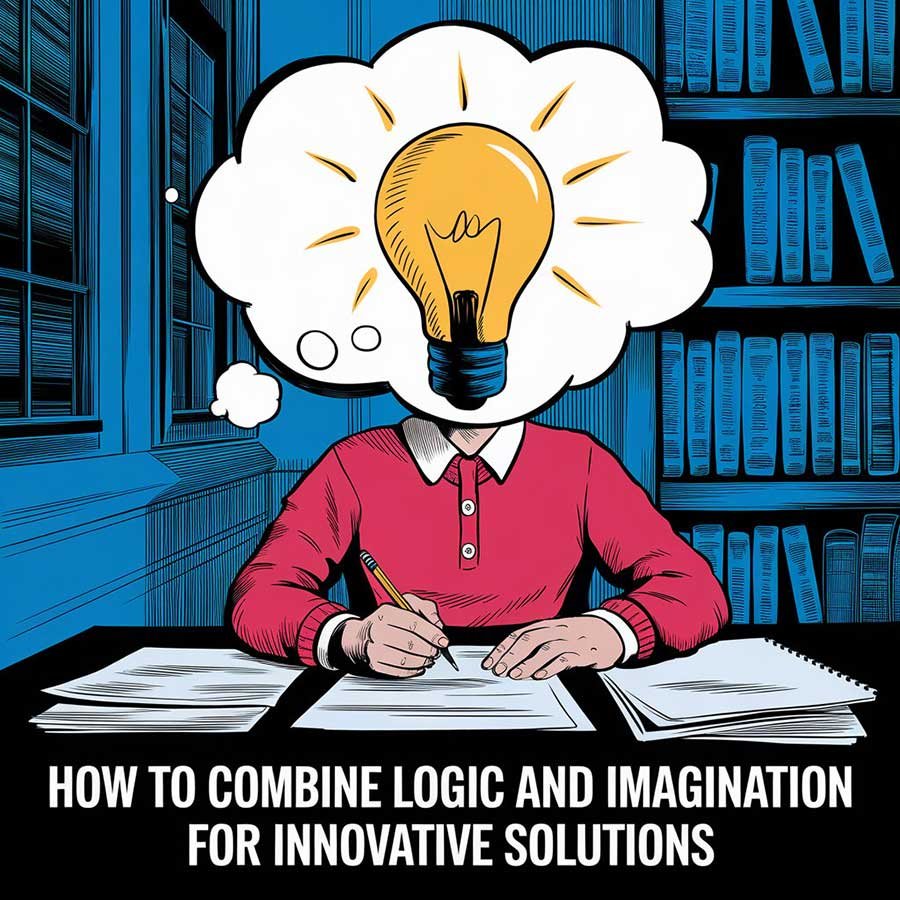
How to Combine Logic and Imagination for Innovative Solutions
The most powerful problem-solving comes from a balance of logic and imagination. Logic helps you analyze data, structure ideas, and make sound decisions, while imagination allows you to think outside the box, explore possibilities, and innovate.

By blending both, you can create breakthrough solutions that are both practical and visionary. Here’s how to combine logic and imagination to solve problems, spark creativity, and develop truly innovative ideas.
1. Define the Problem with Logic, Explore Solutions with Imagination
A strong problem-solving process starts with clear logical thinking, followed by imaginative exploration of solutions.
🔹 Try This:
- Step 1 (Logic): Clearly define the problem—what’s the issue, what are the constraints, and what are the goals?
- Step 2 (Imagination): Brainstorm creative, even wild, solutions without judgment.
- Step 3 (Logic): Evaluate the solutions, refine them, and choose the most practical one.
Logic keeps your ideas grounded, while imagination expands possibilities.
2. Use the “Yes, and…” Technique
This technique, borrowed from improv, helps merge logical ideas with creative thinking to expand innovation.
🔹 Try This:
- Instead of rejecting ideas, respond with “Yes, and…” to build on them.
- Example: If someone suggests a new product idea, instead of saying “That won’t work,” say, “Yes, and if we tweak it this way, it could work even better.”
- Combine practical analysis with imaginative expansion—improving ideas without shutting them down.
This method encourages creativity while maintaining logical progress.
3. Apply Divergent and Convergent Thinking
To solve problems innovatively, use both divergent (imaginative) and convergent (logical) thinking.
🔹 Try This:
- Divergent Thinking (Imagination):
- Generate as many ideas as possible, even unrealistic ones.
- Ask “What if…?” to challenge assumptions.
- Combine unrelated concepts (e.g., “What if we applied game mechanics to healthcare?”).
- Convergent Thinking (Logic):
- Analyze the best ideas for feasibility.
- Test concepts with data and reasoning.
- Narrow down choices to the most viable options.
This process ensures creativity leads to practical solutions.
4. Use Mind Mapping to Connect Logic and Imagination
Mind mapping visually connects structured (logical) and creative (imaginative) thought processes.
🔹 Try This:
- Write the problem in the center of a blank page.
- Branch out with logical factors (facts, constraints, risks).
- Add branches for imaginative ideas (wild ideas, unconventional solutions).
- Look for connections between logical needs and creative solutions.
Mind mapping engages both sides of the brain for better innovation.
5. Ask “What Would a Child Do?”
Children naturally combine imagination and logic—they solve problems with curiosity and experimentation.
🔹 Try This:
- Ask yourself: “How would a child approach this problem?”
- Remove preconceived limitations—think playfully and without fear of failure.
- Then, apply logical filters to refine ideas.
Thinking like a child helps uncover fresh, innovative approaches.
6. Use Analogies to Bridge Creativity and Rationality
Analogies help apply logic from one field to imaginative ideas in another.
🔹 Try This:
- Take a problem and ask, “What other industry has solved something similar?”
- Example: Airbnb used the hospitality principles of hotels and combined them with the peer-to-peer model of Uber.
- Apply existing successful models to your situation in new ways.
Analogies merge proven logic with fresh imagination.
7. Prototype and Test Ideas Quickly
Combining logic and imagination isn’t just about brainstorming—it’s about action and experimentation.
🔹 Try This:
- Turn ideas into small prototypes or sketches.
- Test solutions on a small scale before full execution.
- Use feedback to refine the idea—balancing creativity with practical adjustments.
Testing turns creative ideas into logical, actionable results.
8. Switch Between “Creative Mode” and “Logical Mode”
Your brain functions differently when it’s in creative vs. logical mode. Separating these phases helps maximize both.
🔹 Try This:
- Creative Mode: Spend time freely brainstorming, sketching, or storytelling without restriction.
- Logical Mode: Later, analyze and refine ideas using structure, research, and evaluation.
- Alternate back and forth—new creative insights emerge when logic is applied, and vice versa.
This method prevents overanalyzing during brainstorming and ensures creativity leads to action.
9. Collaborate with People Who Think Differently
Logical thinkers and imaginative thinkers need each other. Collaboration brings balance.
🔹 Try This:
- Pair up with someone who thinks opposite to you—a highly analytical person if you’re creative, or vice versa.
- Encourage open discussions where creativity and practicality balance each other.
- Build teams with a mix of imaginative dreamers and logical problem-solvers.
Diverse perspectives lead to stronger, well-rounded solutions.
10. Accept That the Best Ideas Come from Failure
Logic helps you avoid mistakes, but imagination thrives on trial and error. The best innovators fail fast, learn, and improve.
🔹 Try This:
- View failure as a data-gathering tool—it tells you what to adjust.
- Instead of abandoning ideas, pivot and refine them using logic.
- Celebrate lessons learned instead of fearing mistakes.
Combining creativity with structured improvement leads to the best innovations.
Inspirational Quotes on Logic and Imagination
“Logic will get you from A to B. Imagination will take you everywhere.” – Albert Einstein
“Creativity is seeing what everyone else has seen and thinking what no one else has thought.” – Albert Szent-Györgyi
“The most dangerous phrase in language is: ‘We’ve always done it this way.’” – Grace Hopper
“Imagination is everything. It is the preview of life’s coming attractions.” – Albert Einstein
“To develop a complete mind: Study the science of art. Study the art of science. Learn how to see. Realize that everything connects to everything else.” – Leonardo da Vinci
Picture This
Imagine facing a challenge and feeling excited instead of stuck. Instead of choosing between logic or imagination, you use both—breaking the problem down with structure while thinking of wild, creative solutions.
Your solutions are practical yet original, structured yet visionary. You confidently create, refine, and innovate without limits.
Now, ask yourself: How can I merge logic and imagination to solve my next challenge?
Please Share This Article
If this article inspired you, share it with someone who wants to think more creatively while staying practical!