12 Common Mistakes That Can Make Getting Out of Debt Harder
Paying down debt can feel like walking up a hill that keeps getting taller. You send a payment, the balance drops a little, and then a new charge or fee pushes it back up. It is easy to wonder what is going wrong.
Getting out of debt is hard work, and small slips are normal. Most people make a few of them along the way. The good news is that many common mistakes are easy to spot once you know what to look for, and naming them can take some of the sting away.
This guide walks through twelve mistakes that can make the road longer, with simple ideas to think about for each one. It is written with the United States in mind. It shares general information only, and it is not advice or a set of rules. Take it one idea at a time, and keep what fits your life.
See All Your Debts in One Clear Place
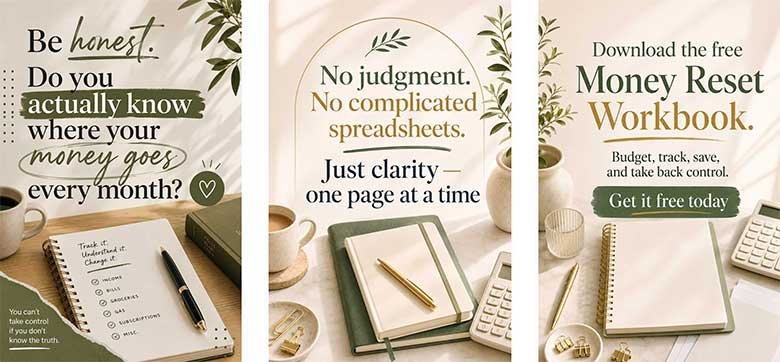
Download the free Money Reset Workbook and get simple pages to list what you owe, so the full picture is easy to see.
Get the Free Workbook1. Not knowing the full picture of what you owe
Many people know their biggest debt by heart but feel fuzzy about the rest. A store card, an old medical bill, or a small loan from a relative can slip out of sight. When part of the picture is missing, it is hard to plan.
A simple list can clear the fog. For each debt, some people write the name, the balance, the interest rate, the minimum payment, and the due date. Seeing it all on one page can feel scary at first, and then it often feels like relief.
Write down every debt you can think of on one sheet of paper.
2. Paying only the minimum without seeing what it costs
The minimum payment is the smallest amount a lender will accept each month. Paying it keeps an account in good standing, which matters. On a credit card, though, the minimum may barely cover the interest, so the balance can shrink very slowly.
Some people find it helpful to look at the box on a card statement that shows how long payoff could take with only minimum payments. Even a small amount above the minimum can shorten that time. Any extra is up to you and your budget.
Find the payoff box on one credit card statement and read it.

Keep a Small Reminder in Plain Sight
Premier Print Works creates quality prints, mugs, and shirts for thoughtful, thrifty people. Find a small reminder of what you are working toward.
Visit Premier Print Works3. Taking on new charges while paying off old ones
It is hard to empty a bathtub while the faucet is still running. In the same way, new charges on a card can undo the progress made by each payment. This often happens without meaning to, one small swipe at a time.
Some people choose to put a card away in a drawer for a while. Others remove saved card details from shopping apps. A few pick one card for bills only and leave the rest alone. Each choice is a way to turn the faucet down.
Pick one small step that makes new charges a little less easy.
“Every mistake you notice is a turn you no longer have to take.”
4. Having no small cushion for surprise costs
A flat tire or a broken phone can show up at the worst time. With no savings at all, a surprise cost often goes right back on a card. That can feel like taking one step forward and two steps back.
Many people choose to keep a small cushion while they pay down debt. It does not have to be large. Even a modest amount set aside can cover a small surprise without new debt. For related reading, see where to keep emergency savings.
Think about a small first amount you might set aside for surprises.

Track Your Debt Wins as You Go
The free Money Reset Workbook gives you a clear page to mark each payment and each balance that drops.
Get the Free Workbook5. Missing due dates and paying late fees
Late fees can add up fast. A missed payment may also raise the interest rate on some cards. Payments that are very late can show up on your credit report and pull down your score.
Due dates can be hard to track when they are spread across the month. Some people set phone reminders a few days before each one. Others turn on autopay for at least the minimum, so a busy week does not lead to a fee. Some lenders let you change your due date, so it may be worth asking.
Put each due date into your phone or a paper calendar.
6. Spreading extra money too thin across every debt
When there is a little extra money, it can feel fair to split it evenly across every debt. The trouble is that tiny amounts on many balances can make it hard to see progress anywhere.
Many people choose one debt to focus on while paying the minimum on the rest. Some pick the smallest balance for a quick win. Others pick the one with the highest interest rate to save more over time. Both are common, and the right fit depends on you. Another place to look is deciding which debt to pay first.
Circle the one debt you might focus on first.
7. Moving debt around without changing the habits behind it
A balance transfer card or a debt consolidation loan can lower interest for some people. These tools can help, and they can also bring fees and fine print. If old habits stay the same, the old cards may fill back up.
Before moving debt, it can help to ask what led to it in the first place. Was it a one-time emergency, a gap in income, or regular spending that ran ahead of pay? The answer may shape which tools make sense, if any.
Write one sentence about what led to your largest debt.
8. Trying to do it all in secret and alone
Debt can bring a lot of shame, so many people hide it. Keeping it secret can make the weight feel heavier. It can also make it harder to ask for help when it is needed.
Some people talk with a partner, a trusted friend, or a nonprofit credit counselor. Talking does not mean giving up control. It can simply mean having someone in your corner while you work through the numbers.
Think of one person or place you could talk with about your debt.
9. Making a budget too tight to live with
A budget with no room for fun can work for a week or two. After that, many people feel worn out and give up on the whole plan. A plan that is too strict can break under real life.
Some people leave a small line for treats, coffee, or a night out. It keeps the plan human. A budget that bends a little is often easier to keep for months than one that is perfect on paper. You may also like a debt payoff budget.
Add one small line for fun to your monthly plan.
10. Falling for offers that sound too good to be true
Ads that promise to wipe away debt fast can sound like a lifeline. Some of these offers come with large fees, harm to your credit, or no real help at all. Payday loans and title loans can also carry very high costs.
It can help to slow down before signing anything. Read the fees, ask questions, and look up the company with your state attorney general or consumer protection office. A nonprofit credit counselor can also talk through options at little or no cost.
Write down three questions to ask before signing any debt offer.
11. Ignoring calls and letters from lenders
When money is tight, it is natural to want to hide from the mail. Yet unopened letters can hold important news, such as a missed payment, a rate change, or a chance to set up a plan. Ignoring them can let small problems grow.
Many lenders have hardship programs, payment plans, or lower payments for a short time. These are often easier to get before an account falls far behind. Opening one letter at a time, with a cup of tea nearby, can make it feel less scary. For related reading, see tips for people fixing their finances.
Open one letter from a lender today and read it slowly.
12. Forgetting to notice how far you have come
Paying off debt can take months or years. If you only look at what is left, it can feel like you are stuck in place. That feeling can drain the energy it takes to keep going.
Many people find it helps to mark small wins. A chart on the fridge, a note in your phone, or a small treat when a card is paid off can keep spirits up. Every payment counts, even the small ones.
Write down one debt win from the past few months, however small.
Explore Our Top Picks for a Better Life
We have gathered the tools, resources, and products we think are genuinely worth your time, covering mindset, self-care, health, and home. All in one place, hand-picked to support the goals you are working toward.
See Our Top PicksReal Stories, Real Results
Let me share two examples I like to use. Amara paid a little extra on four cards each month and felt like nothing was moving. She chose one card to focus on and paid the minimum on the rest. She told me that the day the first card hit zero, she finally believed she could do the rest.
Joel kept a stack of unopened letters on his counter for months. One quiet Sunday, he opened them all and found that one lender offered a lower payment for a short time. He called, and it helped. Both of them said the same thing: the mistakes were easier to fix once they looked at them in the light.
Each Mistake You Spot Makes the Road a Little Shorter
Imagine looking at your debt list and seeing balances that only go down. No new charges sneak in. No late fees show up. Your payments land on time, and you can see the progress on a simple chart.
Pick one mistake from this list that feels most familiar, and start there. Download the free Money Reset Workbook to map out your debts in one place. Small changes can add up to a lighter load.
Want Ready-Made Tools to Help You Put This Into Action?
Sometimes the fastest way forward is a tool that someone has already built. Browse our hand-picked resources and downloads, chosen to help you take the next step with less guesswork.
Browse Resources and Downloads
Ready to Make the Road a Little Shorter?
The free Money Reset Workbook helps you see your numbers clearly, so you can plan your next step with calm.
Download Free Now
Fill Your Space With Things You Love
Premier Print Works makes quality prints, mugs, and shirts for people who plan ahead. Browse the collection and find what speaks to you today.
Visit Premier Print WorksDisclaimer
The content on this page is for informational and inspirational purposes only. It is not professional financial, investment, tax, legal, insurance, or estate planning advice. Interest rates, prices, fees, and account terms vary and change, so please read the details of any offer. If you are struggling with debt, a nonprofit credit counselor, a local legal aid office, or 2-1-1 (in the U.S.) may be able to point you to help. This guide is written with the United States in mind. Results vary widely from person to person.
I am not a financial advisor, and I am not a licensed tax, legal, or investment professional. I share this information to help people learn about money and see new options. Please treat it as general information only, and talk with a qualified professional about your own situation before making financial decisions.
The stories of Amara and Joel are illustrative composite characters created to bring the content to life. They are not real people. Any resemblance to a real person is purely coincidental.
Some links on this page, including links to Premier Print Works and other resources, are affiliate links. If you make a purchase through one of these links, we may earn a small commission at no extra cost to you. We do not own, produce, or control any affiliate products, and we are not responsible for them — we only own and sell the products offered through our own store, Premier Print Works.
All content on A Self Help Hub is the property of Digital Marketing 215 LLC and is protected by copyright law. No part of this page may be copied, reproduced, republished, distributed, or transmitted in any form without prior written permission from the author.