Trying Smarter, Not Just Harder: Adjusting Your Budget Strategy When Effort Is Not Enough
You skipped the coffee shop all month. You said no to dinner out twice. You checked every receipt. And somehow, the account still ran low three days before payday. It can feel like the harder you push, the less it helps.
When that happens, the problem may lie in the budget strategy, not in your effort. Effort matters, and you clearly gave plenty. Yet effort poured into a plan that does not fit your life can feel like running on a treadmill. You work hard and stay in the same spot. Sometimes a small change in approach does more than a big push in the same direction.
This guide shares general ideas to think about, and it is not advice or a set of instructions. We will look at signs a strategy might need a change, a few different ways to budget, and how to test a new approach without starting from zero. Go one step at a time. Trying something new is a sign of learning, not of failure.
Test a Budget Approach That Fits
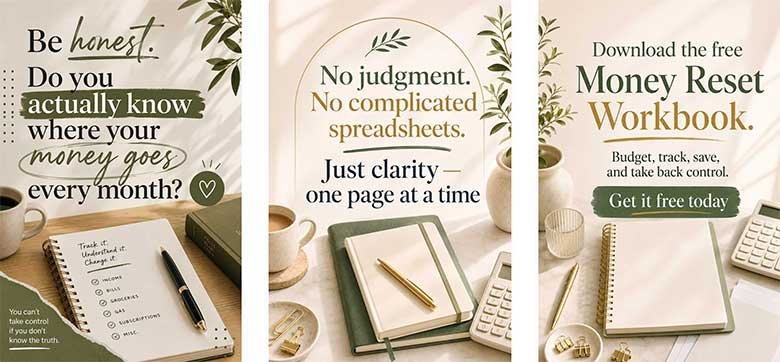
Download the free Money Reset Workbook for simple pages that help you try a new budget strategy and see what works.
Get the Free WorkbookNotice when more effort stops making a difference
Some signs show up again and again. You cut back hard, then overspend in a rush. You feel tired of money every single day. The same category runs over every month, no matter what you try.
These signs are useful. They suggest the plan may be fighting against your real life. Pushing harder on the same plan often leads to burnout, and burnout tends to lead to giving up.
Noticing the pattern is the first smart step. It turns frustration into information you can use.
Write down the one money pattern that keeps repeating no matter how hard you try.
Look at the plan, not at your character
When a budget keeps failing, it is easy to blame yourself. “I have no self-control.” “I am lazy.” Those thoughts hurt and rarely help.
A kinder question is, “What about this plan does not fit?” Maybe the grocery number was set too low for your family. Maybe bills land at awkward times. Maybe the plan has no room for fun, so it snaps.
Looking at the plan like a tool you can fix makes it easier to try something new. Tools can be adjusted. People do not need to be fixed.
Finish this sentence on paper: “My budget plan does not fit my life because…”

A Reminder to Work Smarter
Premier Print Works makes quality prints, mugs, and shirts for people finding a better way forward.
Visit Premier Print WorksCheck whether your numbers match real life
A common reason budgets break is that the numbers were wishes. A grocery line of $200 looks nice on paper. If the real bills usually run closer to $320, the plan starts every month already behind. These are made-up numbers, and the idea fits any budget.
One option is to look back at two or three months of real spending. What did each category actually cost? Using real numbers can feel discouraging at first, yet it gives the plan a fair start.
From there, you can look for gentle ways to bring numbers down over time, instead of expecting a big drop all at once. For related reading, see a free monthly budget template.
Compare one budget category with what you actually spent over the last two months.
“When pushing harder stops working, a small turn in a new direction can carry you farther.”
Try a different budgeting method
There are many ways to budget, and each one fits different people. A zero-based budget gives every dollar a job before the month starts. A cash envelope method uses physical cash for categories like groceries and fun. A simple percentage approach splits income into a few broad buckets.
Some people like lots of detail. Others do better with just three or four big categories. Neither is right or wrong. The method that fits is the one you can stick with.
If one method has felt like a struggle for months, testing another can be a smart move. You may also like a look at how zero-based budgeting works.
Choose one budgeting method you have not tried, and read a little about it this week.

Compare Your Plan With Real Life
The free Money Reset Workbook gives you a calm place to line up bills, paydays, and real spending.
Get the Free WorkbookLine up your budget with your paydays
Sometimes the problem is timing. If rent, the car payment, and the phone bill all come out in the same week, that week can feel like a crisis even with a good plan.
Some people budget by paycheck instead of by month. They list which bills each check will cover. Others call companies to ask about moving a due date, which many companies allow.
A small change in timing can make the same income feel much steadier. Nothing changed but the order of things.
Write each paycheck date and the bills that come out after it, and look for crowded weeks.
Make room for small joys so the plan does not snap
A budget with zero fun money can work for a short while. Over time, many people find it snaps. They end up spending a lot all at once after weeks of saying no.
Adding a small, planned amount for treats can make a plan last longer. Here is an example with made-up numbers: $15 a week for fun is $60 in a four-week month. That might feel easier to manage than one surprise $120 splurge.
Planned joy can turn a strict budget into one you can live with. Another place to look is ideas for working smarter with money.
Add a small, planned fun line to your budget, even if it is only a few dollars.
Use simple supports instead of more willpower
Effort and willpower get tired. Simple supports do not. Automatic transfers on payday, a grocery list kept on the fridge, phone reminders before due dates, and deleting saved card numbers from shopping sites are all supports.
Each support takes one decision off your plate. Over a month, that can mean many fewer chances to slip.
Think about where you most often struggle. Then ask what small support could make the right choice a little easier in that moment.
Pick your hardest money moment and add one small support to it.
Test the new approach for a set time
Changing a budget strategy does not have to be forever. You can treat it like a short test. Try the new method for one month, or two pay periods, and then look back.
During the test, a few notes can help. What felt easier? What felt harder? Did the account last longer? Short notes at the end of each week are plenty.
At the end, you can keep what worked and drop what did not. Each test teaches you more about what fits. For related reading, see beginner budgeting tips.
Choose a start and end date for testing a new budget idea, and mark both on your calendar.
Ask for a fresh pair of eyes
Sometimes the reason a plan does not work is hard to see from the inside. A trusted friend or family member may notice something you missed. A nonprofit credit counselor can also review a budget and talk through options.
Sharing your numbers can feel uncomfortable. It may help to remember that most people have struggled with a budget at some point. A kind listener can make the work feel lighter.
If money stress feels heavy or constant, a counselor or trusted professional can also help with the feelings that come with it.
Think of one person or free resource who could look at your budget with you.
Explore Our Top Picks for a Better Life
We have gathered the tools, resources, and products we think are genuinely worth your time, covering mindset, self-care, health, and home. All in one place, hand-picked to support the goals you are working toward.
See Our Top PicksReal Stories, Real Results
Let me share two examples I like to use. Amara kept a tight monthly budget and ran out of money every month anyway. She switched to budgeting by paycheck and moved one bill’s due date with a quick phone call. She told me that the same income suddenly felt like enough, and she could breathe again.
Joel tried to give up all fun spending and kept breaking down at the end of the month. He added a small weekly fun line and set up an automatic transfer to savings on payday. Both of them said the same thing: changing the plan helped far more than trying harder at the old one.
A Budget That Fits the Life You Actually Live
Imagine a budget that feels like a helpful map instead of a cage. The numbers match real life. Bills line up with paydays. There is a little room for joy, and simple supports do some of the work for you.
Pick one thing about your current plan to test this month. Download the free Money Reset Workbook to try a new budget approach and keep notes on what works.
Want Ready-Made Tools to Help You Put This Into Action?
Sometimes the fastest way forward is a tool that someone has already built. Browse our hand-picked resources and downloads, chosen to help you take the next step with less guesswork.
Browse Resources and Downloads
Ready to Try a New Approach?
The free Money Reset Workbook helps you test small changes and keep notes on what helps.
Download Free Now
Encouragement for the Long Haul
Premier Print Works offers prints, mugs, and shirts for people who keep learning. Browse the collection and find one you like.
Visit Premier Print WorksDisclaimer
The content on this page is for informational and inspirational purposes only. It is not professional financial, investment, tax, legal, insurance, or estate planning advice, and it is not mental health advice. Budget methods are described in a general way. The numbers in the examples are made up to show how the math works. Prices, fees, and account terms vary and change, and results vary widely from person to person. A nonprofit credit counselor may be able to help review a budget, and a counselor or trusted professional can help with money stress.
I am not a financial advisor, and I am not a licensed tax, legal, or investment professional. I share this information to help people learn about money and see new options. Please treat it as general information only, and talk with a qualified professional about your own situation before making financial decisions.
The stories of Amara and Joel are illustrative composite characters created to bring the content to life. They are not real people. Any resemblance to a real person is purely coincidental.
Some links on this page, including links to Premier Print Works and other resources, are affiliate links. If you make a purchase through one of these links, we may earn a small commission at no extra cost to you. We do not own, produce, or control any affiliate products, and we are not responsible for them — we only own and sell the products offered through our own store, Premier Print Works.
All content on A Self Help Hub is the property of Digital Marketing 215 LLC and is protected by copyright law. No part of this page may be copied, reproduced, republished, distributed, or transmitted in any form without prior written permission from the author.