Wise Words About Time, Money, and What Matters
Have you ever stopped to think about how many hours a purchase really costs? Or how much money you spend trying to save a little time? Time and money are tangled together in almost every choice we make, from what we eat for dinner to how we spend a Saturday.
Thinking about time and money side by side can bring a quiet kind of clarity. When you look at your hours and your dollars side by side, it becomes easier to see what you truly value. Many people find that the things they care about most cost very little, and the things that cost the most often matter less than they expected.
The sayings below are original reflections written for this page and shared nowhere else. They are general ideas to think about, not advice. Each one comes with a short reflection, a small made-up example when it fits, and one gentle idea to try. Read slowly and keep the ones that ring true for you.
See Where Your Money and Time Go
Download the free Money Reset Workbook and line up your spending with what matters most to you.
Get the Free Workbook“Every price is also paid in hours.”
Money usually comes from time. Hours at work, shifts, projects, or years of saving. When you buy something, you are trading some of that time.
Here is an example with made-up numbers. If you take home $18 for each hour you work, a $90 pair of shoes costs about five hours of work. A $36 dinner out costs about two hours.
Seeing prices in hours is not meant to make you feel guilty. It can simply help you ask whether the item is worth that much of your life.
Work out your take-home pay per hour and use it to look at one price this week.
“Spend money where your heart already lives.”
Each person has a few things that bring real joy. Time with family, a hobby, good food, travel, learning. When money flows toward those things, spending often feels satisfying.
When money flows toward things you barely notice, it can feel like it disappeared. A gentle question is: Does this purchase connect to something I love?
Writing down your top three joys can make choices clearer. For related reading, see small changes for saving money and living better.
Write down three things that bring you the most joy.

Keep a Small Reminder in Plain Sight
Premier Print Works creates quality prints, mugs, and shirts for thoughtful, thrifty people. Find a small reminder of what you are working toward.
Visit Premier Print Works“The moments you treasure rarely show up on a receipt.”
Think about your favorite memories. Many of them might be free or nearly free. A long talk on the porch. A walk with a friend. Laughing at the dinner table. A child’s first steps.
This saying is a reminder that the most meaningful parts of life often happen without spending. Money can help make room for them, and it is rarely the main ingredient.
Noticing this can take some pressure off the budget. You do not need a lot to have a rich day.
Recall three favorite memories and notice how much each one cost.
“When your hours and your dollars point the same way, life feels a little more like your own.”
“Saving a little time can be as good as saving a little money.”
Frugal living is often about money, and time matters too. Spending an hour driving across town to save two dollars may not be a good trade for everyone.
Sometimes paying a bit more to save time makes sense. Sometimes doing it yourself is worth the hours. There is no single right answer. It depends on what you have more of and what you value.
Planning meals ahead is one way many people save both time and money. You may also like meal planning ideas for time and money.
Think of one choice where saving time might be worth a little extra money, or the other way around.
Spend on What You Value
The free Money Reset Workbook has simple pages to compare spending with your priorities, so choices feel clearer.
Get the Free Workbook“A full calendar and a full life can be two different things.”
Busy weeks can feel productive. Yet a calendar packed with activities, events, and errands can also drain both time and money. Each outing often comes with gas, food, or tickets.
Leaving some empty space can feel strange at first. That space can hold rest, family time, or simple pleasures at home.
Looking at a week and choosing one thing to drop can free up both hours and dollars. Another place to look is common time wasters.
Look at next week’s calendar and choose one thing you could let go.
“Money can buy back time, and time can help money last.”
Time and money work in both directions. Sometimes money buys time, like paying for a ride so you can spend an evening with your kids. Sometimes time makes money last, like cooking at home or fixing something yourself.
Seeing this two-way trade can make choices feel more balanced. Neither one is always more important.
Many people find it helpful to ask: Which do I have more of right now, time or money? The answer can guide the choice.
Ask yourself whether you have more time or more money this week, and let that guide one choice.
“What you will remember is a good guide for what to spend on.”
Some purchases fade from memory within days. Others become stories you tell for years. A trip with family, a class that taught you a skill, a shared meal at a special place.
Before spending, you might ask: Will this still be in my memory a year from now? If the answer is yes, it may be worth more to you than its price.
If the answer is no, you might still buy it, and you might also choose to save that money for something more lasting.
Before a purchase, ask whether you will remember it a year from now.
“Enough is a finish line you get to draw.”
There is always more to buy, more to earn, and more to do. Without a sense of enough, the race never ends.
Deciding what enough looks like for you can bring a sense of peace. Enough clothes. Enough space. Enough savings for a cushion. Enough work hours to cover what matters.
Your enough will be different from anyone else’s. That is the point. For related reading, see a challenge for saving more and living better.
Write down what enough looks like in one area of your life.
“Let today hold one thing that matters.”
Big ideas about time and money can feel overwhelming. One simple way to bring them into daily life is to make sure each day holds one thing that matters to you.
It might be ten minutes with a book, a call to a parent, a walk outside, or a meal cooked with care. Small and free is perfectly fine.
Over weeks and months, these small moments can add up to a life that feels full, no matter what the bank balance says.
Choose one small thing that matters to you and give it a place in today.
Explore Our Top Picks for a Better Life
We have gathered the tools, resources, and products we think are genuinely worth your time, covering mindset, self-care, health, and home. All in one place, hand-picked to support the goals you are working toward.
See Our Top PicksReal Stories, Real Results
Let me share two examples I like to use. Amara started looking at prices in hours of work. A pair of boots she wanted cost almost a full day of her time. She told me that she still bought them, and she skipped several smaller things that no longer felt worth the hours.
Joel realized his calendar was packed with outings that cost money and left him tired. He cleared one evening a week for simple time at home with his kids. Both of them said the same thing: seeing time and money together helped them spend both on what mattered most.
Your Hours and Dollars Can Point the Same Way
Picture a week where your money goes to things you love and your time holds moments you will remember. There is a little empty space on the calendar and a little extra in the account. Life feels full and steady.
Choose one saying to think about this week. Download the free Money Reset Workbook to see where your money and time are going. Small steps toward what matters.
Want Ready-Made Tools to Help You Put This Into Action?
Sometimes the fastest way forward is a tool that someone has already built. Browse our hand-picked resources and downloads, chosen to help you take the next step with less guesswork.
Browse Resources and Downloads
Ready to Spend Your Hours and Dollars With Care?
The free Money Reset Workbook helps you see your numbers clearly, so your money follows what you value.
Download Free Now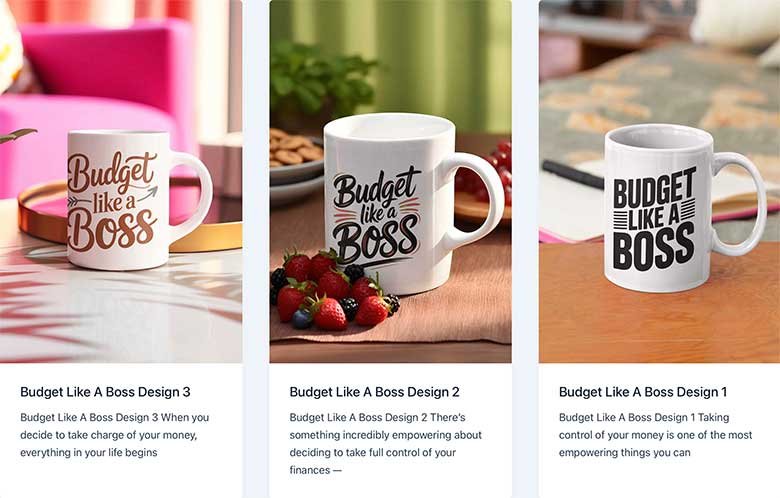
Fill Your Space With Things You Love
Premier Print Works makes quality prints, mugs, and shirts for people who plan ahead. Browse the collection and find what speaks to you today.
Visit Premier Print WorksDisclaimer
The content on this page is for informational and inspirational purposes only. It is not professional financial, investment, tax, legal, insurance, or estate planning advice. The sayings are original reflections written for this page and are shared as general information. The reflections here are not medical or mental health advice. A doctor or counselor can help with heavy feelings. The numbers in the examples are made up to show how the math works. Pay, prices, and costs vary and change, and results vary widely from person to person.
I am not a financial advisor, and I am not a licensed tax, legal, or investment professional. I share this information to help people learn about money and see new options. Please treat it as general information only, and talk with a qualified professional about your own situation before making financial decisions.
The stories of Amara and Joel are illustrative composite characters created to bring the content to life. They are not real people. Any resemblance to a real person is purely coincidental.
Some links on this page, including links to Premier Print Works and other resources, are affiliate links. If you make a purchase through one of these links, we may earn a small commission at no extra cost to you. We do not own, produce, or control any affiliate products, and we are not responsible for them — we only own and sell the products offered through our own store, Premier Print Works.
All content on A Self Help Hub is the property of Digital Marketing 215 LLC and is protected by copyright law. No part of this page may be copied, reproduced, republished, distributed, or transmitted in any form without prior written permission from the author.