17 Budgeting Habits That Help You Take Control of Your Money
I remember a month when I earned enough and still felt out of control. I couldn’t have told you what was in my account on any given day. Nothing dramatic went wrong. I just never felt like I was the one driving.
I later found out that feeling has a place in the research. In 2015, the Consumer Financial Protection Bureau published a report on what financial well-being actually means. The team drew on interviews with consumers and financial practitioners, a review of the research, and advice from experts. They landed on four elements. The first is having control over your day-to-day and month-to-month finances. The others are being able to absorb a financial shock, being on track to meet your financial goals, and having the financial freedom to make choices that let you enjoy life. The bureau later released a 10-question scale to measure it.
The bureau’s materials make a point I like: financial well-being isn’t about how much you earn. It’s about being able to make decisions with the money you have.
A caution. This is a definition built from interviews and research, and it doesn’t prove that any particular habit works. The 17 habits below are my own. I’ve sorted them by the four elements, starting with control, since that’s what most people mean when they say they want to “take control” of their money.
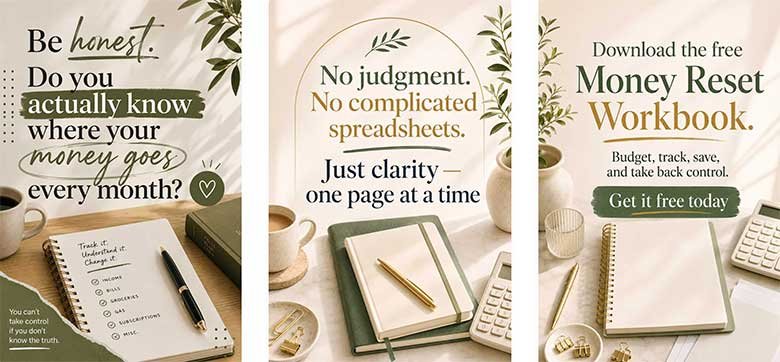
Get Your Whole Money Picture on Paper
Grab my free Money Reset Workbook. It’s a good place to start putting your bills, goals, and numbers in one spot.
Get the Free Workbook1. Check your balance a few times a week so you always know where you stand
Control starts with knowing. I remember going weeks without looking at my account because I was afraid of what I’d see. When I finally looked, it was better than I’d feared, and not knowing had been the worst part.
Pick two or three days a week to check your balance. It takes a minute. You’re not judging yourself. You’re just finding out where things are.
Try this: Pick two days a week, like Monday and Thursday, and set a phone reminder to check your balance.
2. Put your fixed bills in one list with amounts and due dates
Rent, insurance, phone, utilities, loan payments. List them all in one place with the amount and the date each is due. When you can see your fixed costs at a glance, the month feels less mysterious.
A sheet of paper works, and so does a page in the Money Reset Workbook. Add up the total, and you’ll know the minimum your month has to cover.
Try this: Write down every bill you pay each month with its amount and due date, then add up the total.

A Small Reminder to Stay in the Driver’s Seat
I make prints, mugs, and shirts at Premier Print Works. Some people like a reminder where they can see it.
Visit Premier Print Works3. Plan the month on a single page before it starts
A one-page plan lists what’s coming in, what’s going out, and what’s left. It doesn’t have to be fancy or exact. It’s a map, and a rough map beats no map.
Do it in fifteen minutes at the start of the month. You can change it as things happen. The point is that you decided on purpose before the month decided for you.
Try this: Draw three columns on a page labeled “coming in,” “going out,” and “left,” and fill them in for this month.
Taking control of your money isn’t about how much you earn. It’s about being able to make decisions with what you have.
4. Give yourself a weekly number for everyday spending
Groceries, gas, eating out, and small purchases are where the month slips away. Take the amount you can spend on those, divide it by the number of weeks, and treat that as your weekly number.
When you know the number, each purchase has context. You can see quickly whether you’re on track or need to ease off for a few days. That approach is my own, and you can adjust the number as you learn.
Try this: Work out your weekly number for everyday spending and write it on a sticky note.

Take a Week to Check In With Your Money Habits
My free 7-Day Life Reset is a short week of reflection on your own routines. It’s a good place to start seeing what gets in your way.
Start the Free Reset5. Know your three biggest costs
For most people, a few big categories, like housing, transportation, and food, take most of the money. Knowing which three are yours tells you where a change would matter most.
Look at last month and find your top three. Trimming a small expense feels good, but a small change to a big cost can make a bigger difference. It’s worth knowing the difference.
Try this: List your three biggest spending areas from last month and their totals.
6. Start a small emergency fund with any amount
Now for the second element: being able to absorb a financial shock. I remember a month when a surprise car repair landed on a credit card because I had nothing set aside. It wasn’t a big repair, but it stayed with me for months.
You don’t need a huge fund to begin. Start with whatever you can, even $10 or $20 a paycheck. A small cushion turns some emergencies into inconveniences.
Try this: Set up a small automatic transfer to a savings account, for any amount you can manage.
7. Keep the emergency fund in its own account
Money that sits next to your spending money tends to get spent. A separate account makes the line clear. Many banks let you open a free savings account and give it a name.
Call it “Emergency” or “Just in Case.” The name reminds you what it’s for. That’s my own approach.
Try this: Open or rename a savings account so that it’s clearly labeled as your emergency fund.
8. Decide in advance which bills come first if money gets tight
A tight month is a bad time to make decisions, since you’re stressed. So decide ahead of time. For most people, housing, utilities, food, transportation to work, and insurance come first.
Write your own order on a sheet of paper and keep it with your bill list. If a rough month hits, you already have a plan. You aren’t deciding under pressure.
Try this: Write down the five bills you’d protect first if you couldn’t pay everything.
9. Know what you’d owe in a worst case
A deductible is the amount you pay before your insurance begins to pay. If your car, home, or health plan has one, know the number. A surprise is much harder when you’ve never looked.
Check your policies for the deductible and out-of-pocket maximum. Then ask whether you could cover that amount today. If not, you know what your emergency fund is working toward.
Try this: Look up the deductible on your car and health insurance and write the numbers down.
10. Write down two or three money goals with dates
The third element is being on track to meet your goals, and you need goals to be on track. Keep them few and specific. “Save $1,000 by June” is a goal. “Be better with money” is a wish.
I remember writing “pay off the card by December” on a note and taping it inside a cabinet. Seeing it every day helped me make small choices with it in mind. Pick two or three and write them down.
Try this: Write down two money goals with an amount and a date for each.
11. Turn each goal into a monthly amount
A big goal feels distant. A monthly amount feels doable. Divide the goal by the number of months until the date. “$1,000 by June” with six months left means about $167 a month.
If that number is too high, adjust the date or the goal, not your hopes. A realistic plan you follow beats a perfect plan you drop.
Try this: Divide each goal by the months left and write the monthly number next to it.
12. Check your progress once a month
Once a month, compare where you are with where you planned to be. Ahead? Behind? On track? It takes five minutes.
If you’re behind, don’t panic. Ask what changed. A month of checking tells you much more than a year of guessing.
Try this: Put a monthly “goal check” on your calendar for the same day each month.
13. Update your goals when life changes
A new job, a baby, a move, or a medical bill can change what’s realistic. Adjusting your goals isn’t failing. A plan is supposed to fit the life you have right now.
When something big happens, sit down with your goals and ask what needs to change. Move a date, lower an amount, or swap one goal for another. Then keep going.
Try this: Think about one change in your life from the past year and ask whether your goals still fit.
14. Budget for enjoyment on purpose
The last element is the financial freedom to make choices that let you enjoy life. A budget with no room for fun often falls apart. I remember cutting everything out for a month, and then blowing it all in a weekend.
Give yourself a set amount for things you enjoy, and spend it without guilt. It’s part of the plan, not a break from it.
Try this: Set a monthly “fun” amount and write it in your plan.
15. Decide what “enough” looks like for you
“More” has no finish line. “Enough” does. Ask yourself what a comfortable month looks like, in a number, for your life right now.
Your answer might be different from your neighbor’s, and that’s fine. Knowing your own “enough” makes it easier to say yes to the things that matter and no to the rest.
Try this: Write down the monthly amount you’d need to feel comfortable, not rich.
16. Say no to one expense that doesn’t match what you value
Look through last month’s spending and find one expense you didn’t really care about. A subscription you don’t use, a habit you’ve drifted into, a purchase you can’t remember.
Cut that one, and let the money go toward something you do care about. This is about spending on purpose, not about spending less for its own sake.
Try this: Find one expense from last month that you’d skip next time and cancel or avoid it.
17. Review the whole plan every few months and reset it
Every three or four months, step back and look at everything. Your bills, your cushion, your goals, your fun money. Is it all still working?
This is a bigger check than the monthly one. Set aside an hour, make a few changes, and start fresh. A plan you keep tuning will serve you far better than one you set once and forget.
Try this: Put a one-hour “big review” on your calendar three months from now.
Explore Our Top Picks for a Better Life
I put together a list of tools and products I think are worth your time, covering mindset, self-care, health, and home.
See Our Top PicksTwo People Who Took the Wheel
I know a woman named Kezia who felt out of control even though she earned a steady paycheck. She started checking her balance on Mondays and Thursdays and set a weekly number for everyday spending. She told me the money hadn’t changed, but she finally felt like she knew where she stood.
I also think about a guy named Daniel who had nothing set aside for emergencies. He started moving $25 from each paycheck into a separate account. When his car needed a repair a few months later, he paid most of it from that account, and he told me it was the first time a surprise bill didn’t feel like a disaster.
Picture Knowing Where You Stand
Imagine a month where you know your balance, your bills, and your weekly number. You have a small cushion, a couple of goals with dates, and room for things you enjoy. You’re not perfect, but you’re driving.
Start with one habit this week. Check your balance, or list your bills. If you’d like a place to put it all, get my free Money Reset Workbook.
Want to Go Further?
I’m building out some deeper, paid resources for people who want more than a single article can cover. They’re not live yet, but you can see everything I currently have ready for you, free and otherwise, on my Top Picks page.
See What’s Available
Ready to Take Control of Your Money?
Download my free Money Reset Workbook and start putting your numbers in one place.
Download Free Now
A Small Reminder to Stay in the Driver’s Seat
Take a look at Premier Print Works for prints, mugs, and shirts made for people who like a small daily reminder.
Visit Premier Print WorksDisclaimer
This page is for information only. It is not financial, tax, legal, insurance, investment, or estate planning advice. Everyone’s finances are different, so consider speaking with a qualified professional, such as a certified financial planner or a nonprofit credit counselor, before making major money decisions. The definition referenced here comes from the Consumer Financial Protection Bureau’s report “Financial well-being: The goal of financial education” (January 2015), which drew on consumer and practitioner interviews, a review of the research, and expert consultation, summarized here in plain language. It is a definition of financial well-being, not proof that any specific habit works. The 17 habits are my own and are based on my experience. Results vary from person to person.
Kezia and Daniel are made-up characters used to bring this content to life. They are not real people.
Some links on this page, including links to Premier Print Works, are affiliate links. If you buy something through one, we may earn a small commission at no extra cost to you. We only own and sell products through our own store, Premier Print Works.
All content on A Self Help Hub belongs to Digital Marketing 215 LLC and is protected by copyright law. No part of this page may be copied or reused without written permission.